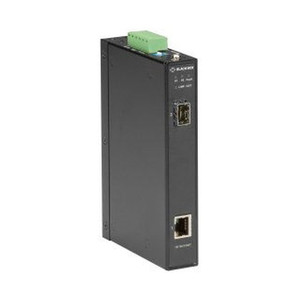
i-PRO WJ-PR201 1-Channel Coaxial IP Media Converter
Overview
The i-PRO WJ-PR201 is a 1-channel receiver-side coaxial-to-IP media converter designed to integrate legacy analog coaxial surveillance cameras into IP-based networks without requiring active network management. If you're running hybrid deployments or retrofitting analog camera infrastructure to IP, the WJ-PR201 eliminates the need for separate management interfaces—it operates as a passive bridge, accepting coaxial input and delivering IP-ready output on a single Ethernet connection. This accessory is purpose-built for integrators and facilities managers who want to extend the life of existing coaxial plant without wholesale system replacement.
Key Features
- 1-Channel Receiver-Side Conversion: Transforms incoming coaxial signals into IP format, reducing the footprint and complexity of hybrid deployments where you're managing both analog and digital cameras on the same network.
- Unmanaged Design: No VLAN configuration, SNMP management, or network admin overhead required—plug it in and route traffic through your standard network switch. Ideal for small-to-medium installations where IT resources are limited.
- Single RJ45 Ethernet Port: Delivers one IP connection per converter unit, making it easy to count port consumption and plan switch capacity. No daisy-chaining or complex topologies.
- One Coaxial Input/Output Port: Accepts standard coaxial cable runs from existing or new analog cameras. Maintains compatibility with common coax gauges used in legacy surveillance deployments.
- DC Power Input: Operates on DC supply, offering flexibility in power distribution compared to AC-only devices. Lower instantaneous power draw means less strain on facility power infrastructure in retrofit scenarios.
- Indoor-Rated Durability: Designed for stable, controlled indoor environments (electrical rooms, control centers, server closets). Not rated for outdoor, wet, or high-vibration deployment—confirm mounting location before installation.
- Wired Connectivity: No wireless dependencies eliminates interference, range limitations, and security exposure from RF signals. All data flows over Ethernet to your recorder, NVR, or VMS.
Integration & Compatibility
The WJ-PR201 works with any standard IP network infrastructure—switches, NVRs, and VMS platforms that accept IP camera streams. Because it's unmanaged, it doesn't require vendor-specific management software or proprietary network configurations. The converter is a member of the i-PRO camera and accessory family, and pairs naturally with i-PRO network video recorders and video management systems that support standard ONVIF-compliant camera inputs. For installations using managed network switches with PoE or standard Ethernet, the WJ-PR201 integrates without additional network planning. Confirm your NVR or VMS accepts IP camera streams at the resolution and frame rate your analog cameras deliver through the converter.
Deployment Context
This converter is most valuable in three scenarios: (1) facilities with existing coaxial runs where replacing all cable and cameras is cost-prohibitive, (2) hybrid deployments where you're retiring analog cameras incrementally while deploying new IP units on the same network, and (3) environments where integrators want to preserve customer relationships by extending analog camera life without major infrastructure overhaul. The WJ-PR201 (often searched as WJ PR201) reduces per-unit conversion cost compared to deploying full IP camera replacements, though acknowledge that analog-to-IP conversion cannot improve image quality beyond the original analog camera's resolution or low-light capability.
Frequently Asked Questions
Q: Can the WJ-PR201 improve image quality from my existing analog cameras?
A: No. The converter bridges the signal from coaxial to IP format, but does not enhance resolution, low-light performance, or frame rate beyond what the analog camera delivers. If your analog cameras are 480-line or 600-line, the IP output will reflect that limitation. For quality upgrades, plan camera replacement.
Q: What power supply do I need for the WJ-PR201?
A: The converter requires a DC power source—consult the product datasheet for voltage and amperage specifications. Standard industrial DC supplies (commonly 12V or 24V in security installations) are typical. Do not assume PoE will power this device; the Ethernet port is data-only unless explicitly stated in your specific configuration.
Q: Is the WJ-PR201 weatherproof for outdoor use?
A: No. The converter is rated for indoor deployment only. Do not install it in outdoor, wet, or high-humidity environments without additional environmental protection (enclosure, conduit, desiccant). Outdoor use will void warranty and risk equipment failure.
Q: How many WJ-PR201 converters do I need?
A: Each converter handles one coaxial camera input. If you have 8 analog cameras to integrate, you'll need 8 units and 8 Ethernet ports on your network switch or NVR.
Q: Does the WJ-PR201 require VLAN or network configuration?
A: No. The unmanaged design means it ships ready to deploy—no VLAN tagging, SNMP, or firmware configuration required. Connect Ethernet to your network, supply DC power, and connect your coaxial camera. The device does not expose a management interface.
Q: Can I use the WJ-PR201 with any IP surveillance platform?
A: Yes, as long as your NVR or VMS accepts standard IP camera inputs. The converter outputs a standard IP stream that any ONVIF-compliant or IP camera-compatible recorder will recognize. Confirm compatibility with your specific platform before purchase if you have questions.
Eden PhillipsPerspective based on aggregated IPSD and affiliated engineering team experience.
The WJ-PR201 solves a real problem: you've got coaxial infrastructure in place, analog cameras still operational, and a VMS or NVR that speaks IP. Rather than rip-and-replace, this unmanaged converter lets you bridge the gap one camera at a time. No SNMP, no VLAN headaches, no separate management interface to babysit.
Technical Highlights:
- Unmanaged Topology: Zero configuration overhead means lower total cost of ownership and faster deployment. Plug DC power in, connect Ethernet to your switch, route coax from your analog camera—done. This matters in retrofit scenarios where every hour of labor adds up.
- 1-Channel Architecture: Each WJ-PR201 handles a single coaxial input, forcing you to size your network switch and power supply accurately. If you're converting 16 cameras, you're buying 16 converters and consuming 16 Ethernet ports. Plan accordingly.
- DC Power Input: Lower power overhead compared to AC devices. In environments where you're already running 12V or 24V DC distribution for locks, strobes, or access control, the converter integrates into existing power infrastructure without additional circuits.
Deployment Considerations:
- Indoor rating only—coax runs and the converter itself must stay in climate-controlled space. If your analog cameras are mounted outdoors, the converter lives in an electrical room or control center, not at the camera.
- Coaxial-to-IP conversion preserves only what the analog camera delivers. Legacy 600-line or D1 analog cameras will not suddenly output 2MP or 4K over Ethernet. You're gaining network transport and VMS compatibility, not image quality uplift.
- Each converter is a single point of failure for that camera's stream. Unlike some enterprise converters with redundancy, the WJ-PR201 is a simple pass-through. If it fails, that camera drops offline until you swap the unit.
Use the WJ-PR201 in retrofit and hybrid transition deployments where you're extending analog infrastructure while gradually migrating to IP. It's cost-effective for small-to-medium integrations (4–12 cameras) where wholesale replacement is not feasible; for larger analog estates, consider whether a full IP migration timeline is more economical than managing dozens of converters long-term.