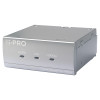
i-PRO WJ-PR204 4-Channel Coaxial Media Converter
The i-PRO WJ-PR204 is a 4-channel unmanaged coaxial receiver-side media converter designed to bridge legacy analog camera systems with modern IP network infrastructure. This accessory enables security integrators and enterprise buyers to extend the service life of existing coaxial camera plants without wholesale replacement, supporting phased migrations from analog to IP-based surveillance across warehouses, retail, industrial facilities, and multi-site enterprises.
Key Features
- 4 coaxial input ports: Accepts analog video from existing camera feeds — means you keep field-deployed cameras running while upgrading your backend recording and management layer.
- 4 RJ45 Ethernet outputs: Bridges analog signals to standard IP network infrastructure, eliminating the need to run parallel cabling or redesign distribution points.
- Unmanaged operation: Zero configuration overhead — no IP assignment, VLAN tagging, or network management required. Plug the coaxial feeds into the input side, connect the Ethernet ports to your switch or recorder, and the converter handles the signal translation automatically.
- DC power supply: Operates on DC input (exact voltage confirmed in product datasheet), enabling deployment in locations where AC availability is constrained — typical in warehouse racks, outdoor junction boxes, or retrofit installations where power infrastructure is limited.
- Indoor-rated durability: Designed for controlled environments (office, server room, secure facility interiors) — not suitable for direct outdoor exposure or temperature extremes beyond typical building HVAC ranges.
- Cost-effective migration path: Eliminates the need to replace functioning analog cameras and reduces network infrastructure overhaul scope, making it ideal for budget-conscious facility upgrades or branch expansions on tight timelines.
Integration & Compatibility
The WJ-PR204 operates as a passive bridge between coaxial analog infrastructure and Ethernet-based network video recorders (NVRs), video management systems (VMS), or edge storage devices. Because it is unmanaged, it imposes no load on your network management platform and does not require ONVIF configuration, driver installation, or firmware updates. It functions in any deployment where analog video signals need to be transitioned to IP delivery without touching the source cameras themselves — common in retail point-of-sale expansions, warehouse compliance upgrades, or educational institution hybrid rollouts.
Integrators should verify that their downstream NVR or VMS supports the analog-to-IP encoding format output by the converter and that DC power provisioning is available at the intended installation site. Indoor placement in a climate-controlled equipment rack or secure wiring closet is recommended to maintain operating specifications and prevent moisture or thermal stress.
Deployment Context
This converter is most valuable in scenarios where analog camera infrastructure is stable and functional but backend recording, storage, or monitoring systems require modernization. Typical deployments include: branch office camera system consolidation into a central IP-based hub, temporary camera extensions during facility renovation, or initial hybrid segments of a multi-year network migration. It is not a replacement for upgrading individual cameras to native IP models, nor is it suitable for outdoor, high-reliability, or analytics-driven applications where direct IP camera deployment offers superior performance and reliability.
Frequently Asked Questions
Q: Can the WJ-PR204 convert IP signals back to coaxial?
A: No. The WJ-PR204 is a receiver-side converter — it accepts analog coaxial video input and outputs to Ethernet. It does not reverse the process.
Q: Does the WJ-PR204 require network configuration or IP address assignment?
A: No. It is unmanaged and requires zero configuration. Plug coaxial inputs and Ethernet outputs into your network — no software setup needed.
Q: What type of DC power does the WJ-PR204 require?
A: Consult the product datasheet for exact voltage and current specifications. Ensure your power source is sized accordingly and properly provisioned at the installation location.
Q: Is the WJ-PR204 suitable for outdoor installation?
A: No. It is rated for indoor use only. Outdoor deployment requires enclosure hardening and is not recommended without additional weatherproofing measures.
Q: Can I use the WJ-PR204 to extend camera distance beyond typical coaxial limits?
A: No. The converter accepts analog signals from cameras already connected via coaxial cable. It does not extend or regenerate coaxial signal range — that depends on your existing camera-to-converter wiring.
Q: What happens if I lose power to the WJ-PR204?
A: The converter will stop functioning. Ensure your DC power supply is connected to a stable source and consider UPS backup if uptime is critical.
Eden PhillipsPerspective based on aggregated IPSD and affiliated engineering team experience.
The WJ-PR204 fills a specific niche in surveillance infrastructure upgrades: it lets you preserve existing coaxial camera investments while moving storage and management to IP. This is not a long-term architecture choice, but as a temporary bridge during a phased migration or as a localized solution for a branch site still running analog, it sidesteps costly camera replacement. The unmanaged design means no configuration overhead — critical when integrators are managing dozens of installations and cannot afford management complexity at the edge.
Technical Highlights:
- 4-channel parallel conversion: Accepts four coaxial feeds simultaneously and outputs to four independent Ethernet ports, so you can consolidate multiple camera feeds into a single NVR or VMS without bottlenecking throughput or introducing signal loss between converter and recorder.
- DC power architecture: Operates on direct current rather than AC, which is advantageous in retrofit or outdoor equipment enclosures where AC availability is limited or where backup power (battery, UPS) is already provisioned for other systems — no need to source separate AC infrastructure.
- Zero-configuration deployment: Unmanaged operation eliminates VLAN setup, IP addressing, firmware updates, or driver installation — plug-and-play behavior reduces deployment time and minimizes field labor cost, especially valuable when integrating converters into existing NVR or VMS installations that have no spare management bandwidth.
Deployment Considerations:
- Indoor-only rating: Not suitable for outdoor cabinets, pole mounts, or exposed environments. If your coaxial cameras are outdoor-mounted and the converter needs to sit in a weatherproof junction box or pole housing, you will need external enclosure hardening or relocation to an indoor equipment rack.
- Power dependency: Unlike passive coaxial infrastructure, the WJ-PR204 requires continuous DC power. Loss of power halts conversion — consider UPS or redundant power provisioning if the converter sits between mission-critical analog cameras and your recorder.
- One-way translation only: This is a receiver-side converter, not a transmitter. It pulls analog signals from cameras and outputs to Ethernet — it cannot ingest IP video and convert it back to coaxial. Verify your signal direction before purchasing.
Best fit: retail or warehouse environments completing a multi-site transition from analog to IP, where a few branch locations or departments are still running coaxial infrastructure and the organization needs a cost-effective temporary bridge rather than emergency camera replacement. Not recommended for new installations, outdoor deployments, or facilities requiring analytics or high-availability redundancy.