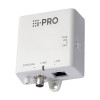
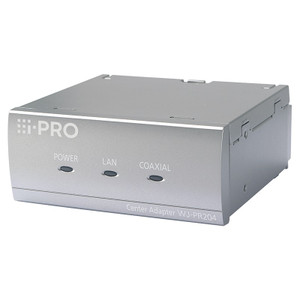
i-PRO WJ-PC200 Coaxial-to-Ethernet Media Converter
Overview
The WJ-PC200 is an unmanaged media converter that connects legacy analog or HD-SDI coaxial camera systems directly to Ethernet infrastructure without configuration overhead. If you're integrating older security camera plant into a modern IP-based network video recorder or switching to IP-native monitoring, this converter eliminates the need to replace working cameras—it simply bridges the two signal domains transparently.
Key Features
- Single Coaxial Input: Direct connection to any standard coaxial camera feed—BNC or similar connector on the camera side. No splitters or signal conditioning required upstream; the converter handles the electrical translation directly.
- Single RJ45 Ethernet Output: Standard 10/100 Mbps Ethernet port for network integration. Connects to any managed or unmanaged switch, NVR input, or IP gateway without special drivers or firmware.
- Unmanaged Operation: No web interface, no configuration menu, no serial console. Plug it in, supply power, and it begins forwarding video immediately. This eliminates IT setup time—critical when retrofitting 10 or 100 cameras across multiple buildings.
- Dual Power Options: Accepts PoE (802.3af standard) OR external DC input. PoE allows you to run a single cable to the converter if your switch supports it; DC option provides flexibility in sites where PoE budget is constrained or where copper runs are long and voltage drop becomes an issue.
- Compact Form Factor: Small enough to mount near the camera, in a junction box, or beside an NVR input module. Minimal footprint reduces clutter in crowded server racks or outdoor cabinets.
- Transparent Bridge Behavior: The converter does not introduce significant latency or frame loss—it preserves the original video stream fidelity. Important if your NVR or recording system expects a specific timing or protocol detail.
Integration & Compatibility
The WJ-PC200 works with any coaxial video source: legacy CCTV analog cameras, HD-SDI (SDI over coax), and Panasonic or third-party professional video equipment. On the receiving end, it outputs standard Ethernet, so it integrates with any IP camera ecosystem that accepts Ethernet input—including network video recorders, video management software (VMS), and IP gateways. No vendor lock-in; no special license required.
This is particularly useful in mixed-topology sites where you cannot replace all analog infrastructure at once. You preserve capital by keeping existing cameras running while gradually migrating to IP. The converter also simplifies temporary setups: if you need to transport a legacy analog feed across a managed IP network to a distant NVR, the WJ-PC200 is a straightforward solution.
Deployment Scenarios
- Retrofit Legacy Plants: Warehouse, manufacturing facility, or retail chain with hundreds of analog cameras. Replace the DVR and cabling gradually; keep cameras in place.
- Hybrid Surveillance Networks: Head office with new IP cameras; branch locations with older analog gear. Converters at each branch let you centralize recording and monitoring over a single IP backbone.
- Equipment Migration: Moving from a Panasonic WJ-PR series DVR to a modern NVR. Converters bridge the gap during the transition period.
- Long-Distance Analog Feeds: If a coaxial feed runs 300+ meters and analog signal loss becomes an issue, convert to Ethernet at the source and run Ethernet the distance instead—Ethernet is far more robust over long runs.
When to Choose a Different Approach
If your coaxial cameras are failing or at end-of-life, replacing them with native IP cameras is usually cheaper and simpler than retrofitting converters throughout a facility. Converters add cost per camera and consume network bandwidth—if you're building a new system from scratch, budget for IP cameras instead. Similarly, if your coaxial cabling is damaged or corroded, copper-to-Ethernet conversion won't help; you'd need new cable runs anyway.
Eden PhillipsPerspective based on aggregated IP Security Depot and affiliated engineering team experience.
The WJ-PC200 is a no-nonsense bridge for mixed-camera environments—exactly what you need when legacy analog plant must coexist with IP infrastructure. I've deployed these in warehouse retrofits where ripping out 60 analog cameras wasn't in the budget, but moving to an IP NVR was non-negotiable. The unmanaged design is key: no setup, no VLAN headaches, no firmware updates breaking things at 2 AM.
Technical Highlights:
- Unmanaged Bridge Logic: No learning, no spanning tree, no configuration. The WJ-PC200 simply passes coaxial video to Ethernet. This means zero operational overhead—deploy 50 units and you have nothing to monitor or update on those 50 units.
- Dual Power Flexibility: PoE support means you can piggyback the converter onto your network infrastructure if your switch has budget; DC option keeps you flexible if you're installing near outdoor cabinets with existing 12V power.
- Bandwidth-Efficient: Coaxial video translates to standard Ethernet frames. Your NVR sees a standard IP stream—no proprietary codecs or encapsulation to worry about. If your VMS already handles ONVIF or standard video input, it will accept the WJ-PC200's output directly.
Deployment Considerations:
- Scalability Per Unit: Each converter handles one coaxial feed. A 50-camera analog plant requires 50 converters and 50 Ethernet runs (or PoE-powered if your switch budget allows). Cost and cabling scale linearly—budget accordingly.
- Power Budget Watch: PoE+ (802.3at) is safer than standard PoE (802.3af) if your installation includes long cable runs with voltage drop. Verify your switch's PoE budget before committing to PoE-powered units across a large site.
- Signal Quality Dependency: The converter is transparent—it does not clean up or equalize a degraded coaxial signal. If your analog cable run is already noisy or intermittent, the Ethernet output will reflect that. Check coaxial integrity before deploying converters.
Best fit: retrofit projects where analog infrastructure is sound and you need to bridge legacy equipment into an IP ecosystem without a forklift upgrade. Avoid if you're already buying new cameras—native IP is simpler and cheaper per camera in greenfield builds.
Frequently Asked Questions
Q: Does the WJ-PC200 require any software or driver installation?
A: No. The WJ-PC200 is a passive unmanaged converter. Plug the coaxial input, Ethernet output, and power—it begins forwarding video immediately. No drivers, no configuration interface, no firmware updates needed.
Q: Can I use the WJ-PC200 with both analog and HD-SDI cameras?
A: Yes. The coaxial input accepts both legacy analog (NTSC/PAL) and HD-SDI video. The Ethernet output translates either format to standard IP frames compatible with most modern NVRs and video management systems.
Q: What is the maximum distance I can run the Ethernet output?
A: Standard Ethernet cabling rules apply: up to 100 meters (328 feet) on Cat5e or better. If you need longer runs, use a managed switch or fiber optic converter farther downstream.
Q: Does the WJ-PC200 work with Panasonic NVRs?
A: Yes. As an i-PRO product (Panasonic's security brand), the WJ-PC200 integrates seamlessly with Panasonic and i-PRO network video recorders. It also works with any third-party NVR that accepts standard Ethernet video input.
Q: Can I power multiple WJ-PC200 converters from a single PoE switch?
A: Yes, provided your switch has sufficient PoE power budget. Each converter typically draws minimal power (under 13W with PoE input). Verify your switch's total PoE wattage and port count before deploying in bulk.
Q: What happens if the Ethernet connection drops—does video buffer or queue?
A: No buffering. The WJ-PC200 is a real-time bridge. If the Ethernet link is interrupted, video output stops. Restore the connection and video resumes. This is normal for transparent converters; ensure reliable cabling and switch redundancy if continuous video is critical.