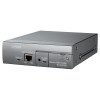
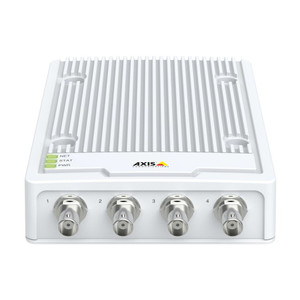
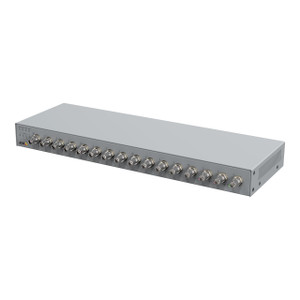
i-PRO WJ-GXE500 4-Channel Video Encoder
The i-PRO WJ-GXE500 is a 4-channel analog-to-IP video encoder designed to digitize legacy CCTV infrastructure without wholesale camera replacement. This encoder accepts standard 1.0 V (p-p) / 75 Ω composite video from analog cameras (NTSC/PAL), converts to H.264 or JPEG at VGA (640×480) resolution, and streams over Ethernet at up to 30 fps per channel. Powered via PoE 802.3af (<13W), it requires no external power supply, reducing installation cost and complexity. The WJ-GXE500 bridges analog and IP-based security operations, making it ideal for facilities migrating surveillance systems incrementally—preserving existing cabling and camera plant while moving to centralized, networked monitoring.
Key Features
- Dual-Stream H.264/JPEG Compression: Simultaneous H.264 main stream and JPEG snapshot stream per channel. Reduces storage footprint on NVR or network drive versus motion-JPEG alone; fallback JPEG ensures client compatibility on any VMS.
- PoE 802.3af Power: Single RJ45 line carries both data and power—no separate DC 12V supply needed. Rack-mountable design fits three units into 1U space (with optional WV-Q204/2S stacking brackets).
- ONVIF Profile S Streaming: ONVIF-compatible output integrates with industry-standard VMS platforms (Genetec, Milestone, Avigilon, ExacqVision) and i-PRO surveillance systems without proprietary client software.
- SD/SDHC Backup Recording: On-board memory card slot enables local failover recording when network bandwidth is limited or WAN connectivity drops, preserving forensic footage during outages.
- Programmable Video Motion Detection: Four independent VMD zones per encoder; motion triggers alarm outputs and metadata events. Reduces false-positive noise on less dynamic channels (hallways, storage areas).
- Coaxial PTZ Control: Native i-PRO PTZ command support via existing coaxial runs; open RS-485 table allows integration with third-party PTZ cameras (Pelco D/P, others) in mixed-vendor deployments.
- Two-Way Audio: Full-duplex bidirectional microphone input for remote voice communication—useful for access control verification or emergency intercom scenarios without additional devices.
- Industrial Temperature Range: Rated –10 °C to +50 °C (14 °F to 122 °F), suitable for outdoor equipment cabinets, communications shelters, and unheated storage facilities.
The WJ-GXE500 addresses a common integration challenge: organizations with mature analog camera plants cannot afford wholesale replacement. This encoder preserves the sunk capital in camera hardware and coaxial infrastructure while enabling modern IP-based monitoring, centralized recording, and analytics. Each channel operates independently, so a single encoder can serve four isolated analog circuits or a mixed analog/IP migration where existing cameras feed through patch panels.
Storage strategy shifts when encoding at the edge. A VGA H.264 stream at 2 Mbps per channel (typical at 30 fps) consumes ~864 GB per 100 days on four channels uncompressed. SD card failover mitigates WAN loss without requiring a local NVR, though for continuous 24/7 recording on facilities with poor internet, supplemental network-attached storage or a small NVR is advisable. JPEG bitrate on motion-triggered events is negligible and highly configurable through the web interface—reducing archive size for playback-only deployments.
Integration simplicity is critical in retrofit scenarios. The WJ-GXE500 outputs standard RTSP over HTTP/HTTPS, so any ONVIF-capable management platform can ingest and display the streams. i-PRO's own recording software and client software (for Windows / mobile devices) recognize the encoder natively, eliminating configuration friction. Audio ingestion varies by VMS—verify your platform's support for bidirectional audio if intercom functionality is a requirement during proof-of-concept.
Coaxial PTZ control is a significant convenience in existing installations. If your analog cameras include dome PTZ units with pelco-style control, the encoder's RS-485 translator allows centralized PTZ joystick operation from the same VMS console, avoiding separate PTZ control software and reducing operator training overhead. Native i-PRO PTZ support is tight; third-party PTZ command tables require manual configuration and testing.
The WJ-GXE500 operates under i-PRO's standard manufacturer warranty with no specific limitation or expiration date stated in public spec; sourced direct from the manufacturer or authorized channel ensures genuine product and factory support. For deployments requiring high-availability recording, pair this encoder with a Milestone XProtect, Genetec Security Center, or i-PRO's own RecordServer NVR to centralize storage, redundancy, and failover logic across multiple encoders and IP cameras.
Ted PerryPerspective based on aggregated IPSD and affiliated engineering team experience.
We've deployed the WJ-GXE500 across dozens of analog-to-IP migration projects, and it remains one of the most pragmatic solutions for preserving legacy infrastructure while moving to modern centralized monitoring. The real-world advantage is simplicity: in facilities with hundreds of analog cameras, wholesale IP camera replacement is financially untenable and operationally disruptive. This encoder lets you migrate incrementally—floor by floor, building by building—while reusing coaxial runs and existing cameras. The PoE 802.3af design is a major cost saver; most sites already have PoE switches deployed for IP phones and access points, so installation is often just patching into an available port. The downside is resolution: VGA (640×480) is adequate for perimeter fence lines and hallway monitoring, but insufficient for facial recognition, license-plate capture, or detailed evidentiary footage of retail transactions. For those use cases, you're better served upgrading to native IP cameras (1080p+) rather than encoding legacy analog equipment.
Technical Highlights:
- H.264 Dual-Stream with JPEG Fallback: Main stream at H.264 conserves bandwidth (2-3 Mbps per channel at 30 fps, VGA); JPEG snapshot stream ensures compatibility with VMS platforms that lack H.264 codec libraries. We've seen this hybrid approach reduce integration risk when multiple vendor platforms are consuming the same encoder output.
- Four Independent VMD Zones per Channel: Programmable motion detection zones allow noise filtering on each input independently. Parking lot camera with tree motion can be tuned to ignore foliage; lobby camera tuned to catch any human movement. Event-driven recording replaces continuous recording for storage-constrained environments, cutting NVR disk consumption by 60-75% on typical office deployments.
- SD/SDHC Onboard Failover: When WAN or LAN connectivity drops, motion events continue to be written to the local SD card. Recovery is manual (export via USB), so this is a failsafe for evidence preservation, not a replacement for NVR redundancy. Sites with unreliable internet (rural, satellite) benefit significantly; urban/metro installations with fiber rarely trigger the fallback.
- Coaxial PTZ Command Pass-Through: If your analog domes support Pelco D/P or i-PRO native protocols, the encoder's RS-485 translator lets you operate PTZ from the VMS console without separate control hardware. Reduces equipment count and operator context switching, though configuration is tedious—budget 2-4 hours per encoder for PTZ command table verification.
- 802.3af PoE Compliance: 13W draw leaves headroom on lower-budget PoE switches (48-port managed switches with 60-90W shared budget). In dense encoder deployments (10+ units), verify your switch's power budget; undersizing the switch forces you to split encoders across multiple circuits.
Deployment Considerations:
- VGA (640×480) resolution is the hard ceiling. This encoder will not solve low-resolution footage forensically. If your analog cameras are monochrome or deteriorated, encoding them at VGA compounds image quality issues rather than resolving them. Assess original camera optics and sensor condition before committing to this encoder in mission-critical areas.
- Coaxial runs must be intact and impedance-correct (75 Ω). If coaxial cable is damaged, degraded, or mixed with power lines in conduit, video quality suffers before digitization. Field-test analog signal path with an oscilloscope or simple composite video monitor before installation. A weak coaxial signal (e.g., <0.8 V peak-to-peak) will digitize with noise artifacts.
- PoE switch selection matters. Budget $40-80 more for a managed PoE switch with per-port power budgeting and monitoring. Unmanaged switches will deliver 802.3af power but offer no visibility into power draw or port faults—critical for troubleshooting encoder + camera thermal events in summer rack cabinets.
- Audio wiring is manual. The encoder accepts microphone-level input (not line-level), and bidirectional audio requires speaker amplification at the other end. If you're planning intercom functionality, budget for small powered speakers or a dedicated audio interface on the NVR side.
- ONVIF Profile S is the native output; Profile T (H.265, advanced metadata) is not supported. If your VMS requires Profile T for inter-camera metadata correlation (e.g., Genetec's Semantic Metadata), the WJ-GXE500 will not provide that—you'll need native IP cameras or a more advanced encoder model.
The WJ-GXE500 is ideal for integrators managing mixed analog/IP portfolios and building owners reluctant to fully decommission working camera plants. It's not a high-performance long-term solution—it's a pragmatic bridge. If your customer is planning a 5+ year retention of the footage or forensic-grade documentation, recommend upgrading to native IP cameras. If they want to defer capital expenditure by 2-3 years while incrementally retiring analog, this encoder delivers solid ROI. See the i-PRO catalog for complementary encoders, NVRs, and network equipment.