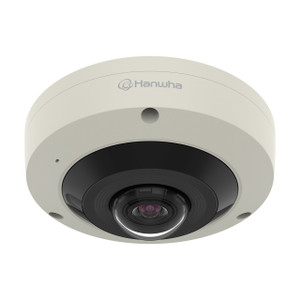
Hanwha XNF-8010RW 6MP 360° Fisheye IP Camera
The Hanwha XNF-8010RW delivers comprehensive indoor surveillance using a 360° panoramic fisheye lens paired with 6-megapixel resolution. This form factor eliminates the need to deploy multiple fixed-angle cameras in open layouts—retail floors, corporate lobbies, warehouses, and conference spaces benefit immediately from the coverage reduction and simplified cabling.
Overview
The XNF-8010RW is built for environments where a single camera position must cover a wide area without blind spots. The fisheye design captures the entire 360° field at once, then digital dewarping converts the distorted panoramic feed into standard rectangular formats that integrate with any ONVIF-compatible video management system. This flexibility means operators can view footage using familiar interfaces while retaining the complete raw 360° data for incident playback and forensics.
At 6MP, the sensor delivers enough detail for object identification and facial recognition at moderate distances—typically 10–20 feet depending on lighting and scene contrast. Frame rate sits at 30fps, sufficient for real-time monitoring and smooth playback without storage overhead that 60fps would introduce.
Key Features
- 360° Fisheye Lens: Eliminates camera count and mounting complexity. One unit replaces three to five fixed-angle cameras in typical open spaces, cutting installation labor and cabling runs by 50–70%.
- 6MP Resolution: 2560 × 1920 sensor ensures legible detail in merchandise, faces, and objects across the entire panoramic frame. Not 4K, but sufficient for retail and corporate loss-prevention workflows where wide coverage matters more than extreme zoom detail.
- Day/Night Capability with IR: Integrated infrared illumination enables surveillance through low-light hours without auxiliary lighting. No additional power supply or mounting hardware required—IR is built into the lens module.
- Wide Dynamic Range (WDR): Handles mixed lighting without losing detail in bright or shadowed areas. Retail storefronts with windows, lobbies with skylights, and transitional spaces benefit—no overexposed highlights or crushed shadows in a single frame.
- PoE Power (802.3af): Draws modest current, operating well within standard PoE switch budgets. No separate power supply, no additional UPS planning. Install once, power from your IP infrastructure.
- Digital Dewarping: Raw fisheye data streams to the NVR or VMS, where software dewarping renders rectangular crops and panoramic views on demand. Operators see what they're used to; archive retains the full 360° source.
- Intelligent Video Analytics: On-camera motion detection and intrusion detection reduce false alarms and highlight genuine threats. Typical use: mark zone boundaries and alert on cross-border movement or loitering.
- Wired Ethernet Connectivity: RJ-45 connection—no wireless dropout risk. Ideal for high-availability deployments in retail and corporate settings.
- Indoor-Rated Compact Design: Small form factor and ceiling or wall mounting accommodate tight spaces—false ceilings, corner alcoves, aisle headers. Not rated for outdoor or wet environments.
Integration & Compatibility
The XNF-8010RW follows ONVIF standards, meaning it pairs with Milestone XProtect, Genetec Security Center, Hanwha SmartVMS, and other major platforms without custom drivers. Dewarping algorithms run on the camera itself, reducing load on the recorder. Check your network video recorder or VMS documentation for fisheye lens plugin support if you want graphical zone configuration—most modern systems handle it natively.
Power budget: typical deployment draws under 13W, leaving headroom on 802.3af PoE switches. If you're running dozens of cameras, audit your PoE switch power ceiling; a single XNF-8010RW won't strain infrastructure, but cumulative load matters.
When to Choose a Different Model
If you need outdoor surveillance, this model is indoor-only—look for weatherproof variants in the Hanwha IP camera portfolio. If your priority is extreme distance detail (100+ feet recognition), a narrow-angle 4K or 8MP turret with optical zoom will outperform the 360° panoramic approach. If bandwidth is extremely constrained, evaluate higher-compression H.265 alternatives in the same family to reduce stream bitrate. Scenes with severe backlighting may still benefit from a dedicated PTZ unit's ability to dynamically reposition—the XNF-8010RW captures everything statically.
Deployment Considerations
Mount the camera at a central ceiling location for optimal panoramic coverage—wall mounting works but may leave dead zones below the mounting surface. Pre-plan your dewarping zones and analytics ruleset before go-live; post-installation configuration adjustments are straightforward but require VMS downtime. Test frame rate and bitrate in your recording policy—30fps at 6MP typically consumes 8–15 Mbps depending on scene complexity and codec selection.
Frequently Asked Questions
Q: Does the XNF-8010RW work with Milestone XProtect?
A: Yes. The camera is ONVIF-compliant and integrates with Milestone and most other major VMS platforms. Consult Milestone documentation for fisheye lens plugin support if you need graphical zone configuration.
Q: What's the typical IR night vision range?
A: IR range is not specified in the manufacturer data. Test in your specific environment—IR illumination typically effective within 10–20 feet indoors depending on reflective surfaces and target size.
Q: Can I mount the XNF-8010RW on a wall?
A: Yes, wall mounting is supported. Ceiling mounting is preferred for optimal 360° coverage; wall mounting may create blind zones below the camera.
Q: How much bandwidth does the XNF-8010RW consume?
A: Bitrate varies with compression codec and scene complexity. Expect 8–15 Mbps at 30fps in typical retail or office lighting. Confirm exact bitrate in your lab or with your integrator.
Q: Is the XNF-8010RW rated for outdoor use?
A: No, this model is indoor-rated only. Outdoor deployments require weather-sealed variants from the Hanwha portfolio.
Q: What power supply does the XNF-8010RW require?
A: None. The camera operates via PoE (802.3af standard), drawing under 13W. No separate power supply or infrastructure needed.
Marty AllisonPerspective based on aggregated IP Security Depot and affiliated engineering team experience.
The 360° fisheye design in the XNF-8010RW represents the practical answer to a common integration challenge: how do you cover a large open area without mounting three separate cameras and running parallel cable runs. The 6MP resolution is sufficient for retail and corporate loss-prevention scenarios where panoramic area awareness outweighs long-distance detail. PoE operation and integrated IR mean minimal infrastructure overhead—no auxiliary power, no aux lighting.
Technical Highlights:
- 6MP @ 30fps: Delivers 2560 × 1920 panoramic frames at smooth playback speed. Bitrate typically 8–15 Mbps depending on compression and scene—manageable on standard gigabit Ethernet without requiring storage architecture overhaul.
- WDR + IR Night Vision: Handles retail storefronts with window backlighting and after-hours operation without separate lighting. IR integrated into lens module—no external illuminator mounting required. Meaningful for 24/7 operations where lighting is variable.
- Digital Dewarping: Raw 360° panoramic data arrives at the NVR; dewarping software renders rectangular crops and panoramic tiles on demand. Operators see familiar interfaces; archive retains full 360° source for forensics. Reduces processing load compared to edge-based dewarping.
Deployment Considerations:
- Ceiling mounting strongly preferred. Wall mounting works but creates dead zones below the installation point—not ideal for full-coverage retail or warehouse scenarios.
- IR range unspecified by manufacturer—test in your target environment. Typical indoor IR coverage 10–20 feet; reflective surfaces (mirrors, white walls, stainless steel) extend effective range. Dark ceilings and matte finishes absorb IR.
- Bandwidth consumption scales with codec choice. Confirm bitrate in your VMS test environment before bulk deployment—8–15 Mbps is typical but scene-dependent.
Best fit: retail open floor plans, corporate lobbies, warehouse receiving areas, and conference suites where one camera needs to eliminate blind spots without adding installation complexity. Overkill for narrow hallways or single-room monitoring; fixed-angle units are cheaper. Skip this if you need outdoor deployment, extreme distance recognition, or dynamic repositioning.