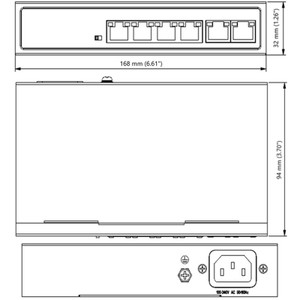
Geovision 140-APOE81W-000 8-Port PoE+ Managed Network Switch
The Geovision 140-APOE81W-000 is a managed network switch designed to consolidate power delivery and data connectivity for mid-sized IP camera deployments. Eight 10/100/1000 Mbps PoE+ ports deliver up to 30W per port via IEEE 802.3at, enabling direct connection to power-hungry IP PTZ cameras, high-speed domes, and thermal imagers without external PoE injectors. Dual gigabit uplink ports provide redundant paths to your core network, isolating surveillance traffic from business data and preventing video congestion during bandwidth-heavy operations. Built-in managed features (VLAN, QoS, port mirroring) let you segment camera streams, prioritize critical video feeds, and simplify troubleshooting on complex surveillance networks.
Key Features
- 8× PoE+ Ports: 10/100/1000 Mbps with 802.3at power delivery (30W per port). Eliminates the need for separate PoE injectors on PTZ and dome camera runs, cutting installation time and capex on legacy PoE+ splitters.
- 2× Gigabit Uplink Ports: Dedicated 1000 Mbps backhaul for management and video aggregation. Redundant uplink topology prevents single-point-of-failure on your network backbone.
- Managed Switch Capabilities: VLAN support, QoS scheduling, and port mirroring enable traffic segmentation and diagnostic packet capture. Reserve bandwidth for mission-critical camera streams separate from office traffic.
- Cat5e/Cat6 Cabling: Standard copper runs (up to 100m per IEEE 802.3) reduce copper cost versus proprietary connector schemes. Works with existing site cabling infrastructure.
- Compact Form Factor: Rack-mountable design fits standard 19-inch enclosures without requiring external power supplies or cooling modules. Low thermal footprint for closet or equipment-room deployment.
- LED Status Indicators: Per-port link/activity LEDs and power status lights provide instant visibility into port health without logging into a management console.
- Industrial Temperature Range: Rated 0–50°C operating; tolerates equipment-room thermal swings and outdoor cabinets (with proper ventilation).
PoE+ (802.3at) supplies up to 95W total switch power budget across all eight ports. In practice, this means you can run four to five simultaneous high-draw devices (PTZ domes at 60W, thermal cameras at 40–50W) without oversubscription; lighter cameras (standard 5MP domes, turrets at 10–15W) allow near-full eight-port saturation. Plan your port allocation accordingly during design phase, or use the two uplinks to chain additional PoE+ switches for campus-scale deployments.
The managed architecture supports VLAN tagging (IEEE 802.1Q), so you can isolate surveillance traffic on a dedicated VLAN and prevent broadcast storms from cameras from degrading office network performance. QoS (Quality of Service) rules let you throttle non-critical traffic (NTP, DNS queries) and guarantee low-latency, high-priority bandwidth for video codec streams. Port mirroring is essential for forensic packet capture: mirror a suspect camera port to a sniffer tool, diagnose codec drops or latency artifacts, and isolate configuration errors without touching the live camera.
The switch integrates seamlessly with any ONVIF-compliant IP camera and NVR platform (Geovision GV-Multisensor, Axis, Hanwha, Hikvision, Dahua, Milestone, Genetec, Avigilon). No proprietary software required — standard SNMP (Simple Network Management Protocol) and web-based management console let you monitor uptime, power consumption per port, and temperature via any network admin dashboard. Redundant uplinks pair well with ring or mesh topologies, where two switches or NVRs connect via both gigabit ports; if one link drops, traffic reroutes automatically in under 100ms.
Compliance and management: the 140-APOE81W-000 carries CE and FCC certification for electromagnetic compatibility and is free of grey-market sourcing. No external power adapter is required (power is supplied via standard 12V DC or terminal block depending on configuration — verify your specific build). Manufacturer warranty covers defects in materials and workmanship; typical lifecycle is 5+ years in stable-temperature environments.
Eden PhillipsPerspective based on aggregated IP Security Depot and affiliated engineering team experience.
We've deployed dozens of Geovision PoE+ switches across parking lots, warehouse perimeters, and multi-building campuses, and the 140-APOE81W-000 earns its place in mid-tier surveillance designs where you need managed switching without the capex of a carrier-grade Cisco or Arista backbone. The real win is power consolidation: a single 8-port PoE+ switch eliminates the clutter of individual PoE injectors, reduces cable tray congestion, and gives you one device to warranty instead of eight separate units. On a 12-camera PTZ perimeter deployment, that's noticeable capex and labor savings. The two gigabit uplinks are not redundancy theater — we've seen sites running one uplink to the NVR and the other to a secondary monitoring station, or one to the primary NVR and a second to a mesh network for wireless backup cameras. VLAN isolation keeps surveillance video off business LANs, which your IT team will thank you for.
The honest limitation: the 95W total power budget is real, and it bites on dense deployments. A PTZ dome pulling 60W, a thermal turret at 40W, and a 5MP box camera at 15W exhausts 115W — you can't run all three on one switch. We size projects conservatively: assume 20W average per camera, divide 95W by that, and you get 4–5 simultaneous high-draw units. If you're unsure, chain two switches on the gigabit uplinks and segment power-hungry cameras across both. Temperature range is good for equipment rooms and outdoor cabinets with fan cooling, but not for direct mounting in unshaded enclosures in Arizona July heat.
Technical Highlights:
- PoE+ 802.3at Budget (95W total): Sufficient for four to five simultaneous IP PTZ domes (60W typical) or eight standard turrets and fixed boxes (10–15W each). Know your camera power draw and sum it before final port allocation — oversubscription will cause brownout resets. Many integrators create a spreadsheet: model each camera's worst-case draw, plan uplinks to secondary switches if total exceeds 80W, and leave 15% headroom for margin.
- Dual Gigabit Uplinks: Allow ring topology or N+1 redundancy without extra cost. In our experience, one uplink to the NVR, one to a backup site or secondary recording station, is the most common pattern. Failover is automatic in ring mode — if one uplink port drops, traffic reroutes in <100ms.
- Managed Switch (VLAN, QoS, Mirroring): Separating surveillance traffic onto a dedicated VLAN prevents camera multicast storms from degrading office Wi-Fi. Port mirroring is invaluable for remote diagnosis — mirror a problem camera port to a laptop running Wireshark, capture codec artifacts, and resolve latency without a site visit.
- Compact DIN-Rail / Rack Mount: Takes up minimal space in equipment closets. Temperature-stable design means no active cooling required in most climates; passive convection is sufficient if mounted with 2–3 inches of clearance on all sides.
Deployment Considerations:
- Power budget is the gating factor. Before installation, calculate worst-case simultaneous draw on all eight ports. If total exceeds 85W, plan a second switch or confirm that peak simultaneous load is lower (e.g., PTZ cameras don't all pan at once). A simple spreadsheet (camera model, datasheet watts, port assignment) takes 15 minutes and saves troubleshooting later.
- Cat5e is officially supported for PoE+ runs up to 100 meters. Cat6 is preferred for thermal cameras and long runs (>50m) to reduce voltage drop and ensure stable 30W delivery. Measure your longest run; if it exceeds 80m, budget for Cat6 and a midspan power meter to verify arrival voltage at the camera.
- VLAN configuration requires basic networking knowledge — if your integrator or IT team is unfamiliar with 802.1Q tagging, allow 2–4 hours for initial setup and testing. A simple 2-VLAN design (cameras on one, management on another) is low-risk and takes minimal config time.
- Firmware updates are periodic but not frequent. Check Geovision support quarterly for security patches, especially if the switch faces untrusted networks or remote management access. Most updates are non-disruptive (no reboot) but test on non-critical ports first.
- Uplink port configuration: if using ring topology with two switches, ensure both units are set to the same VLAN for uplink traffic. Mismatch here causes uplink isolation and defeats redundancy — a common mistake on first deployment.
The 140-APOE81W-000 is ideal for integrators building mid-sized surveillance systems (8–40 cameras total) where simplicity and managed feature depth matter. Sites that need VLAN isolation, remote diagnostics via port mirroring, or N+1 redundancy will find it pays for itself in operational clarity alone. For larger campuses, chain multiple units; for small single-location jobs, a simpler unmanaged 8-port PoE+ switch may suffice. Explore the full Geovision catalog for companion recording devices and ancillary switching solutions.