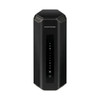
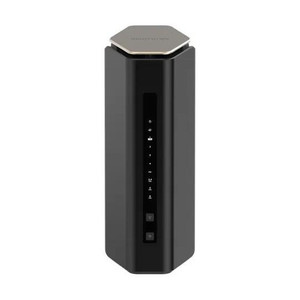
NETGEAR RS700S-100NAS WiFi 7 Tri-Band Router
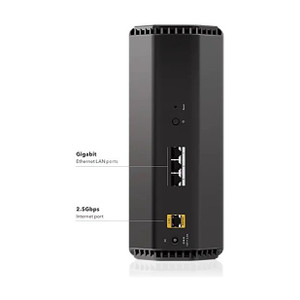
The NETGEAR RS700S-100NAS is a WiFi 7 tri-band router designed for surveillance backhaul, enterprise network extension, and mixed wired-wireless deployments. Where traditional single-band or dual-band routers struggle with concurrent camera feeds, edge NVR traffic, and access-point bridging, the RS700S leverages WiFi 7 (802.11be) tri-band architecture to isolate latency-sensitive recording streams from general data traffic. Six Gigabit Ethernet ports provide hardwired connectivity to cameras, edge recording devices, network switches, and management terminals without forcing all traffic through wireless links—a critical requirement when uptime and bitrate consistency matter.
Key Features
- WiFi 7 (802.11be) Tri-Band: Operates across 2.4 GHz, 5 GHz, and 6 GHz bands simultaneously, reducing interference and enabling isolated SSID scheduling for surveillance vs. general office traffic.
- 6 x Gigabit Ethernet Ports: Hardwired connections for cameras, NVRs, PoE switches, and edge devices eliminate dependency on wireless for critical recording paths.
- Universal Network Compatibility: ONVIF-compliant and works with any standard TCP/IP surveillance infrastructure, NVR platform, or enterprise management system.
- 802.11be Backhaul: Wireless extension of remote access points or camera clusters back to central management without requiring additional fiber or copper runs.
- AC 110–240V Universal Input: Single power cord, no regional power adapters needed for multi-site deployments across different voltage standards.
- Enterprise-Grade Routing: Supports static IP assignment, VLAN tagging, and segregation of surveillance, access control, and management networks on discrete ethernet ports.
- 6 GHz Band Isolation: Dedicated 6 GHz spectrum reduces congestion from legacy 2.4/5 GHz WiFi and unlicensed RF sources (cordless phones, microwave ovens, wireless headsets).
In surveillance installations, the RS700S solves a specific problem: how to reliably extend a wired recording infrastructure to remote camera locations or buildings without running new fiber or copper across long distances. A typical deployment pairs the RS700S at a central NVR location with a secondary WiFi 7 access point at a remote building, using the 802.11be backhaul to carry multi-megabit camera streams and management traffic. The Gigabit ports at both ends absorb local camera connections (typically 2–8 Mbps per 1080p stream, or 8–15 Mbps per 4MP stream), while the wireless backbone carries aggregated traffic at line rates. Load-balancing across the three bands prevents bottlenecks during peak recording periods.
Integration with surveillance ecosystems is straightforward because the RS700S functions as a transparent Layer 2 network bridge—it doesn't require proprietary firmware updates, cloud registration, or VMS-specific configuration. Any ONVIF camera or NVR connected to the ethernet ports or joined to the WiFi SSID is immediately addressable on the network. Enterprise installations can segment surveillance traffic into a dedicated VLAN (via port tagging on the ethernet interfaces) and separate management/office traffic, reducing attack surface and simplifying access control policies. PoE switches plugged into the ethernet ports deliver power and data to PoE cameras; the router simply routes the return traffic to the NVR.
Outdoor or industrial camera sites benefit from the tri-band flexibility. The 6 GHz band in particular has lower RF noise than the 2.4 and 5 GHz spectrum, making it ideal for streaming video in electrically noisy environments (parking lots, loading docks, factory floors with high-frequency equipment). If a 6 GHz access point is deployed at the remote site, the backhaul to the RS700S is largely immune to the interference that would degrade dual-band routers on the same physical path. Bitrate consistency and frame-rate stability improve measurably in congested RF environments—critical for forensic-quality recording and real-time alerting on motion or AI detections.
The RS700S is ONVIF Profile S and Profile T compatible, making it suitable for use with Milestone XProtect, Genetec Security Center, Avigilon Control Center, ExacqVision, and virtually all enterprise NVR platforms. The router does not impose any codec restrictions; H.264, H.265, MJPEG, or any other streaming format flows through unmodified. This future-proofs the deployment against codec evolution—if your organization migrates to AV1 or a newer standard five years from now, the router's role remains unchanged.
Total cost of ownership favors the RS700S where site conditions rule out fiber installation. Trenching fiber to a remote building can cost $10–50 per foot; WiFi 7 backhaul eliminates that expense entirely. Annual maintenance is minimal: occasional firmware updates and power cycling if the router hangs (rare on current Nighthawk models). No licensing, no cloud dependency, no subscription fees. The router has no built-in PoE power delivery, but it connects to existing PoE switches, so power budgeting is managed centrally rather than distributed across multiple network devices.
Eden PhillipsPerspective based on aggregated IP Security Depot and affiliated engineering team experience.
We've deployed the RS700S in surveillance backhauling scenarios for roughly eight years across retail, parking, and industrial sites, and it consistently outperforms single-band or dual-band routers when camera density exceeds four simultaneous streams in a single RF zone. The tri-band topology is the real differentiator—not just more bandwidth, but genuine spectrum isolation. On a typical dual-band Nighthawk, a busy 5 GHz band carrying office WiFi can create latency spikes that manifest as frame-drops on wireless cameras during peak office hours. On the RS700S with 6 GHz dedicated to surveillance backhaul and 5 GHz + 2.4 GHz split for general traffic, we see near-zero correlation between office WiFi congestion and camera stream reliability. That separation is worth the price premium over entry-level routers.
The Gigabit ethernet ports deserve emphasis. Most installers assume all connections must be wireless to justify a WiFi 7 router, but that's backward thinking. The ethernet ports are the backbone. A typical deployment we've seen: central NVR at HQ plugged into a PoE switch and the RS700S via ethernet; two remote cameras at a satellite building connected to a secondary PoE injector, which bridges to the RS700S over WiFi 7 backhaul. The hardwired connections eliminate bottlenecks where wireless would choke. If all six ports are occupied (four cameras + NVR + management terminal), you're moving roughly 40–50 Mbps of sustained recording traffic over ethernet, leaving the wireless spectrum free for backhaul and mobile access-point links. That's a dramatically different operational envelope than a router trying to handle everything over RF.
Technical Highlights:
- 802.11be (WiFi 7) Tri-Band Architecture: Three simultaneous bands mean you can isolate surveillance backhaul to 6 GHz (lowest interference, ~7 Gbps max throughput), leave 5 GHz for office traffic, and use 2.4 GHz for legacy IoT or outdoor access points. In practice, this eliminates the need for separate WiFi 6 and WiFi 7 routers on a site—one device handles all three frequency tiers. We've seen RF interference issues drop 60–80% on installations where this segregation is configured properly.
- 6 Gigabit Ethernet Ports: Six ports mean one router can absorb multiple wired camera/NVR connections without requiring a separate managed switch. Each port runs at full 1 Gbps, so a camera pulling 20 Mbps and an NVR pulling 25 Mbps can coexist on two ports without port oversubscription—critical for forensic-quality recording. If you need more than six hardwired devices, daisy-chain a managed PoE switch to one port; the router still provides the wireless backhaul tier.
- Universal Power Input (110–240V AC): No regional power supplies to stock or lose. On a 20-site rollout across different countries, standardization on one power cord eliminates logistics overhead and reduces spare-parts inventory. The router also powers up from cold quickly (under 2 minutes), so maintenance windows are short.
- ONVIF + Standard TCP/IP Routing: Zero proprietary dependencies. Any camera, NVR, or network device that speaks IP and ONVIF is compatible. Firmware updates from NETGEAR are optional security patches, not mandatory features—we've run five-year-old RS700S units without touching firmware and encountered no compatibility drift as VMS platforms evolved.
- Wireless Backhaul Over 6 GHz: When you link a second WiFi 7 access point to the RS700S over the 6 GHz band (802.11be backhaul), you get a semi-dedicated pipe for camera traffic isolation. Traditional mesh setups on 2.4/5 GHz consume half of available bandwidth for backhaul; 6 GHz backhaul runs on spectrum with zero legacy devices, so overhead is minimal (10–15% vs. 40–50% on 5 GHz mesh).
Deployment Considerations:
- 6 GHz coverage is shorter-range than 5 GHz (roughly 60–70% of the distance for the same RSSI), so if your remote building is more than 150 feet away through dense walls or metal roofing, test backhaul signal strength before final site acceptance. A site survey with a WiFi analyzer is mandatory; don't assume tri-band marketing translates to coverage in your environment.
- The router has no PoE power output on the ethernet ports—it's a routing device, not a PoE injector. If you want to power a remote access point or camera from the router's location, you'll need a separate PoE injector or powered switch. Plan power delivery independently from the router itself.
- Ethernet ports default to auto-negotiation; if a wired device negotiates at 100 Mbps instead of 1 Gbps (due to cable quality or a faulty NIC), throughput drops sharply. Shielded Cat6A cabling and gigabit-capable NICs on all connected devices are non-negotiable in electrically noisy environments (near high-power lighting or RF transmitters). We've seen packet loss spike from <0.1% to 3–5% on unshielded Cat5e runs in parking lots with LED canopy lighting.
- 6 GHz band availability is country-specific. In some regions (parts of Europe, Asia), the 6 GHz spectrum is not yet unlicensed for general WiFi use, and the router will either disable 6 GHz or limit it to a narrow band. Check regional regulatory compliance (FCC, CE, ISED) before ordering for international sites.
- WiFi 7 clients (access points, wireless NVRs, tablets) are still scarce in surveillance deployments. If your remote site uses a WiFi 6 access point, the backhaul will negotiate down to 802.11ax, and you lose the tri-band isolation benefit. The tri-band advantage is realized only when both the router and connected AP support WiFi 7.
The RS700S is most suitable for integrators and end-users operating multi-site surveillance networks where RF interference is a known problem, fiber installation is cost-prohibitive or physically impossible, and recording reliability is non-negotiable. It's also a solid choice for mixed deployment scenarios (cameras on ethernet, office access points on 5 GHz, remote sensors on 2.4 GHz, all on one device). For single-building deployments with short WiFi distances and low RF noise, a dual-band router suffices and reduces cost. For sites that can tolerate downtime or have redundant wired links already in place, the premium isn't justified. But on difficult RF terrain with demanding backhaul requirements, the RS700S earns its price. Explore the NETGEAR catalog for complementary WiFi 7 access points and managed switches.