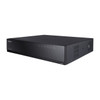
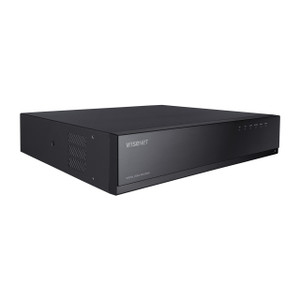
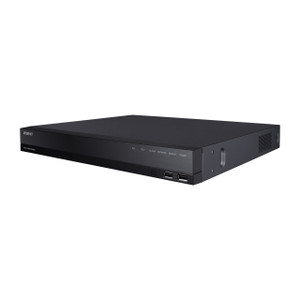
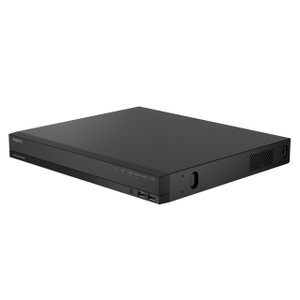
Hanwha HRX-835A-4TB 8-Channel Pentabrid DVR
The Hanwha HRX-835A-4TB is an 8-channel pentabrid digital video recorder engineered for surveillance environments in transition from analog to IP infrastructure. Unlike recorders that force a choice between analog and network cameras, this unit handles AHD (up to 8MP), HDTVI (up to 8MP), HDCVI (up to 5MP), CVBS analog, and IP network cameras simultaneously on a single platform. This eliminates the hard cost and operational friction of equipment replacement during infrastructure migration, allowing you to preserve existing analog investments while progressively adding IP cameras without system redesign.
Key Features & Deployment Benefits
- 8-Channel Analog + 10 Network Camera Inputs (expandable to 2 additional native channels): Manage mixed-camera environments without external scalers or parallel recorders. The 10-channel network capacity means you can deploy IP cameras selectively in high-priority zones while retaining analog coverage elsewhere—phase equipment migration over time rather than all at once.
- Pentabrid Architecture (AHD, HDTVI, HDCVI, CVBS, IP): True simultaneous support for all input types prevents bottlenecks and compatibility conflicts during staged rollouts. You are not locked into a single analog standard, which matters if your installed base mixes older CVBS coax cameras with newer HDTVI domes.
- Up to 8MP Resolution (AHD, HDTVI, IP): Delivers sufficient pixel density for facial recognition and license plate capture in retail and warehouse deployments without jumping to higher megapixel tiers that demand larger storage and bandwidth allocations.
- H.265 Codec (plus H.264 and MJPEG): H.265 compression reduces storage footprint by roughly 40–60% compared to H.264 depending on scene complexity and motion. On a 4TB base unit, this translates to measurable retention gains without additional hardware cost. Multi-codec support allows you to assign compression per channel based on content type—static perimeter cameras in H.265, high-motion loading docks in H.264.
- 80 Mbps Maximum Recording Bandwidth: Adequate for 8 analog channels at mid-range resolution plus a handful of IP streams. At peak load, this bandwidth ceiling is a real constraint if you attempt to record all 8 analog channels + 10 IP cameras simultaneously at 8MP; plan IP deployment strategically or upgrade to a higher-capacity network video recorder if the facility requires full saturation.
- Frame Rates: 8 fps @ 8MP, 12 fps @ 5MP, 15 fps @ 4MP, 30 fps @ 2MP and below: Frame rate drops at higher resolution are expected and typically acceptable for warehouse and retail perimeter coverage. Interior high-detail zones (entrance, till line) are better served at 4MP or lower to maintain 15–30 fps and reduce storage load.
- 4TB Pre-installed Storage, Expandable to 24TB (four SATA HDD slots, 6TB per drive maximum): The 4TB baseline supports roughly 10–14 days of continuous 8-channel recording at 8MP with H.265, depending on motion and scene complexity. Expansion capacity ensures this recorder scales with facility growth or longer retention mandates without replacement.
- 32 Mbps Playback Bandwidth Supporting Simultaneous 10-Channel Playback: Forensic review across multiple camera angles is fluid, though not at full recording bitrate—expect 10–15 fps during playback rather than real-time rates. Sufficient for incident investigation and legal discovery workflows.
- Dual HDMI and VGA Outputs: Supports dual-monitor or multi-screen security operation center setups. HDMI carries full resolution; VGA is legacy support for older display infrastructure.
- 8 Alarm Inputs and 4 Relay Outputs: Integrates third-party sensors (door contacts, PIR, glass break) and triggers external devices (door locks, strobes, audible alarms) without additional I/O modules. Useful for warehouse automation integration and emergency response workflows.
- 8-Channel Audio Input, 1-Channel Audio Output: Enables two-way communication at designated zones or bidirectional intercom between control room and loading dock without separate audio infrastructure.
Integration & Compatibility
The HRX-835A-4TB integrates with Hanwha IP cameras and third-party ONVIF-compliant IP cameras via the 10 network channels. Analog camera inputs accept standard coaxial connections (RG-59 or RG-6); no balun converters required for AHD or HDTVI. Audio input supports line-level or microphone-level sources via 3.5mm connectors. The recorder's HDMI and VGA outputs feed standard displays or KVM switches for multi-site monitoring.
Consult a video storage and retention guide when sizing HDD expansion to match your local recording mandates—frame rate, resolution, and scene complexity all affect burndown rates significantly.
When to Choose a Different Model
If your facility requires 16+ analog channels or expects to saturate all 10 IP channels at 8MP simultaneously, consider a higher-capacity recorder in the Hanwha family with larger storage and bandwidth headroom. If you are deploying exclusively IP cameras with no legacy analog infrastructure, a dedicated NVR may offer better efficiency and cost per channel. If you require advanced video analytics (people counting, zone crossing, crowd detection) at the recorder level, evaluate whether edge-based analytics on individual IP cameras or a VMS-integrated approach better suits your operational workflow.
Frequently Asked Questions
Q: Can the HRX-835A-4TB record all 8 analog channels and all 10 IP channels simultaneously at 8MP?
A: No. The 80 Mbps recording bandwidth ceiling means you cannot saturate all 18 inputs at 8MP simultaneously. Plan IP deployments to stay within bandwidth—for example, 8 analog channels at 4MP + 4 IP channels at 8MP is feasible; adding more IP channels at 8MP will either reduce analog frame rates or require step-down in IP resolution.
Q: What is the typical retention period on the 4TB base storage?
A: With continuous 8-channel recording at 8MP and H.265 compression, expect 10–14 days depending on motion levels. Add HDD modules to extend retention; each 6TB expansion drive adds approximately 15–21 days at the same settings.
Q: Does the HRX-835A-4TB support ONVIF Profile S cameras?
A: Yes. The 10 IP channels accept any ONVIF-compliant network camera. Ensure the IP camera's bitrate and frame rate combination fit within the 80 Mbps total bandwidth limit.
Q: Can I use this recorder with mixed HDTVI and HDCVI analog cameras?
A: Yes. The pentabrid architecture supports HDTVI, HDCVI, AHD, and CVBS on the same 8 analog channels. You can mix camera types, but note that HDCVI maxes out at 5MP while HDTVI reaches 8MP—resolution will vary by camera.
Q: What happens if I exceed the 80 Mbps bandwidth limit?
A: The recorder will either drop frames on lower-priority channels, downgrade resolution, or reduce frame rate to stay within budget. Monitor bandwidth usage in the recorder's web interface during commissioning to avoid surprises.
Q: Does the HRX-835A-4TB come with hard drives pre-installed?
A: Yes. The 4TB model ships with one 4TB drive installed. Three additional SATA slots remain available for expansion up to 24TB total (4x 6TB maximum per slot).
Ted PerryPerspective based on aggregated IP Security Depot and affiliated engineering team experience.
The HRX-835A-4TB is a pragmatic fit for facilities with active coax camera plant and a mandate to migrate toward IP without forklift economics. The pentabrid input design and 80 Mbps bandwidth limit are not drawbacks—they're honest constraints that force you to architect the deployment properly rather than oversell capacity. Here's what matters on install day.
Technical Highlights:
- H.265 codec with H.264 fallback: Real-world bandwidth savings depend on scene content—motion-heavy loading docks benefit more than static perimeter shots. On a 4TB drive with 8 channels at 8MP, the difference between H.265 and H.264 is roughly 3–5 extra days of retention. Over 12–24 months, that adds up.
- 80 Mbps ceiling with 32 Mbps playback bandwidth: This asymmetry is deliberate. You record at higher bitrate for quality, play back at lower bitrate for investigation. Don't expect real-time multi-angle forensic replay; if that's a hard requirement, upgrade the recorder or investigate a dedicated VMS layer.
- Frame rate scaling (8 fps @ 8MP down to 30 fps @ 2MP): This is the mathematical tax on pixel density. A warehouse entrance at 8MP, 8 fps is acceptable for facial ID; a perimeter boundary at 2MP, 30 fps is fine for motion detection. Mix resolutions and frame rates per channel to balance detail and storage burndown.
Deployment Considerations:
- The 10 IP network channels are a bridge, not a wholesale replacement. Don't assume you'll migrate 18 analog cameras to 18 IP cameras on this recorder—the bandwidth doesn't support it. Plan for 8 analog + 6–8 IP as a sustainable mixed configuration.
- Storage expansion is modular but not hot-swappable; adding a new HDD requires a system shutdown. Schedule HDD upgrades during maintenance windows, not mid-shift when the recorder is live.
- Dual HDMI + VGA outputs are useful for split-duty control rooms (live view on one screen, playback on another), but they don't provide independent video streams—both show the same recorder state. If you need multi-monitor failover or redundancy, layer a VMS on top.
The HRX-835A-4TB excels in mid-tier retail and warehouse deployments where budget constraints prevent wholesale IP swaps and operational reality demands coexistence with older coax infrastructure. Size the HDD expansion upfront based on your actual frame rate and resolution mix, not theoretical maximums, and you'll avoid the common pitfall of undersized storage that forces aggressive compression or frame-rate culling.