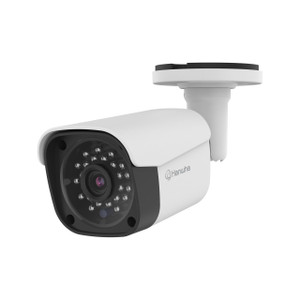
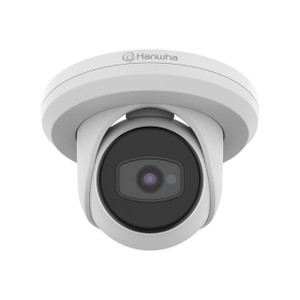
Hanwha ACE-8020R 5MP IR Turret Camera
Overview
The Hanwha ACE-8020R is a fixed-lens analog turret camera engineered for outdoor surveillance on coaxial infrastructure where 5MP resolution is required without migration to IP-native architecture. This turret operates across AHD, TVI, CVI, and CVBS formats simultaneously—field-selectable via switch—enabling a single SKU to deploy across heterogeneous analog HD systems. Many installations still rely on established coaxial backbone infrastructure; the ACE-8020R addresses the practical reality that ripping out and replacing cable runs is often infeasible or economically unjustifiable. Rather than forcing a wholesale digital upgrade, this turret delivers modern 5MP capture on existing coaxial networks, making it a targeted choice for perimeter and building-exterior surveillance where analog coaxial runs already exist.
Key Features
- 5MP Resolution at 30 FPS (2592 × 1944 pixels) — Delivers enough detail for license plate and facial recognition work at medium range without saturating coaxial bandwidth. CVI mode supports up to 4MP at full 30 FPS. The 30 FPS ceiling is adequate for typical outdoor perimeter surveillance; if you require 60 FPS for high-motion scenarios (parking lot traffic, conveyor line monitoring), evaluate higher-frame-rate variants within the Hanwha surveillance line or consider an IP-based alternative that supports frame-rate flexibility.
- 3.6mm Fixed Focal Lens, 94° Horizontal FOV — Provides wide-angle coverage standard on turret deployments for building exteriors and fence-line installations. The fixed lens eliminates mechanical focus drift and wear inherent to varifocal designs, reducing maintenance overhead on remote or difficult-to-access mounting points. The tradeoff: you lose zoom flexibility; if a single mounting point must cover variable distances or if pan-tilt-zoom functionality is required, a varifocal or PTZ alternative becomes necessary.
- 20m Infrared Illumination (65 feet) — Delivers continuous IR output sufficient for medium-distance night surveillance without supplemental external lighting. At 20m range, subjects are recognizable; beyond 25m, IR beam spread reduces effective illumination significantly. Before final placement, overlay the 20m IR coverage footprint against your perimeter zones to confirm nighttime visibility gaps. Extended IR range (30m+) may require a different turret model in the same family.
- 0 Lux Operation in B/W IR Mode; 0.4 Lux Minimum in Color — The camera automatically switches to grayscale via Auto ICR (Infrared Cut-off Relay) at dusk, eliminating the color bleed and ghosting typical of older hybrid designs. In total darkness, IR sustains grayscale surveillance; in low ambient light (twilight, parking lot sodium vapor), the 0.4 lux color threshold preserves color detail during evidence-critical hours. This dual-mode behavior is standard on quality turret designs and matters when color evidence—vehicle paint, clothing, signage—is operationally important.
- IP67 Weatherproof, IK10 Vandal Resistance — IP67 rating means the turret resists rain, dust, and brief water spray without degradation; temporary immersion (up to 1 meter, 30 minutes) is survivable but not the intended use case. If the camera will sit in standing water or endure high-pressure washdowns, IP67 is marginal—verify mounting elevation and drainage. IK10 vandal rating withstands 20J impact strikes (5kg mass dropped from 40cm) without mechanical failure. Pair this with wall or ceiling mounting out of casual reach, and the turret becomes a credible deterrent to smash-and-grab tampering; ground-level pole mounts remain vulnerable to deliberate destruction. Salt-fog coastal environments may accelerate corrosion on mounting hardware—verify environmental sealing on fasteners.
- 12VDC Power, 4.3W Typical Consumption — Low power draw means the ACE-8020R can operate reliably on long coaxial cable runs (up to 300m on 5C2V coaxial cable per Hanwha specification) without voltage sag or dedicated power supplies at each camera. This is a significant operational advantage on large perimeter installations where power distribution becomes cost and complexity; verify your DVR's 12V output capacity if powering multiple turrets from a single supply.
- Multi-Protocol Flexibility (AHD, TVI, CVI, CVBS) — A single camera operable across all four analog HD standards means you can mix turret deployments across heterogeneous coaxial systems without reformatting the entire network. Coaxial control compatibility (via twisted-pair control lines) allows integrators to manage camera selection from a hybrid DVR without re-cabling. This is a real operational advantage if you're inheriting or retrofitting mixed-vendor analog infrastructure.
- Operating Temperature Range: −30°C to +55°C (−22°F to +131°F) — The turret operates reliably across extreme temperature swings without lens fogging or IR efficiency loss, making it suitable for northern climates and unheated outdoor enclosures. Thermal cycling at the extremes may stress solder joints over years; verify mounting orientation to minimize direct sun exposure and thermal stress on the PCB.
Integration and Compatibility
The ACE-8020R (often searched as ACE 8020R) integrates with any hybrid DVR or TVI/AHD/CVI recorder that supports multi-protocol input switching. Field-selectable protocol switches on the camera allow protocol assignment without returning to the factory. Coaxial control over twisted-pair enables DVR-side camera selection and configuration on compatible recorders. If your DVR supports only a single protocol (e.g., pure AHD or pure TVI), confirm the ACE-8020R can be locked to that protocol via switch configuration before ordering.
When to Choose a Different Model
If your installation requires varifocal coverage (zoom flexibility on a single camera) or pan-tilt functionality, the ACE-8020R's fixed 3.6mm lens is a limiting constraint—evaluate a varifocal turret or PTZ variant in the Hanwha family. If IR range beyond 20m is essential for your perimeter zones, confirm a longer-range turret variant is available. If migrating to IP-native architecture is planned within 2–3 years, the cost-benefit of this analog turret diminishes; factor lifecycle planning into your procurement decision.
Frequently Asked Questions
Q: What coaxial cable distance can the ACE-8020R support?
A: Hanwha specifies up to 300m (984 feet) transmission distance on 5C2V coaxial cable. Beyond 300m, signal degradation becomes noticeable; verify your DVR's input equalizer capability if approaching that limit on existing cable runs.
Q: Can the ACE-8020R be used indoors?
A: Yes, the turret form factor and low power draw make it suitable for indoor ceiling or wall mounting in warehouses, parking garages, and facility lobbies. However, the IP67 rating and IK10 vandal resistance are engineered for outdoor durability; indoors, these features offer extra robustness but are not required. A lower-cost indoor turret variant may be more economical if outdoor weather resistance is unnecessary.
Q: Does the ACE-8020R support motion detection or video analytics?
A: Motion detection is handled by the connected DVR or recorder; the ACE-8020R is a straightforward analog video source and does not embed on-camera analytics. If on-camera analytics (object detection, people counting, etc.) are required, migrate to an IP camera platform with edge intelligence support.
Q: What is the warranty on the ACE-8020R?
A: Warranty details are not provided in the available specification evidence. Contact the manufacturer or your specialty distributor for the precise warranty period and coverage terms.
Q: Can I use the ACE-8020R with an IP NVR?
A: No. The ACE-8020R is an analog turret camera (AHD/TVI/CVI/CVBS) and requires a hybrid or analog DVR. IP NVRs do not accept analog video inputs. If integration with an IP NVR is required, you must use an IP camera instead of this analog model.
Q: Is the ACE-8020R NDAA or TAA compliant?
A: Compliance certifications are not documented in the available specification evidence. Contact the manufacturer or a compliance specialist to confirm NDAA Section 889 or TAA eligibility for federal procurement scenarios.
Marty AllisonPerspective based on aggregated IP Security Depot and affiliated engineering team experience.
The Hanwha ACE-8020R occupies a specific and often-overlooked niche: analog HD surveillance on coaxial infrastructure where IP migration is deferred or economically infeasible. I've deployed turrets like this on warehouse perimeter retrofits and parking structures where ripping out 500+ meters of run cable was never going to happen. The ACE-8020R's multi-protocol flexibility (AHD, TVI, CVI, CVBS via field switch) is genuinely useful when you inherit mixed-vendor analog systems or need to standardize on a single camera model across heterogeneous DVR platforms.
Technical Highlights:
- 5MP at 30 FPS with 3.6mm Fixed Lens: The resolution-to-lens pairing is optimized for building-perimeter and fence-line coverage typical of turret deployments. License plate recognition is achievable at 15–20m with the 94° FOV; beyond that, detail drops. The fixed lens eliminates focus drift on remote mounts, reducing maintenance tickets over time.
- 20m IR and 0.4 Lux Color Threshold: The IR range is honest—20m covers most facility perimeters without external lighting, but it's not a long-throw solution. The Auto ICR mode switching between IR grayscale and color at 0.4 lux is critical for mixed-light scenarios (e.g., parking lots with sodium vapor fixtures). You preserve color evidence during twilight hours when it matters most.
- 4.3W Draw on 12VDC, 300m Coaxial Range: Low power consumption and extended cable reach mean you can power multiple turrets from a single DVR 12V output without sag or secondary supplies on the run. This is a hidden cost-saver on large perimeters.
- IP67 / IK10 Environmental Rating: The turret survives rain, dust, and casual impact without mechanical failure. Mounting height and orientation matter—direct sun exposure can induce thermal cycling stress on long-term reliability. Coastal salt-fog environments may corrode fasteners; spec stainless hardware if salt spray is a factor.
Deployment Considerations:
- Coaxial distance limit is 300m on 5C2V cable; if your runs approach or exceed that, verify DVR-side equalizer capability or accept signal degradation. Budget for cable quality and continuity verification before final commissioning.
- The fixed 3.6mm lens is a hard constraint if your perimeter requires variable zoom coverage or if mounting locations demand varifocal flexibility. Plan camera placement carefully; you cannot adjust coverage after installation without repositioning the turret.
- Analog turrets lack on-camera analytics; motion detection, object counting, and behavioral analytics depend entirely on DVR firmware. If you need deep-learning-based analytics, transition to an IP camera platform.
- This is not a cloud-connected or remote-management device. Configuration and monitoring happen at the DVR only; if distributed multi-site oversight is required, IP-native architecture becomes necessary.
Deploy the ACE-8020R when you're retrofitting a large coaxial perimeter installation and cannot economically justify ripping out existing cable infrastructure. It's a pragmatic choice for warehouse exteriors, parking structures, and building perimeters where coaxial backbone already exists and 5MP detail at 20m IR range meets your operational requirements. It is not a forward-looking investment; treat it as a mid-lifecycle analog refresh, not a long-term platform expansion.