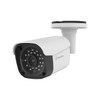
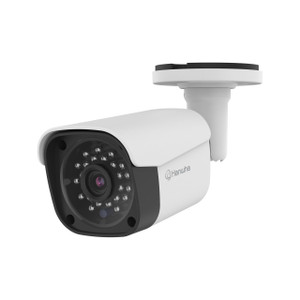
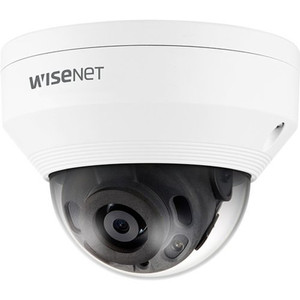
Hanwha ACO-8020R 5MP IR Bullet Camera
The Hanwha ACO-8020R is a 5MP analog HD infrared bullet camera engineered for outdoor surveillance in mixed-protocol environments where coaxial infrastructure is already deployed. Part of the Wisenet A Series, this camera selects between AHD, TVI, CVI, or CVBS output formats via coaxial control — meaning you can integrate it into existing DVR systems without hardware replacement or the cost of transition to IP architecture. It captures 2592×1944 resolution at 30 FPS (20 FPS on CVI) and delivers 20 meters of infrared coverage in complete darkness, enabling authentic 24/7 monitoring across parking lots, loading docks, building perimeters, and high-traffic outdoor zones.
Key Features
- 5MP Resolution (2592 × 1944) at 30 FPS: Records at real-time frame rate, delivering forensic-quality detail for license plate reads, facial identification at distance, and perimeter event verification — a meaningful step up from legacy 1080p or D1 systems without requiring IP camera infrastructure overhaul. On CVI protocol, frame rate caps at 20 FPS, so confirm your DVR's native protocol before purchase if real-time playback is critical.
- 20-Meter IR Range: Built-in infrared LED array enables monochrome surveillance in zero ambient light (0 lux B/W mode). In practice, this covers standard outdoor zones — parking lots, fence lines, warehouse docks — without the need for auxiliary lighting, reducing installation complexity and ongoing operational expense.
- Multi-Protocol Hybrid Output (AHD/TVI/CVI/CVBS): Selectable via coaxial control, eliminating the cost and inventory burden of managing separate camera SKUs. Deploy this single model across mixed analog DVR ecosystems — a real advantage in retrofit and multi-site deployments where DVR standardization is incomplete.
- 3.6mm Fixed Lens: Provides a 92-degree horizontal field of view suitable for standard perimeter and approach monitoring. Not motorized, so it cannot zoom or reposition remotely — factor this into site surveys and confirm coverage angles before purchase. Lens selection is locked at installation.
- Digital WDR (DWDR): Compensates for high-contrast scenes and backlighting common in outdoor retail, warehouse dock, and transit environments. Preserves detail in both bright sunlit areas and deep shadows simultaneously, reducing the need for post-processing or manual gain adjustment during mixed lighting conditions.
- Day/Night ICR Switching: Automatic infrared cut-off filter transitions the image sensor between color mode (daylight) and monochrome mode (darkness). Improves low-light sensitivity by removing the filter when ambient light drops, and restores color fidelity during daytime — no manual intervention required.
- IP67 Weatherproofing: Rated for dust and water immersion up to 1 meter for 30 minutes. In practical terms: washdown-safe, rain-resistant, and suitable for coastal or wet industrial environments. Not rated for permanent submersion or high-pressure jets.
- IK10 Vandal Resistance: Heavy-duty metal housing withstands 20-joule impact tests (equivalent to a strike from a standard hammer). Necessary in high-risk retail, transit, and high-crime perimeter zones where tampering or destruction is a concern.
Integration & Compatibility
The ACO-8020R integrates directly into any hybrid DVR that supports AHD, TVI, CVI, or CVBS input. Confirm your DVR's supported protocols and frame rates before purchase — some CVI implementations cap at 20 FPS instead of the full 30 FPS available on AHD and TVI. This camera requires coaxial video transmission (standard RG59 or RG6 cable) and typically draws 12VDC power via a separate power supply, though some installations may support DC power injection over the coaxial line depending on DVR architecture. For multi-camera deployments, verify your power supply budget and coaxial cable quality to avoid signal degradation over distance. Signal loss increases notably beyond 150 meters of coaxial run, so account for amplifiers or shorter cable runs in large perimeter installations.
When evaluating outdoor surveillance cameras, the ACO-8020R's protocol flexibility makes it especially valuable for environments where equipment refresh cycles are staggered or where multiple DVR vendors are in use. If you are transitioning to IP-based infrastructure, compare against IP cameras to understand the infrastructure cost difference upfront — IP requires network provisioning and PoE power, whereas this analog option uses existing coaxial runs.
When to Choose a Different Model
If your requirement is IP-native architecture, network-based VMS integration, or built-in analytics (object detection, line crossing), the ACO-8020R is the wrong choice — it is a pure analog device with no onboard intelligence. If your site requires zoom flexibility or remote pan/tilt capability, the fixed 3.6mm lens is a limitation; consider a PTZ camera or varifocal model instead. If you need color video in very-low-light conditions (twilight dusk where IR is not yet necessary), the DWDR alone may not be sufficient — request a low-light demo on-site. For coastal or salt-spray environments, even IP67 protection requires quarterly rinsing to prevent corrosion; plan maintenance accordingly.
Frequently Asked Questions
Q: Can I mix the ACO-8020R with other protocols on the same DVR?
A: Yes. If your DVR supports multiple input protocols (AHD, TVI, and CVI channels on the same device), you can configure the ACO-8020R to match whichever protocol that DVR channel uses. The camera's protocol is set via coaxial control, not a physical jumper, so reconfiguration requires DVR access.
Q: What is the actual visible range of the 20-meter IR in fog or dust?
A: IR range specifications assume clear air. In fog, dust, or rain, visible range typically drops 30–60% depending on particle density. In warehouse environments with overhead dust or dock areas with salt spray, plan for 10–12 meters of reliable identification range rather than the full 20 meters.
Q: Does the ACO-8020R work with modern IP-based VMS platforms like Milestone or Genetec?
A: No. The ACO-8020R is a coaxial analog camera. It requires a hybrid DVR with analog input channels. If you need VMS integration, you must deploy an encoder (analog-to-IP converter) between the camera and the VMS, adding cost and complexity. Confirm your DVR's protocol support before purchase.
Q: What is the minimum illumination in color mode (without IR)?
A: Manufacturer specifications list the camera as operating in color mode down to approximately 0.005 lux with AGC (automatic gain control) enabled, though image quality degrades significantly below 1 lux. For reliable color detail at night, supplement with auxiliary lighting or rely on IR monochrome mode.
Q: Can I power the ACO-8020R over the coaxial cable?
A: Some hybrid DVR systems support DC power injection over coaxial cable, but it is not guaranteed. The standard configuration uses a separate 12VDC power supply. Verify your DVR's specifications and cable quality if you intend to inject power; long coaxial runs (over 150 meters) increase voltage drop and may result in insufficient camera power.
Q: Is the lens on the ACO-8020R replaceable or upgradeable?
A: No. The 3.6mm lens is factory-sealed and not field-replaceable. Lens selection is a permanent installation decision. If coverage angles require adjustment, consult a site survey or request a demo at the intended mounting location before purchase.
James EverettPerspective based on aggregated IP Security Depot and affiliated engineering team experience.
The ACO-8020R makes sense in a narrow but real scenario: you have coaxial infrastructure already in place, your DVR ecosystem is mixed (multiple vendors or protocols), and you cannot justify a full transition to IP architecture right now. The 5MP resolution and 30 FPS capability deliver a genuine upgrade from 1080p analog, and the protocol flexibility means you can deploy this one model across AHD, TVI, and CVI systems without SKU fragmentation.
Technical Highlights:
- 30 FPS at 5MP (AHD/TVI): Captures 2592×1944 pixels in real time on AHD and TVI, versus 20 FPS on CVI. That 50% frame-rate difference matters for vehicle license plate reads and perimeter tracking — confirm your DVR's native protocol before deployment to avoid post-purchase surprises.
- 20-Meter IR with Day/Night ICR: The automatic infrared cut-off filter switching means zero configuration or scheduling — the camera handles the transition automatically as ambient light changes. That simplicity is valuable in retrofit installations where you cannot afford field recalibration.
- IP67 + IK10 combined: Water and impact resistance together protect against both weather washdown and deliberate tampering. In a loading dock or high-crime perimeter, that dual rating justifies the hardened housing cost versus a cheaper consumer-grade bullet.
Deployment Considerations:
- Protocol lock-in: The ACO-8020R is a retrofit tool, not a future-proofing purchase. If your roadmap includes migration to IP, encoder costs will compound — plan that separately.
- Fixed 3.6mm lens: Not motorized, not adjustable. Site surveys are mandatory. Mounting angle errors are permanent installation mistakes, so request a demo or use a temporary tripod on-site to verify coverage before final mounting.
- Coaxial distance limits: Signal quality degrades over 150+ meters of cable run. In sprawling parking lots or large warehouse perimeters, budget for shorter runs or active amplifiers. That increases BOM cost in large deployments.
Deploy the ACO-8020R where you are retrofitting a DVR ecosystem with mixed protocols and cannot justify the capex of a parallel IP infrastructure. It is not a future platform — it is a pragmatic refresh for existing analog installs. For greenfield deployments, IP-native cameras and NVRs offer better long-term flexibility despite higher upfront cost.