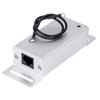
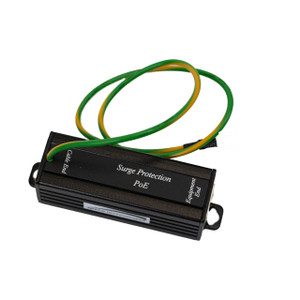
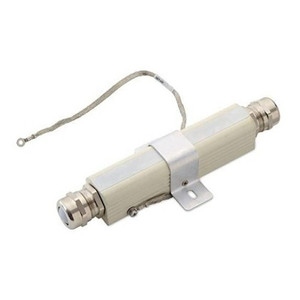
Vivotek AT-PSP-001 PoE Surge Protector
Overview
The Vivotek AT-PSP-001 is an indoor PoE surge protector engineered to shield networked surveillance cameras, access points, and other PoE-powered devices from electrical transients and power surges. If your installation faces intermittent power instability or operates in regions with frequent lightning activity, the AT-PSP-001 delivers dual-mode voltage clamping that activates in nanoseconds — fast enough to prevent device damage before it starts. This is the kind of accessory that sits quietly until it matters; when it does matter, it matters a lot.
Key Features
- 8–10KA surge handling capacity — handles high-energy transients that would destroy unprotected PoE devices. The rating translates to real-world protection against nearby lightning strikes or industrial switching transients without requiring bulky external suppressors.
- Dual-mode protection architecture — common mode clamping at 20KV (10/700µs) and differential mode at 4KV (10/700µs) means surges are caught on both the signal and return paths. Result: voltage stays below the 600V (line-to-ground) and 20V (line-to-line) damage threshold.
- 5-nanosecond response time — activation happens in billionths of a second, before capacitors on camera power supplies or NIC cards see stress. This is what separates effective protection from too-slow, reactive designs.
- Minimal insertion loss: 1dB @ 10MHz/100MHz — PoE data and power path remain transparent. You won't see degraded bandwidth or power delivery; the device sits invisibly in line.
- Return loss -20dB @ 10MHz/100MHz — signal reflections stay low, preserving network stability across the full Ethernet frequency range.
- Supports up to 2A (4-pair) or 1A (2-pair) DC current — accommodates High PoE (802.3bt), standard PoE+ (802.3at), and basic PoE (802.3af) devices without bottlenecking. Choose based on your cable configuration and power budget.
- Wide operating temperature: -40°C to 85°C — handles indoor installations in unheated closets, equipment rooms near HVAC, or climates with seasonal extremes without performance drift.
- Compact form factor: 25 × 40 × 80mm — fits inline with standard RJ-45 cabling without requiring a dedicated junction box or taking up rack space. Mount directly to a camera pole, wall bracket, or equipment cabinet.
- Safety indicator light — visual confirmation that surge protection remains active. If the indicator goes dark, the unit has taken a hit and needs replacement before the next transient event.
- 12-month warranty — covers manufacturing defects. Budget for replacement units as consumables in high-lightning-risk zones.
Integration & Compatibility
The AT-PSP-001 integrates into any PoE cabling run between a PoE switch, injector, or splitter and a powered endpoint. Install it at the device end (closest to the camera or access point) for maximum protection of sensitive electronics. It works with Vivotek IP cameras and third-party PoE devices that conform to IEEE 802.3af/at/bt standards. Because it preserves signal integrity and passes full power budgets, it introduces no compatibility constraints — swap it in and forget about it.
For PoE planning and power infrastructure in lightning-prone installations, pair this protector with surge-protected power distribution at the switch or rack level. The AT-PSP-001 handles the last-meter device protection; external lightning arrestors on building entry points handle the bulk of the energy.
When to Choose a Different Model
If you need outdoor surge protection for cables running across rooftops or exposed conduit, look for a Vivotek surge protector rated for IP67 outdoor enclosure. The AT-PSP-001 is interior-only. For installations in non-PoE environments (12VDC or AC-powered devices), you'll need a protector matched to that voltage and current profile — this one is PoE-specific.
Deployment Context
Surveillance integrators working in coastal regions, high-altitude areas, or industrial zones with frequent electrical disturbances should treat the AT-PSP-001 as a baseline defense on every camera run. A failed camera caused by transient damage costs far more than the $50–100 per-unit cost of inline protection. In data center or telecom environments where uptime is non-negotiable, staged protection (rack-level + device-level) is standard practice — the AT-PSP-001 fills the device tier efficiently.
Frequently Asked Questions
Q: What's the difference between common mode and differential mode protection on the AT-PSP-001?
A: Common mode protects the entire PoE pair against ground surges (20KV rating). Differential mode protects between the signal lines themselves (4KV rating). Together, they clamp transients regardless of how the surge couples into the cable — a necessary redundancy for real-world environments.
Q: Does the AT-PSP-001 require power or configuration?
A: No. It's purely passive — no power input needed, no setup required. Install it inline and it begins protecting immediately. The indicator light draws power from the PoE circuit itself.
Q: Can I use the AT-PSP-001 outdoors?
A: Not recommended. It's rated for indoor use only (-40°C to 85°C operating range, no IP rating for moisture or UV). For outdoor exposed runs, consult a weatherproof surge protector variant.
Q: If the AT-PSP-001 takes a direct hit from a surge, does it need replacement?
A: Yes. Surge protectors are consumables — once they clamp a transient, the internal suppression elements degrade slightly. After a major event, the indicator light typically darkens or the device fails open. Replace it before the next electrical event.
Q: Will the AT-PSP-001 slow down PoE data transfer?
A: No. The 1dB insertion loss and -20dB return loss are well within acceptable limits for Gigabit Ethernet. Data throughput and power delivery remain unaffected.
Q: Is the AT-PSP-001 compatible with all PoE standards?
A: Yes, it supports 802.3af (13W), 802.3at (30W), and 802.3bt (90W+) PoE delivery. Current capacity is 2A (4-pair) or 1A (2-pair) depending on cable configuration.
Ted PerryPerspective based on aggregated IP Security Depot and affiliated engineering team experience.
The AT-PSP-001 is a straightforward piece of protection infrastructure that most integrators underestimate until a surge event forces the conversation. I've seen too many surveillance rollouts in storm-prone areas skip inline surge protection, assuming the PoE switch's built-in fusing is enough. It's not. The Vivotek AT-PSP-001 delivers that missing layer of defense with a 5-nanosecond response time — fast enough to clamp transients before they reach the camera's power regulation circuits.
Technical Highlights:
- Nanosecond activation (5ns response): Transient energy is clamped to safe levels before camera capacitors see stress. This speed differential is why passive inline protection works better than relying on fuses or circuit breakers that respond in microseconds.
- 20KV common mode / 4KV differential mode clamping: Dual-path suppression means no matter how the surge couples into the cable (ground spike, line-to-line transient, or hybrid), voltage is driven down to 600V line-to-ground or 20V line-to-line — well below device damage thresholds.
- Minimal insertion loss (1dB @ 10MHz/100MHz): The -20dB return loss figure keeps the PoE network transparent; you won't see data corruption or power delivery sag. This is why it works reliably in production without requiring bypass paths or fallback switching.
Deployment Considerations:
- Placement matters: Install the AT-PSP-001 at the device end of the PoE run — closest to the camera or access point — not at the switch. This protects the most vulnerable electronics (low-voltage regulators, SoC inputs) from the final transient spike.
- Consumable lifespan: After a major surge event, the suppression elements degrade. The safety indicator light will dim or extinguish, signaling replacement. Budget for spare units in high-risk zones; don't assume a single unit will provide indefinite protection through multiple events.
- Indoor-only rating: No IP rating means moisture ingress is a risk outdoors. If you need to protect external cable runs, use a weather-sealed variant or install the protector indoors at the switch end and accept some residual risk on the exposed segment.
The AT-PSP-001 shines in warehouse automation environments, coastal surveillance deployments, and industrial sites where electrical transients are routine. Pair it with upstream rack-level surge suppression for defense-in-depth, and you've eliminated a major failure mode that catches most integrators off guard. In regions with significant lightning or industrial switching, it's not optional — it's mandatory infrastructure.