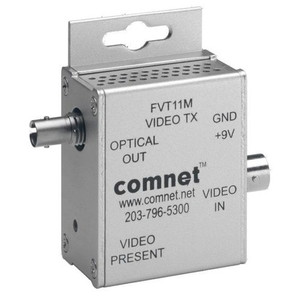
Comnet FDX70EBM1 Universal Data Point-to-Point Fiber Optic Converter
Overview
The Comnet FDX70EBM1 is a universal fiber optic converter designed to extend serial data signals (EIA RS232/RS422/RS485) over multimode fiber connections. This is the "B" end module in a point-to-point pair, handling industrial-grade data transmission for traffic management systems, access control integration, and field device communication where noise immunity and distance are critical. Built to NEMA TS-1/TS-2 and Caltrans Specification standards, it's purpose-built for highway and transportation infrastructure that demands proven reliability.
Key Features
- Serial Data Interface: Supports EIA RS232/RS232 2-wire, RS422/RS485 2-wire and 4-wire protocols — covers every standard industrial serial topology you're likely to deploy. No bridge converters or protocol translation hardware needed upstream.
- Multimode Fiber (MM) with ST Connector: One fiber channel via ST connection minimizes cabling runs in high-EMI environments (near power distribution, along highway corridors). MM fiber is more forgiving than single-mode for shorter distances (under 2 km), reducing installation cost while maintaining signal integrity.
- Hot-Swappable Module Design: Field-replaceable module architecture means you can swap the FDX70EBM1 without powering down the rack or backplane — critical for 24/7 operational networks where downtime is measured in traffic delays.
- Wide Optical Dynamic Range: Handles signal variation across the fiber link without requiring manual attenuation tuning. Plug-and-play commissioning reduces on-site configuration labor.
- Bi-Color LED Status Indication (Red/Green): Immediate visual feedback on module health and data activity — no need to log into management software to confirm the converter is operational. Green = link active and data flowing; red flags signal loss or module fault.
- Voltage Transient Protection: Surge protection on data lines guards against voltage spikes from nearby high-power equipment (motor starters, solenoids on access gates). Reduces warranty claims and unplanned outages on sensitive downstream devices.
- NTCIP Compliant: National Transportation Communications for ITS Protocol compliance ensures compatibility with traffic signal controllers, toll booth systems, and other ITS infrastructure that standardizes on this protocol for interoperability.
- Multiple Mounting Options: Stand-alone, rack mount, or DIN-rail mounting gives you flexibility in cabinet and field enclosure layouts — no custom brackets or adapters required for most installations.
Integration & Compatibility
The FDX70EBM1 pairs with an "A" end module to form a complete point-to-point fiber link. This is the receive/termination end; ensure you order the matching transmit end for your application. Works with any device that outputs or accepts standard EIA serial protocols (traffic signal controllers, gate operators, CCTV matrix switchers, access control panels, industrial PLCs). NTCIP compliance makes it the standard choice for DOT and Caltrans-specified transportation projects where cross-vendor equipment must interoperate reliably.
Environmental & Installation Notes
Designed for outdoor transportation cabinets and harsh industrial environments covered by NEMA TS-1/TS-2 enclosure ratings. Verify your mounting enclosure meets these standards. Single data channel (one fiber) carries one bidirectional serial link; if you need simultaneous A and B channel operation, plan for a second fiber pair and module set. ST connectors require proper termination and polishing — use standard fiber jumper cables and follow fiber handling best practices to avoid contamination and signal loss.
What's in the Box
The FDX70EBM1 module itself is included. Fiber optic patch cables, power supply (if required for your specific end type), and mounting hardware are typically ordered separately or bundled with a complete point-to-point system. Confirm the exact contents with your order, as "A" and "B" end modules may have different power and accessory requirements.
Frequently Asked Questions
Q: Is the FDX70EBM1 the transmit or receive end?
A: The FDX70EBM1 is labeled the "B" end (receive/termination end). It must be paired with an "A" end module on the opposite side of the fiber link. Always order both ends together for a complete point-to-point installation.
Q: What fiber type do I need for the FDX70EBM1?
A: Multimode (MM) fiber with ST connectors. Standard 62.5/125 μm or 50/50 μm multimode patch cables will work. Maximum recommended distance depends on your specific fiber quality and system design; consult your system integrator for distance calculations.
Q: Does the FDX70EBM1 require external power?
A: Power requirements depend on the specific module configuration (some units draw power from the host device, others require 12V or 24V supply). Verify the power specification for the exact SKU before installation.
Q: Can I use the FDX70EBM1 with RS485 4-wire devices?
A: Yes. The FDX70EBM1 supports EIA RS485 in both 2-wire and 4-wire modes. Ensure your host device and terminating equipment support the same mode (mixed 2-wire/4-wire on the same link will cause data corruption).
Q: What is NTCIP compliance, and why does it matter?
A: NTCIP is the National Transportation Communications for ITS Protocol — a standard for traffic management and intelligent transportation systems equipment. NTCIP compliance ensures the FDX70EBM1 works reliably with DOT, highway, and transit authority traffic equipment without custom drivers or protocol bridges.
Q: How do I know if the FDX70EBM1 is working?
A: The bi-color LED indicator shows status: green = link active and data flowing, red = signal loss or module fault. No blinking or LED activity indicates a power or connection problem. Check fiber connections and LED status before troubleshooting downstream devices.
I spec the FDX70EBM1 into traffic infrastructure and highway toll systems where fiber distance and EMI immunity are non-negotiable. This unit's NEMA TS-1/TS-2 compliance and multimode ST connector design make it the no-argument choice for Caltrans-certified installations. The "B" end designation means it's your termination module, so pair it correctly with the "A" end transmitter.
Technical Highlights:
- Hot-swappable module architecture: Field-replaceable without powering down the cabinet — 24/7 transportation networks cannot tolerate service interruptions for module replacement. This design saves maintenance windows and unplanned downtime.
- Bi-color LED status (Red/Green): Immediate visual fault indication without logging into a management interface. Green confirms data flow; red flags signal loss or module failure instantly. Critical for roadside technicians doing rapid diagnostics.
- Wide optical dynamic range: No manual fiber attenuation tuning required. Plug-and-play commissioning reduces integration labor on highway projects where technician time costs real money and schedules are tight.
- EIA RS232/RS422/RS485 support (2W and 4W): Covers every serial protocol your traffic signal controllers, toll booths, and access gate operators use. No protocol bridges or signal conditioning needed.
Deployment Considerations:
- The FDX70EBM1 is the "B" (receive) end — you must order the matching "A" (transmit) end to complete the point-to-point link. Confirm both module types are in your bill of materials before procurement.
- Multimode fiber with ST connectors is industry standard for transportation cabinets, but fiber handling discipline is critical — contaminated connector faces cause signal loss and intermittent data errors that are maddening to troubleshoot in the field.
- Power sourcing varies by configuration; verify whether your specific module draws 12V, 24V, or local power from the host device before final wiring.
The FDX70EBM1 is the workhorse termination module for DOT and Caltrans traffic management networks where fiber distance, noise immunity, and proven interoperability are the decision drivers. It does one thing and does it reliably — don't over-engineer it.