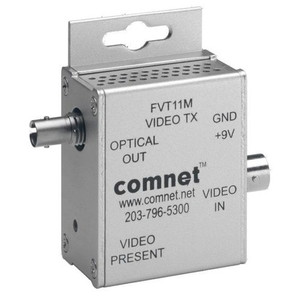
Comnet FDX72M1 Universal Data Drop and Repeat Fiber Extender
The Comnet FDX72M1 is a single-fiber multimode data and relay extender designed to transmit asynchronous serial protocols (RS232, RS422, RS485) plus contact closure relay signals over distances up to 4 kilometers. This is the right device when you need to reach a distant data source—building perimeter sensor arrays, remote camera control systems, PTZ pan-tilt-zoom command circuits, or alarm relay monitoring—without running copper back to your central control point or NVR. Fiber immunity to electrical noise means reliable data delivery in electromagnetically hostile environments like parking structures, electrical substations, or facilities with high-power RF transmission.
Key Features
- Single-fiber architecture (1310/1550 nm): Eliminates the need for dual-fiber or fiber-pair installations—a meaningful cost and routing advantage when you're retrofitting existing conduit or campus cable plants. One fiber in, one fiber out at 4 km maximum reach, meaning you can span warehouse floors, outdoor perimeters, or multi-building campuses with a single strand.
- Data rate up to 1 Mbaud (RS422 & RS485): Sufficient for PTZ speed control, video server command traffic, and most third-party sensor data streams. RS232 maxes at 250 kbps, so if your application is pure RS232, plan for the lower throughput but retain the long-distance advantage.
- Bit error rate <10-12 at maximum optical loss: This ultra-low error floor means your control frames and relay commands arrive clean; no retry storms choking your NVR serial port or causing PTZ jitter. Real-world benefit: your Pelco D protocol strings, Bosch LTC command codes, or custom sensor polling arrive as intended without handshake timeouts.
- Laser diode optical emitter: Higher optical power than LEDs, extending your usable distance and permitting older multimode fiber plant or longer runs without splicing. The FDX72M1 handles standard telco-grade MM fiber without special conditioning.
- Failure relay output (0.5–50 mA capacity): Integrates loss-of-signal detection: if fiber goes dark or the remote unit loses power, a dry contact relay pulls in on the local end. Wire this into your alarm panel or NVR watchdog circuit for automatic failover or alert triggering—invaluable for unattended remote sites where you need to know immediately if the control link is down.
- Operating temperature -40°C to +75°C with MTBF >100,000 hours: Survives outdoor cable vaults, unheated utility closets, and rooftop equipment enclosures typical of distributed surveillance deployments. MTBF >100k hours translates to roughly 11+ years of 24/7 operation before statistically probable failure—a solid reliability footprint for field electronics you'll rarely access.
- 6 LED status indicators: Power, TX, RX, local data, remote data, and failure relay—rapid visual troubleshooting without opening the enclosure. In a dimly lit equipment rack or fiber vault, these give you instant confirmation that both ends are synced and data is flowing.
- ST fiber connector + terminal block interfaces: Standard telco-grade optics cabling; RS232/RS422/RS485 wiring and power via screw terminals eliminate proprietary connectors. Your field techs can terminate data and power lines with a simple screwdriver and multimeter.
- Low power consumption: 8–15 VDC @ 4 W: Operates on the same 12VDC loop supplies that power your remote camera housings, outdoor gear, or building automation relays. One small 24W PoE supply can power six FDX72M1 units plus auxiliary circuits—meaningful in constrained power distribution scenarios.
- Compact 1-slot footprint (6.1 x 5.3 x 1.1 inches): Fits in standard wall-mount enclosures, petite fiber distribution panels, or outdoor relay cabinets without bulk. Weight under 2 lbs means no structural racking or reinforcement needed.
Integration & Compatibility
Deploy the FDX72M1 as a transparent serial pipe between your NVR's COM port and remote PTZ camera controllers, access control readers, or legacy sensor nodes. It does not interpret or modify the data stream—whatever handshake or protocol your camera controller expects, the fiber link preserves it end-to-end. Pair it with PoE-powered network switches and 12VDC field power supplies to build resilient distributed surveillance architectures. Because the unit offers no DHCP or IP-layer intelligence, it is transparent to your VMS and IP camera ecosystem; it simply extends the physical serial / relay interface to wherever your fiber reaches.
The failure relay output integrates cleanly with alarm panels, watchdog timers, and remote reboot controllers—if the FDX72M1 senses fiber loss or power dropout, it signals your NVR or access control system to trigger a failover action or send an alert.
Frequently Asked Questions
Q: What is the maximum distance for the FDX72M1?
A: Up to 4 kilometers (2.5 miles) over standard multimode fiber (1310/1550 nm). Single-mode variants may extend further; consult the manufacturer for SM specifications.
Q: Does the FDX72M1 work with H.264 or H.265 compression codecs?
A: The FDX72M1 is a hardware serial and relay extender, not a codec processor. It transmits serial command data (like PTZ, RS232 camera control) transparently. Video compression happens upstream at your camera or NVR; the FDX72M1 only extends the control path.
Q: Can I daisy-chain multiple FDX72M1 units for longer distances?
A: No. The FDX72M1 is designed as a point-to-point extender. Daisy-chaining may introduce timing issues or handshake delays in your serial protocol. For spans exceeding 4 km, evaluate a fiber backbone upgrade or a repeater-type solution.
Q: What kind of warranty does the FDX72M1 come with?
A: Consult the manufacturer's warranty documentation; the unit carries an MTBF rating >100,000 hours indicating expected field reliability, but specific warranty period terms should be verified directly.
Q: Can the failure relay trigger an automatic alert in my NVR?
A: Yes. Wire the failure relay output into your NVR's alarm input (dry contact input), access control panel, or a networked watchdog module. When the FDX72M1 loses power or fiber signal, the relay changes state and your NVR can log an event or send a notification.
Q: Is the FDX72M1 suitable for outdoor installations?
A: Yes, with proper enclosure. Operating temp range -40°C to +75°C and the laser-based optical design support outdoor cable vaults, pole-mounted junction boxes, and unheated perimeter equipment cabinets typical of surveillance deployments. House the unit in a waterproof, shock-resistant enclosure rated for your local climate.
The Comnet FDX72M1 solves a specific problem: you have a fiber backbone in place, and you need to extend serial command traffic (PTZ, alarm relay, sensor data) from your NVR or access control cabinet out to a remote building or perimeter camera system 2 to 4 kilometers away. The single-fiber, laser-based design is the differentiator here—you're not burning two fibers or dealing with LED limitations on long runs.
Technical Highlights:
- Bit error rate <10-12: At maximum optical loss, your PTZ pan-tilt-zoom commands and RS485 sensor strings arrive intact without handshake retries or timing faults. In a Pelco D or VISCA protocol stream, this zero-error floor eliminates the jitter and command timeouts you'd see with noisier serial extenders.
- 1 Mbaud on RS422 & RS485: Adequate for real-time PTZ joystick polling, Hikvision or Axis camera SDK command frames, and multi-sensor telemetry. If you're running legacy RS232 video server control, cap that at 250 kbps and plan your handshake window accordingly.
- Failure relay (0.5–50 mA): Integrates into your NVR watchdog or alarm panel circuit. When fiber goes dark or the remote unit loses 8–15 VDC, the relay pulls and your system knows the link is compromised—no blind spots where a severed fiber goes unnoticed for hours.
- MTBF >100,000 hours: Translates to roughly 11+ years of continuous operation. In a cable vault or outdoor enclosure that rarely gets visited, that's a comfortable reliability target for something you'll install and forget.
Deployment Considerations:
- The FDX72M1 is transparent to your VMS—it does not interpret video streams or IP traffic. Use it strictly for serial and relay extension. Your NVR's camera streams still flow over IP; this device extends only the out-of-band control path.
- Fiber connector is ST (standard telco-grade)—ensure your fiber plant and splice panels support ST terminations. If your site is all LC or SC, you'll need conversion modules or recable the final run.
- Power supply must be stable 8–15 VDC @ 4 W. If you're sourcing from a building UPS or solar power system with voltage ripple, filter or regulate upstream; noise on the power line can degrade optical margin on the long-range link.
Deploy the FDX72M1 in campus surveillance networks where your central NVR controls dozens of distributed PTZ domes across distant buildings, or in perimeter alarm architectures where relay signaling from a remote sensor node needs to reach the main access control panel over 3+ kilometers of fiber. It's not a universal extender—it's purpose-built for serial and relay over fiber, and it excels in that narrow niche.