Comnet FVT10 Video Transmitter Single-Fiber Module
The Comnet FVT10 is a single-channel video transmitter designed to convert composite video signals into optical form and transmit them across multimode fiber up to 4 km (2.5 miles). It's built for surveillance installations where you need to extend video runs beyond the practical distance of coaxial cable — RG-59 peaks at 100 m; fiber lets you go 40× farther without signal degradation or active repeaters.
Overview
The FVT10 accepts standard 1 Vpk-pk composite video (75 ohm BNC input) and encodes it onto a single-mode 850 nm optical carrier using multimode fiber (ST connector). Powered by 8–15 VDC at just 80 mA, it draws minimal current — a non-issue on most surveillance power budgets. The unit measures 6.1 × 5.3 × 1.1 inches and weighs under 1 pound, so it mounts easily in equipment racks or outdoor junction boxes. Operating across −40°C to +75°C, it handles temperature swings that would stress coax-only systems.
Key Features
- Single-Fiber Transmission: One multimode fiber strand carries video instead of bulky copper bundles. This is critical for conduit-constrained runs (e.g., drilling through firewalls, running alongside high-voltage plant lines, or extending across campuses where trench cost matters).
- 4 km Maximum Reach: Multimode fiber at 850 nm wavelength supports up to 4 km distance with 14 dB optical power budget — enough margin to tolerate splice loss and aging without active regeneration. Practical for warehouse perimeters, industrial parks, and multi-building security grids where copper simply won't reach.
- 60 dB Signal-to-Noise Ratio: Clean signal throughout the fiber span ensures your receive end (paired with a Comnet video receiver) reconstructs crisp, evidence-grade composite video. This SNR floor is audible in the lack of snow or ghosting in playback — matters when you're trying to resolve plate numbers or facial detail from a distant camera.
- Composite Video Input (1 Vpk-pk, 75 Ω BNC): Accepts standard analog video from legacy cameras, DVRs, or IP-to-composite converters. No conversion step required if your upstream device outputs composite; just plug the BNC connector directly in.
- Differential Gain & Phase Control <5%: These numbers mean color saturation and hue stay true across the fiber run. In color surveillance (especially retail or traffic), color aberration can make vehicle or clothing IDs unreliable; the FVT10 minimizes that drift.
- Ultra-Low Power Draw (80 mA @ 12 VDC typical): Less than 1 watt per unit. In large distributed surveillance systems, you can power dozens of transmitters from a single 24 VDC supply with no regulation headaches. This is particularly valuable in remote or solar-powered sites where every milliamp matters.
- Wide Operating Temperature (−40°C to +75°C): Handles desert heat and arctic cold without thermal shutdown or performance drift. The storage range extends to −40°C to +85°C, so equipment can sit in unheated warehouses or outdoor enclosures year-round.
- Multimode Fiber (ST Connector): Multimode is forgiving of longer bends and connector misalignment compared to single-mode, making field termination and reconfiguration less painful. ST connectors are industry-standard for video transmission and widely available.
- MTBF >100,000 Hours: Over 11 years of continuous operation — a conservative metric that translates to predictable lifespan and lower maintenance overhead in 24/7 surveillance environments.
Integration & Compatibility
The FVT10 is a transmit-only module. You must pair it with a corresponding Comnet fiber receiver (typically a model that accepts 850 nm multimode optical input and outputs composite video). The FVT10 does not include built-in power conditioning, so use a regulated 8–15 VDC supply with at least 150 mA capacity for the transmitter plus any other devices on the same rail. Terminal block power connectors accept 16–28 AWG wire; pre-strip and tin leads for reliable contact in vibration-prone environments (vehicles, exterior equipment boxes). BNC video input is 75 Ω standard — if your source is <75 Ω, insert a termination resistor to avoid reflections and signal loss.
Multimode fiber runs require careful attention to bend radius — keep bends ≥5 cm diameter to avoid modal dispersion that degrades signal quality. If you're running fiber through existing conduit or alongside electrical power lines, use recommended fiber spacing to minimize induced noise, though fiber is inherently immune to EMI compared to copper.
What's in the Box
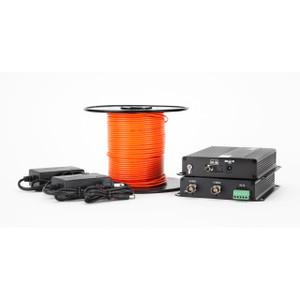
The FVT10 is supplied as a single unit only. Verify the contents against your purchase order; no mounting hardware, fiber adapters, or power cables are included. Plan to source ST fiber patch cables, a 12 VDC regulated power supply, and BNC video cables separately based on your run length and site environment.
Frequently Asked Questions
Q: Can I use the FVT10 with single-mode fiber instead of multimode?
A: No. The FVT10 is optimized for 850 nm multimode only. Single-mode fiber requires different optical components and would not function correctly with this transmitter.
Q: What happens if my fiber run exceeds 4 km?
A: Signal will degrade or drop out entirely. The 14 dB power budget is calculated for 4 km of multimode at 850 nm; longer runs accumulate attenuation loss. If you need to exceed 4 km, consult Comnet for higher-power or regenerated solutions.
Q: Does the FVT10 work with analog DVRs and IP cameras?
A: Yes, if the upstream device outputs composite video (1 Vpk-pk). Analog DVRs and legacy analog cameras are direct matches. IP cameras require an IP-to-composite converter module first.
Q: What's the warranty on the FVT10?
A: Refer to your purchase documentation or contact the supplier directly for warranty terms; they vary by sales channel.
Q: Can I power multiple FVT10 units from one supply?
A: Yes, as long as your 8–15 VDC supply is regulated and rated for the total current (80 mA per unit, plus margin). A 12 VDC 1 A supply can comfortably handle 10+ transmitters.
Q: Is the FVT10 suitable for outdoor mounted equipment boxes?
A: Yes. The −40°C to +75°C operating range and terminal block power input (no exposed connectors) make it suitable for weatherproof boxes, provided you use conduit sealing and appropriate fiber strain relief at the ST connector.
The Comnet FVT10 solves a real problem: extending analog video surveillance beyond 100 meters of copper without active regeneration or power injection hassles. In industrial parks, sprawling manufacturing sites, and multi-building campuses, coax simply isn't economical or practical. The FVT10's 4 km multimode reach with 14 dB power budget gives you margin to tolerate field splices and aging without signal dropout. At 80 mA and 60 dB SNR, this is a no-fuss transmit module that pairs well with legacy analog systems still running on composite video sources.
Technical Highlights:
- Single-Fiber Architecture (850 nm multimode): One ST connector, one fiber strand — versus three or four coax bundles. Cuts conduit count and installation labor, especially valuable when running under roads or through multi-story buildings where each conduit bore is a cost line item.
- 4 km @ 14 dB Power Budget: Multimode tolerates longer distances and rougher field conditions than single-mode. The 14 dB margin accounts for typical connector loss (~0.5 dB per joint) and fiber aging, so a 3.5 km real-world run stays well within spec with room for two or three splices.
- 80 mA @ 12 VDC (typical 1 watt): Negligible power draw. In distributed surveillance across 20–30 remote cameras, you consolidate all transmitter power into one regulated 24 VDC supply. No separate PSU per unit, no voltage drop worries across long control runs.
- 60 dB SNR + <5% Differential Gain/Phase: Clean color and luminance fidelity across the link. If you're transmitting from a PTZ camera or color traffic enforcement system, this SNR ensures plate numbers and uniforms stay sharp and true-color, not washed or hue-shifted by optical noise.
Deployment Considerations:
- You must pair the FVT10 with a corresponding fiber receiver (not included) — verify model compatibility before purchase. Comnet receiver modules for 850 nm multimode are standard, but confirm your receiver's optical specs match the transmitter output.
- Multimode fiber bend radius: keep ≥5 cm to avoid modal dispersion. If you're retrofitting into tight conduit or coiling fiber in equipment boxes, slack loops and strain-relief clamps are non-negotiable — a sharp kink introduces loss and jitter that can drop your SNR below the 60 dB floor.
- Terminal block power connectors need tinned 16–28 AWG leads for reliable contact in vibration-prone environments. Don't rely on bare stranded wire — corrosion and micro-vibration will loosen connections in outdoor junction boxes over months.
The FVT10 excels in industrial campus surveillance and utility SCADA video backhaul where analog video survives, fiber already runs between buildings, and you need minimal power and zero active management. It's not the right fit for new IP camera systems — those travel over Ethernet and don't need dedicated video fiber — but for legacy analog DVR networks extending across a 2–4 km perimeter, this is the workhorse choice.