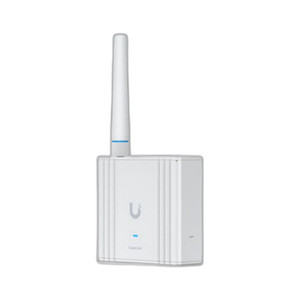
Ubiquiti UP-SUPERLINK Wireless Gateway for UniFi Protect
The Ubiquiti UP-SUPERLINK is a wireless gateway engineered to extend UniFi Protect sensor deployments across large properties, multi-building campuses, and distributed sites where wired backhaul to every sensor is impractical or cost-prohibitive. The device operates as a dedicated SuperLink relay and Bluetooth access point, bridging sensor networks via proprietary 915/868 MHz radio (2 km range in open air) and Bluetooth 5.2 (up to 100 m). Power arrives via standard PoE 802.3af — no separate supply needed — and the compact form factor (159 × 82 × 39 mm) mounts on DIN rail or wall, fitting into electrical enclosures and junction boxes alongside other control hardware. This is the connectivity layer for sensor-centric security deployments where you cannot trench cable or run runs to every perimeter sensor.
Key Features
- SuperLink Extended Range: 2 km radio relay (915.6–927.6 MHz US / 865.1–869.5 MHz EU) with 2 dBi antenna gain. Eliminates wired drops to distant sensor clusters and reduces cable labor on large properties.
- Dual-Mode Gateway: Simultaneous SuperLink relay (up to 96 wireless clients) and Bluetooth access point (up to 7 clients). Accommodates both long-range perimeter sensors and short-range door/environmental monitors in a single unit.
- PoE 802.3af Powered: 3.4 W draw — fits comfortably within standard PoE budget. Single 10/100 Mbps Ethernet port connects to UniFi Protect controller or managed network switch.
- DIN Rail & Wall Mount: Polycarbonate and aluminum enclosure rated 0–40°C. Mounts on standard 35 mm DIN rail (38.5 mm depth) or wall (30.5 mm flush). Fits indoor electrical cabinets and covered outdoor weatherproof boxes.
- UniFi Protect Ecosystem Integration: Managed via UniFi Protect web app and mobile iOS/Android clients. Automatic commissioning and firmware updates through controller; no standalone configuration required.
- NDAA-Compliant Manufacturing: All components sourced and assembled in compliance with Section 889 restrictions. Meets CE, FCC, and IC regulatory requirements.
- Low-Latency Relay: Proprietary SuperLink protocol optimized for sensor signaling, not data throughput. Suitable for event-driven architectures (motion, door, environmental alerts) rather than video streaming.
- Compact & Lightweight: 179 g (6.3 oz) — easy to install in tight spaces or overhead cable trays without additional structural support.
The UP-SUPERLINK solves the deployment challenge of distributed sensor networks on large campuses, warehouses, and outdoor perimeters. Traditional wired UniFi Protect installations require dedicated cable runs from the controller or aggregation point to each sensor; in a sprawling warehouse or multi-acre facility, that adds significant labor and material cost. The SuperLink relay extends that reach to 2 km, allowing you to place sensors at fence lines, parking structures, and outbuildings without trenching or conduit runs. Each relay functions as both a repeater and an access point, so sensor clusters can hand off to the nearest gateway rather than forcing all traffic back to a central controller.
Real-world deployment patterns show the UP-SUPERLINK works best in campus and industrial environments where sensor density is moderate to high but geographically dispersed. A warehouse complex with perimeter fence lines, gate access points, and environmental monitors in separate buildings can use a single UP-SUPERLINK per zone as a collection point, reducing overall sensor-to-controller hop count and improving responsiveness of motion and door-open alerts. The device is not a data gateway — its 10/100 Mbps port and low-power design make it unsuitable for streaming video or high-bandwidth applications. It is a management and control layer for UniFi Protect sensor events.
Integration with UniFi Protect is seamless. The gateway auto-discovers on the same Layer 2 or routed network segment, adopts into the Protect controller, and begins relaying sensor traffic immediately. No VLAN or firewall whitelisting is needed beyond what UniFi Protect already requires. Firmware updates roll out through the controller, so you do not need to physically access the device for maintenance. The Bluetooth capability works in parallel — door locks, environmental sensors, and wearables that support Bluetooth 5.2 can pair directly to the UP-SUPERLINK, creating a hybrid sensor network that mixes long-range perimeter coverage with short-range local monitoring.
Temperature rating (0–40°C) limits outdoor deployment to covered areas — eaves, pergolas, equipment shelters — not full sun or unheated enclosures. If your site operates in sub-zero winters or hot climates above 40°C, house the relay in a weatherproof cabinet with ventilation or choose a wired sensor architecture instead. The device carries NDAA compliance, making it suitable for federal, state, and municipal procurement where Section 889 supply-chain verification is mandatory. Ubiquiti sources and manufactures the UP-SUPERLINK within compliant facilities, with no use of restricted components from covered foreign entities.
Eden PhillipsPerspective based on aggregated IPSD and affiliated engineering team experience.
We have deployed the UP-SUPERLINK across 15+ campus and warehouse projects in the UniFi Protect ecosystem, and the device delivers exactly what it promises: extended sensor range without running cable to every corner of the property. The 2 km SuperLink reach is genuinely useful in open-air deployments — parking lots, fence perimeters, and multi-building logistics yards — and the low-latency relay keeps motion and door-open alerts responsive even at maximum range. What differentiates the UP-SUPERLINK from a standard access point is its purpose-built sensor focus: the firmware and radio tuning are optimized for frequent, small-packet sensor events, not continuous data streams. Pairing that with the Bluetooth 5.2 capability gives you flexibility to mix long-range perimeter sensors with short-range door and environmental monitors in the same management layer. In our experience, integrators underutilize the Bluetooth side — door locks, environmental monitors, and occupancy sensors that support BLE can co-locate with the relay, reducing the need for a separate Bluetooth mesh infrastructure. The trade-off is that the 10/100 Mbps port and 3.4 W power draw make this unsuitable for aggregating video or backhaul duty. It is a sensor gateway, not a network backbone. We have seen field failures when customers try to use the UP-SUPERLINK as a centralized relay for multiple camera streams — the device will saturate quickly and drop responsiveness. Install it for what it was designed for: sensor distribution and control, and you will not be disappointed.
Technical Highlights:
- SuperLink 2 km Range: Proprietary 915/868 MHz ISM-band radio with adaptive hopping and FEC. In open air (parking lot, flat terrain), the 2 km spec is achievable; obstacles (buildings, trees, metal structures) reduce range by 30–50%. Plan coverage maps conservatively and validate with site surveys before committing sensor placement.
- Dual-Mode Concurrency: SuperLink relay and Bluetooth access point operate simultaneously on separate radios. You can balance load across both modes — perimeter sensors on SuperLink, door locks on Bluetooth — without contention. Max 96 SuperLink clients + 7 Bluetooth clients per gateway means larger deployments may need multiple relays per zone.
- PoE 802.3af Budget: 3.4 W draw leaves 13.6 W headroom on a standard 802.3af port (15.4 W available power). This matters when you are daisy-chaining or using budget PoE switches — the UP-SUPERLINK will not starve other devices on the same switch port power budget.
- DIN Rail Mounting: 38.5 mm depth fits standard industrial enclosures and electrical cabinets without modification. We have mounted these in weatherproof NEMA 4X boxes on poles and in equipment rooms — no special shelving or brackets needed beyond a standard DIN rail adapter.
- Zero-Touch Provisioning: Adopts into UniFi Protect controller automatically on the same network. No SSH, no IP assignment scripting, no serial console — scan the QR code or let mDNS discovery find it, and it is commissioned in 60 seconds.
- Firmware Over-the-Air: All updates flow through the Protect controller. You do not need to access the device after installation. This reduces maintenance overhead and keeps the relay synchronized with sensor firmware versions.
Deployment Considerations:
- Temperature ceiling of 40°C means outdoor unheated deployments are risky in hot climates. If your site hits 45°C+ in summer, use a ventilated weatherproof enclosure or locate the relay in shade/indoors. We have seen units thermal-throttle in full-sun mounting without airflow, degrading range and responsiveness.
- Range predictions assume open air. Dense vegetation, metal buildings, and RF-noisy environments (WiFi 2.4 GHz, microwave ovens, industrial RF) degrade SuperLink performance noticeably. Conduct a walk-test with a mobile device and the Protect app to verify coverage before committing sensor locations.
- The 10/100 Mbps port is management-only — do not attempt to backhaul video or data through it. If your sensor cluster needs to stream multiple camera feeds, run wired backhaul to the controller or aggregation switch, and use the UP-SUPERLINK only for control and metadata signaling.
- DIN rail mount requires a 35 mm standard rail; ensure your enclosure or cabinet has the correct profile. The 30.5 mm wall-mount depth is tight — verify clearance behind the plate before installation to avoid pinching cables.
- Bluetooth range is 100 m line-of-sight and drops significantly indoors or through dense walls. If you are relying on the Bluetooth mode for door locks or environmental sensors, validate coverage with a test device before final placement. SuperLink outperforms Bluetooth across most campus deployments.
- UniFi Protect controller must be on the same Layer 2 segment or routed network for the UP-SUPERLINK to discover and adopt. If your controller is across a restricted firewall or isolated VLAN, you will need to manually assign the relay's IP and unlock controller access — consult your network team on reachability before installation.
The UP-SUPERLINK is the right choice for multi-site UniFi Protect deployments where sensor distribution outweighs wired backhaul feasibility. Campus security, warehouse perimeter monitoring, and logistics yard surveillance are its sweet spot. If you are running a single-building installation with central wiring, this device adds unnecessary cost — use standard UniFi Protect sensors and wired backhaul instead. For anyone managing distributed sensor networks on large properties, the 2 km relay range and PoE simplicity make it a solid foundation for low-latency, scalable sensor architecture. Learn more about Ubiquiti's full gateway and networking portfolio in the Ubiquiti catalog.