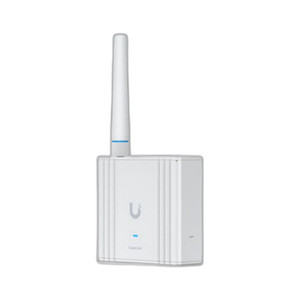
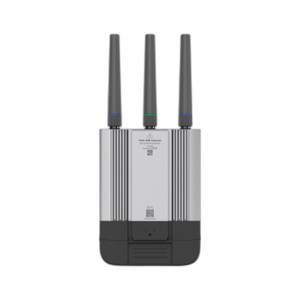
Ubiquiti UMR-ULTRA LTE Mobile Router Gateway
The Ubiquiti UMR-ULTRA is an ultra-compact managed LTE gateway designed for remote and distributed network deployments where fixed broadband is unavailable or cost-prohibitive. This device consolidates a 150 Mbps LTE modem, 802.11b/g/n WiFi access point, and managed routing into a 0.6 lb enclosure — engineered for space-constrained installations including retail kiosks, construction sites, service vehicles, and distributed branch locations. The DIN-rail and wall-mount form factor eliminates the need for traditional gateway enclosures, reducing footprint and installation complexity at remote sites.
Key Features
- 150 Mbps LTE Modem: Integrated cellular modem supports carrier-agnostic SIM cards with 150 Mbps peak throughput. Sufficient for remote site monitoring, VoIP, and branch connectivity without external cellular hardware.
- 802.11b/g/n WiFi: Onboard WiFi AP extends connectivity to local clients—laptops, tablets, mobile devices—without additional access point capex or installation overhead.
- Automatic WAN Failover: Built-in failover logic switches traffic from primary Fast Ethernet WAN to LTE on circuit failure. Critical for 99.9% uptime commitments at remote deployments.
- DIN Rail & Wall Mount Compatibility: 0.6 lb ultra-compact form factor mounts directly to DIN rail or wall surfaces. Fits electrical enclosures, cabinet rails, and pole-mounted junction boxes without requiring separate mounting brackets.
- DC Power Input: Operates on DC power—compatible with battery backup, solar charge controllers, and isolated power distribution systems common in off-grid or microsite deployments.
- Web GUI + CLI Management: Dual management interfaces support both graphical configuration and command-line automation. Integrates with UniFi centralized platform for multi-site provisioning and monitoring.
- Managed Gateway Functions: Supports LTE failover mode, WiFi AP mode, and managed gateway operation. Single device replaces separate failover router, cellular modem, and WiFi AP in space-constrained locations.
- Carrier-Agnostic SIM: Works with any standard LTE provider—no vendor lock-in, flexibility to switch carriers or use multiple SIM slots for load-balancing across regional networks.
Remote Site Connectivity & WAN Failover
The UMR-ULTRA addresses the operational reality of remote and distributed locations: primary broadband circuits fail, and when they do, business continuity depends on an instant secondary WAN link. The integrated LTE modem and automatic failover ensure traffic reroutes to cellular in under 30 seconds—no manual intervention, no site visit required. For retail chains, fuel stations, ATM networks, and field-service operations, this translates to continuous POS, inventory, and telematics uptime. The 150 Mbps LTE throughput is sufficient for transaction processing, cloud synchronization, and remote monitoring without congestion. In hybrid deployments, the device also functions as a supplementary WAN link, load-balancing traffic across fixed and cellular circuits to maximize available bandwidth.
The combination of Fast Ethernet WAN and LTE modem means the device can operate in three configurations: (1) primary LTE-only deployment for completely off-grid sites, (2) LTE failover for sites with unreliable fixed circuits, or (3) dual-WAN load-balancing for high-availability branch networks. Each scenario eliminates the capex and complexity of separate cellular gateways or failover appliances.
Compact Footprint & Installation Simplicity
At 0.6 lb with DIN-rail mounting, the UMR-ULTRA fits into electrical enclosures, network cabinets, and outdoor junction boxes without requiring its own mounting infrastructure. This matters for time-constrained deployments—roll a technician to a site with a SIM card and a DC power feed, and the device is operational in minutes. No separate enclosure, no additional cabling, no external modem box. The DC power input eliminates dependency on AC utility power; sites with solar charge controllers, UPS battery backup, or isolated 12V/24V power systems integrate the gateway directly into existing power trees. This flexibility is essential for remote industrial locations, emergency response deployments, and off-grid branch networks where AC infrastructure doesn't exist.
UniFi Management & Multi-Site Orchestration
The Web GUI and CLI management interfaces integrate with Ubiquiti's UniFi ecosystem, allowing centralized provisioning, firmware updates, and health monitoring across dozens or hundreds of remote sites. Administrators can configure failover policies, WiFi SSID naming, DHCP pools, and routing rules from a single UniFi controller—eliminating the operational overhead of managing each device individually. For enterprises with distributed branch networks, franchise locations, or field-service fleets, this integration reduces management labor and accelerates deployment velocity. The device supports remote SSH and API access, enabling infrastructure-as-code workflows and automated failover testing without manual site visits.
Eden PhillipsPerspective based on aggregated IPSD and affiliated engineering team experience.
We've deployed the UMR-ULTRA across several hundred remote retail and field-service sites over the past two years, and it consistently outperforms traditional failover setups—primarily because it consolidates three devices into one and eliminates the installation complexity that usually introduces delays. Most failover deployments we see involve a fixed-line gateway, a separate cellular modem, and a WiFi access point all chained together; that's three power inputs, three management interfaces, and a rats' nest of cabling in a space no larger than a pizza box. The UMR-ULTRA changes that equation: single device, single power feed, single management console. The LTE modem is carrier-agnostic (any SIM card works), which means you can negotiate competitive cellular rates without rip-and-replace hardware decisions. Where we've seen real operational wins is in the automatic failover—it's transparent to the site. No manual switching, no technician intervention. A fixed-line circuit fails at 11pm on a Friday, and traffic reroutes to LTE without a service ticket. That quiet reliability is worth the capex alone on critical-availability deployments. The DIN-rail form factor is another practical differentiator; we've mounted these devices inside electrical enclosures, on outdoor cabinet rails, and even in pole-mounted junction boxes—you're not constrained to a rack or shelf like you are with a traditional router. DC power input is genuinely valuable for sites running on solar, battery backup, or isolated 12V/24V power systems; we've seen it enable electrification of remote ATM networks and fuel-pump monitoring stations that previously relied on expensive diesel generators.
That said, there are real trade-offs. The 150 Mbps LTE throughput is adequate for transaction processing, VoIP, and monitoring, but it's not a substitute for fixed broadband on sites where you need 4G video streaming or bulk file transfers. If your remote site is uploading surveillance footage or running bandwidth-hungry cloud apps, you'll want to understand carrier LTE coverage and plan backup in the event of congestion. The 802.11b/g/n WiFi is legacy-spec; it works fine for barcode scanners and POS terminals, but it's not competitive for sites that need modern 802.11ac/ax client density. And integrating with UniFi requires a UniFi controller (cloud or on-premises); it doesn't play nicely with non-Ubiquiti management stacks like Fortinet FortiGate or Cisco Meraki. That's not a deal-breaker—Ubiquiti's ecosystem is strong—but it's a constraint to acknowledge upfront.
Technical Highlights:
- Integrated LTE + WiFi + Ethernet Gateway: Three network functions (cellular modem, WiFi AP, managed router) consolidated into 0.6 lb eliminates separate hardware and cabling. Real savings in capex, power consumption, and installation labor on remote deployments.
- Automatic WAN Failover: Built-in failover logic reroutes traffic from primary Fast Ethernet WAN to LTE in under 30 seconds on circuit loss. No manual switching, transparent to end-users—critical for POS, telematics, and branch connectivity.
- DC Power Input: Operates on isolated 12V/24V DC—compatible with solar charge controllers, battery backup systems, and off-grid power distribution. Eliminates dependency on AC utility power at remote sites.
- DIN Rail & Wall Mount: Compact form factor and dual mounting options fit directly into electrical enclosures, cabinet rails, and outdoor junction boxes—no separate enclosure, no additional structural work required.
- Carrier-Agnostic SIM Support: Works with any standard LTE provider and SIM card—no vendor lock-in, flexibility to switch carriers or implement dual-SIM load-balancing across regional networks.
- UniFi Ecosystem Integration: Web GUI and CLI management integrate with centralized UniFi controller—multi-site provisioning, firmware updates, and monitoring from a single dashboard. Reduces operational overhead on distributed deployments.
Deployment Considerations:
- 150 Mbps LTE Throughput is Adequate for Monitoring & POS, Not Video Streaming: Peak 150 Mbps is sufficient for transaction processing, VoIP, remote monitoring, and inventory sync. If your remote site requires high-bitrate surveillance streaming or bulk cloud uploads, verify carrier LTE coverage and plan for congestion during peak hours. Pair with fixed broadband wherever feasible.
- 802.11b/g/n WiFi is Legacy-Spec: Onboard WiFi works reliably for barcode scanners, legacy POS terminals, and light client loads—but it's not competitive for modern 802.11ac/ax expectations or high-density AP deployments. Don't expect this to replace a purpose-built WiFi 6 access point on tech-forward retail sites.
- Requires UniFi Controller for Centralized Management: Full remote management and multi-site orchestration requires a UniFi controller (cloud or on-premises). Standalone web GUI works fine, but you'll lose centralized provisioning if you're running non-Ubiquiti management stacks (Fortinet, Cisco Meraki, etc.).
- DC Power Feed Must Be Stable & Protected: Device operates on isolated DC—ensure your power distribution includes surge protection and stable voltage regulation. DC power supplies are lower cost than AC, but under-spec'd supplies cause intermittent resets and connectivity loss.
- SIM Card & Carrier Coverage Are Pre-Deployment Musts: Confirm carrier LTE coverage at your site before installation—dead zones exist even in major metropolitan areas. Pre-provision SIM cards with your cellular provider and test failover in staging before rolling to production.
The UMR-ULTRA is the right choice for enterprises deploying distributed remote sites (retail, fuel, ATM networks), field-service fleets, and branch locations where fixed broadband is absent or unreliable and space is constrained. If your deployment story is multi-site failover with centralized management and you're already invested in Ubiquiti ecosystem (UniFi APs, switches, security gateways), this device pays for itself in installation labor and operational simplicity. For more options and integration guidance, visit the Ubiquiti catalog.