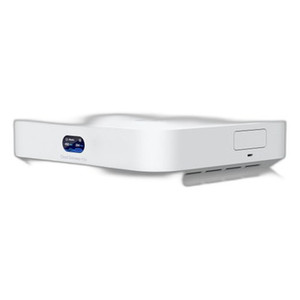
Ubiquiti UCK-G2-SSD UniFi Cloud Key Console
Overview
The Ubiquiti UCK-G2-SSD is a compact, PoE-powered management appliance designed as the central control point for distributed UniFi network deployments. Unlike cloud-dependent or virtualized alternatives, this device consolidates configuration, monitoring, and orchestration across multiple sites into a single on-premises appliance, eliminating external cloud dependencies while maintaining a minimal physical footprint. The UCK-G2-SSD integrates directly into your existing Ethernet infrastructure via a single GbE port and operates entirely on Power over Ethernet (PoE) — no separate power supply, no additional electrical runs required.
Key Features
- Octa-core Arm Cortex-A53 processor with 32 GB eMMC storage: Sufficient compute headroom for mid-to-large scale UniFi deployments (typically 5–15 distributed sites). The fixed 32 GB capacity means you must size retention policies and site count upfront; no field expansion is possible, so validate your monitoring volume before deployment.
- Single GbE RJ45 connectivity: Requires only one network port on your management VLAN or core layer — no port aggregation or special segmentation needed. Simplifies network design in branch offices or co-location facilities.
- Power over Ethernet (802.3af PoE): Draws 9.6W maximum, so a standard 802.3af PoE port or injector handles the load without straining your switch's power budget. Eliminates on-site electrical infrastructure entirely — meaningful in leased spaces or branch locations where power availability is constrained.
- Anodized aluminum enclosure, 0 to 35°C operating range: Durable for indoor and climate-controlled outdoor deployments (network closets, small shelves, adjacent to switching infrastructure). The compact 131.2 x 27.1 x 134.2 mm footprint (560 grams) fits tight spaces; temperature limits rule out uncontrolled outdoor or extreme environments.
- NDAA Section 889 compliance with CE, FCC, IC, and regional certifications: Clears procurement hurdles in regulated enterprise and government environments. Anatel registration (05196-25-08356) and SRRC certification support deployment in jurisdictions requiring local validation.
- Web-based management console: Accessible from any endpoint on the management network; no proprietary client software required. Configuration is straightforward but non-reversible — back up policies before changes.
Integration & Deployment Considerations
This appliance works best when your organization operates multiple UniFi sites requiring synchronized configuration and unified monitoring. Typical scenarios include multi-site WiFi networks, hybrid wired-wireless campuses, or distributed access point and switching environments where policy consistency and centralized visibility are non-negotiable. Deploy on a dedicated PoE-capable port; ensure airflow around the aluminum enclosure and confirm operating temperatures stay within 0–35°C limits. The fixed 32 GB eMMC means archival or external logging should be planned if retention periods exceed available onboard capacity.
For detailed planning around IP camera and network device integration, or guidance on network infrastructure and PoE architecture, review deployment resources specific to your site count and monitoring volume.
When to Choose a Different Model
If you need higher compute capacity, built-in redundancy, or expandable storage for larger deployments (16+ sites), consider higher-tier models in the Ubiquiti console family. If your organization relies heavily on cloud-hosted management, this device may conflict with your operational model — evaluate whether on-premises control aligns with your architecture. For single-site or very small deployments, a dedicated controller appliance may be overkill; evaluate your monitoring and retention requirements before committing.
Frequently Asked Questions
Q: Does the UCK-G2-SSD support 32GB of onboard recording storage?
A: No. The 32 GB eMMC is the controller's operating storage, not a dedicated recording medium. It stores UniFi software, configuration, event logs, and monitoring metadata. Recording from UniFi cameras must be directed to an external NVR, dedicated recording appliance, or cloud service depending on your camera model and licensing.
Q: Can I connect multiple Ethernet ports or use PoE in/out for daisy-chaining?
A: No. The UCK-G2-SSD has a single GbE RJ45 port for management connectivity and draws power exclusively via PoE on that same port. No expansion or pass-through power capability.
Q: What is the maximum number of UniFi sites this appliance can manage?
A: Ubiquiti does not publish a hard ceiling in the datasheet, but the compute and storage profile supports approximately 5–15 distributed sites comfortably. Very large deployments (20+ sites) or those with heavy continuous monitoring may exceed practical capacity. Validate your specific site count and retention policy with a pre-sales engineer.
Q: Is the UCK-G2-SSD NDAA Section 889 compliant?
A: Yes. The device carries NDAA compliance and holds CE, FCC, IC, and regional certifications, supporting deployment in regulated government and enterprise procurement environments.
Q: Can the 32 GB eMMC be upgraded or replaced in the field?
A: No. The eMMC is soldered and not user-replaceable. Capacity is fixed at 32 GB; plan your site count and retention policies accordingly during initial deployment planning.
Q: What happens if the UCK-G2-SSD loses power?
A: The device will shut down. UniFi network devices (APs, switches, cameras) will continue operating if they remain PoE-powered independently; however, centralized management and monitoring through the console will be unavailable until the appliance restarts. For mission-critical deployments, evaluate redundancy options or UPS protection for the PoE circuit.
Ted PerryPerspective based on aggregated and affiliated engineering team experience.
The UCK-G2-SSD UCK-G2-SSD is a purpose-built on-premises controller for organizations that want centralized UniFi management without the overhead of virtualization, external cloud dependencies, or dedicated server hardware. The PoE-only design is deliberate — it eliminates power distribution complexity in branch deployments and keeps the device electrically invisible to local electrical infrastructure, which matters when you're deploying to leased spaces or co-location facilities where power availability is tight.
Technical Highlights:
- 9.6W PoE draw (802.3af): A single standard PoE port on any managed switch powers the entire appliance. No external injectors, no power budgeting against UPS capacity — you just plug it in next to your core switch and it runs.
- 32 GB eMMC fixed capacity: Non-upgradeable storage means upfront capacity planning is non-negotiable. For 5–10 distributed sites with standard event logging and monitoring metadata, 32 GB is comfortable. At 15 sites or with aggressive retention, you'll start bumping limits — external logging or archival should be designed in from day one.
- Octa-core Arm Cortex-A53 processor: Sufficient for multi-site UniFi deployments where you're synchronizing firewall rules, VLAN assignments, and WiFi configurations across distributed access points and switches. Not a high-throughput data processor — it's a management and policy engine.
- 0–35°C operating range: Indoor and climate-controlled outdoor only (network closets, cabinet-adjacent shelves). Unheated warehouses or outdoor equipment cabinets push beyond this envelope. Plan site placement accordingly.
Deployment Considerations:
- The single GbE port means this appliance sits on your management VLAN or core switching layer — no segmentation tricks, no port aggregation. Network design is straightforward, but any congestion on that single link affects management responsiveness across all connected sites.
- NDAA compliance is built in, so government and regulated procurement environments clear without surprise rework. CE, FCC, IC, and Anatel certifications mean regional deployment is vetted.
- Storage is the gotcha: 32 GB is final. If your organization grows from 5 sites to 20 sites after deployment, you'll hit capacity limits and face an appliance swap. Validate site growth projections and retention policies before ordering.
- Web-based console is browser-native — no client software licensing — but configuration changes are not reversible via the UI alone. Backup your configuration regularly, especially before bulk changes across multiple sites.
Best fit: multi-site organizations (5–15 distributed locations) running all-UniFi infrastructure where centralized policy enforcement and synchronized monitoring are mandatory, and where cloud-based or virtualized management conflicts with operational or procurement requirements. If you're managing fewer than five sites, this appliance is overkill. If you're scaling beyond 15 sites, evaluate higher-tier controllers in the Ubiquiti line.