Ubiquiti UCG-FIBER UniFi Cloud Gateway
Overview
The Ubiquiti UCG-FIBER (often searched as UCG FIBER) is a compact, high-performance UniFi Cloud Gateway built for enterprise and mid-market branch offices that need centralized network management, threat defense, and high-speed WAN connectivity without enterprise datacenter overhead. This desktop appliance delivers 10G fiber uplink capacity alongside four 2.5GbE local ports, making it practical for organizations scaling access networks to multi-gigabit speeds while maintaining a small footprint. The UCG-FIBER runs a quad-core ARM Cortex-A73 processor at 2.2 GHz, delivering the throughput and decision-making capacity needed for routing, threat detection, and UniFi device management across distributed sites.
Key Features
- 10G Fiber Uplink: Accepts both multimode and single-mode optics (via compatible transceivers), enabling direct peering with core network switches or carrier uplinks. Real benefit: eliminates copper bottlenecks on high-speed WANs — meaningful if you're pulling 5+ Gbps sustained traffic from branch to datacenter or across multi-site clusters.
- Four 2.5GbE Copper Ports: Each delivers 2.5 Gbps to local UniFi Switches, access points, and edge devices. Avoids the cost and complexity of full 10G distribution while supporting modern WiFi 6E and WiFi 7 access points that saturate gigabit links.
- PoE Power Output on Local Ports: Intelligent power budget allocation via the UniFi controller lets you run UniFi access points and IP cameras directly from the UCG-FIBER without separate PoE injectors. Reduces cable runs and simplifies remote office deployments where rack space is tight.
- 29.4W Typical Power Draw (excluding PoE output): Runs on a single 54V DC/1.1A universal input power supply (100–240V AC). Low power envelope means no dedicated cooling required and minimal operating cost, even in always-on edge or co-location facilities.
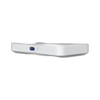
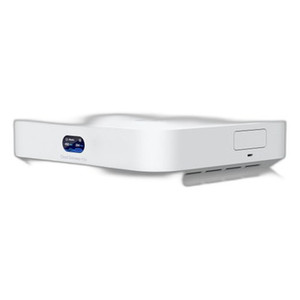
- Compact Desktop Form Factor: Measures 212.8 x 127.6 x 30 mm and weighs 675 grams. Fits on a shelf, in a small cabinet, or mounted vertically in constrained rack space — practical for remote offices, co-location cages, and branch closets where traditional controller appliances would be oversized.
- NDAA Section 889 Compliance & Global Certifications: Holds CE, FCC, IC, SRRC, and Anatel certifications (04395-25-08356). NDAA compliance matters for government and regulated sector contracts — eliminates a procurement hurdle for federal, state, and defense-adjacent deployments.
- ESD Protection & Operating Range: Rated ±8kV air / ±4kV contact ESD, operating 0–40°C ambient. Handles standard office and modest datacenters without climate extremes, but skip this if you need sub-zero or above-40°C tolerance.
- Ethernet-Only Management: No serial console or auxiliary ports required. Management happens exclusively via Ethernet, simplifying headless deployment and reducing physical attack surface in untrusted network edges.
Integration with Ubiquiti Ecosystem
The UCG-FIBER integrates as a regional security gateway and UniFi controller within the Ubiquiti UniFi ecosystem. It consolidates routing, threat detection, and device management for UniFi Switches, access points, and IP cameras across a single or multi-site deployment. The fiber uplink pairs cleanly with Ubiquiti's high-speed switch line for core network peering, and the 2.5GbE ports support both wired access point distribution and PoE-powered camera networks. Configuration and monitoring occur through the standard UniFi controller interface — no proprietary management learning curve.
Deployment Scenarios
Install the UCG-FIBER in campus branch offices where you need a local gateway without full enterprise controller hardware, multi-site service provider networks requiring fiber uplink redundancy, and remote edge compute environments where co-location or ruggedized facilities have fiber but limited rack depth. It works well as a regional security appliance in healthcare, manufacturing, or finance networks where threat detection and policy enforcement happen at the branch rather than solely at the core.
Installation & Setup
Installation requires a single 54V DC/1.1A power supply and one Ethernet management cable. Mount horizontally on a shelf or vertically in a small rack using integrated mounting provisions. No additional cooling is needed within the 0–40°C operating range. Power consumption (29.4W excluding PoE) means standard office outlets or small UPS systems can sustain the unit during brief outages.
Frequently Asked Questions
Q: Is the UCG-FIBER suitable for small office/home office (SOHO) deployments?
A: The UCG-FIBER is designed for mid-market and enterprise branch offices requiring centralized UniFi management and fiber uplink capacity. It is not positioned as a SOHO gateway; for smaller deployments, consider UniFi's Dream Machine or Dream Machine SE variants, which include built-in WiFi and simpler feature sets.
Q: What fiber transceiver types does the UCG-FIBER support?
A: The 10G fiber port accommodates both multimode (MM) and single-mode (SM) optics via compatible SFP+ transceivers. Verify transceiver compatibility with your carrier or core switch vendor before purchasing; Ubiquiti does not supply transceivers in the box.
Q: Can the UCG-FIBER run without an external controller or cloud connection?
A: Yes. The UCG-FIBER can operate as a standalone UniFi controller for local networks. It does not require cloud connectivity to manage local UniFi infrastructure; however, cloud adoption enables remote site management and centralized visibility across multiple branch gateways.
Q: What is the maximum PoE power budget available on the four 2.5GbE ports?
A: Exact per-port and total PoE budgets are not specified in the available documentation. Consult the UCG-FIBER datasheet or contact Ubiquiti pre-sales engineering to confirm power allocation if you plan to connect multiple high-power PoE cameras or access points.
Q: Does the UCG-FIBER support threat detection or DPI (Deep Packet Inspection)?
A: The UCG-FIBER is described as providing "threat defense" and serves as a "security gateway," but specific DPI engines, IDS/IPS capabilities, or threat intelligence integrations are not detailed in the current specification. Confirm feature set with Ubiquiti documentation or your reseller if advanced threat detection is a deployment requirement.
Q: Is the UCG-FIBER FIPS 140-2 certified or suitable for cryptographic workloads?
A: FIPS 140-2 certification is not mentioned in the available specifications. If FIPS compliance is a regulatory requirement, verify directly with Ubiquiti before proceeding.
Ted PerryPerspective based on aggregated IP Security Depot and affiliated engineering team experience.
The UCG-FIBER fills a genuine gap in the Ubiquiti lineup: organizations needing high-speed fiber uplink connectivity and centralized UniFi management at branch sites without paying for full enterprise controller overhead. The combination of 10G fiber uplink and quad-core Cortex-A73 reflects real network topology trends — fiber is increasingly common to the branch edge, but most sites don't need a full UniFi Dream Machine XL or equivalent. The UCG-FIBER (MPN: UCG-FIBER) lets you consolidate gateway and controller functions efficiently.
Technical Highlights:
- 10G Fiber Uplink with Multimode/Single-Mode Flexibility: The ability to accept both MM and SM optics via standard SFP+ transceivers avoids carrier lock-in. If your colocation facility or campus backbone uses SM fiber (99% of carrier uplinks), you're not forced to regenerate to MM.
- Four 2.5GbE Ports with PoE Output: 2.5 Gbps is the practical sweet spot for distribution — modern WiFi 6E access points and managed switches saturate gigabit links, but full 10G to every endpoint is wasteful. PoE output on these ports eliminates extra injectors in cramped branch closets.
- 29.4W Operational Power (excluding PoE): Roughly equivalent to a laptop's power draw. This matters for remote offices on battery backup or co-location facilities billing by watt-hour. A 500W UPS will keep the UCG-FIBER and a couple of PoE access points running for 20+ minutes.
- NDAA Section 889 Compliance: Removes procurement friction for federal contracts and regulated sectors. If you're bidding on government or defense-adjacent work, NDAA compliance is non-negotiable; this appliance clears that hurdle upfront.
Deployment Considerations:
- SFP+ Transceiver Procurement: Ubiquiti does not bundle fiber optics. Budget $100–300 per transceiver depending on type and distance; coordinate with your carrier or core network team to confirm specs (wavelength, speed, vendor compatibility).
- PoE Budget Opacity: Total and per-port PoE wattage are not published in the datasheet. If you're planning to power 4–6 high-draw PoE devices (e.g., high-power access points or PTZ cameras), request detailed power allocation from Ubiquiti or your VAR before committing — you may need supplemental PoE injection.
- Controller Role Clarity: The UCG-FIBER acts as a local UniFi controller but is not a replacement for a centralized cloud or site controller in large multi-site deployments. Plan for either cloud adoption or a separate central controller if you need cross-site orchestration, policy inheritance, or unified reporting across 10+ branches.
Deploy the UCG-FIBER in campus branch offices transitioning to multi-gigabit access networks, service provider edge gateways requiring fiber uplink redundancy and threat defense, and co-location environments where compact footprint and low power consumption outweigh the need for full rack-mounted appliance complexity. Skip this if your branch is sub-100 Mbps or if you need full enterprise IDS/IPS with external threat intelligence — those workloads belong on a larger platform.