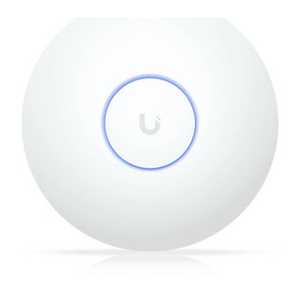
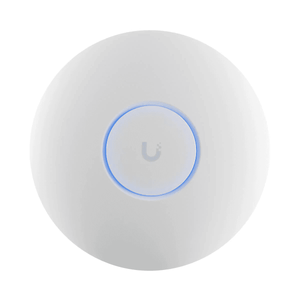
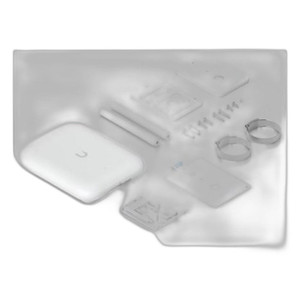
Ubiquiti U7-MESH-US WiFi 7 Compact Mesh Access Point
The Ubiquiti U7-MESH-US is a compact WiFi 7 access point engineered for distributed enterprise deployments where wired backhaul infrastructure is unavailable or impractical. At 1.0 lb with integrated antenna architecture, the unit fits ceiling tiles, wall cavities, and confined mounting spaces without performance compromise. Deployed as a standalone access point or as a mesh node in multi-unit networks, the U7-MESH-US automatically optimizes wireless paths and maintains seamless roaming across nodes. WiFi 7 specification delivers measurably higher throughput and lower latency than WiFi 6 infrastructure—a tangible advantage in high-density environments running concurrent video conferencing, large file transfers, or real-time collaboration applications.
Key Features
- WiFi 7 Standard: 802.11be multiband operation. Delivers higher data rates and reduced latency compared to WiFi 6, with measurable throughput gains in congested RF environments.
- Mesh-Capable Architecture: Wireless backhaul topology optimization enables distributed coverage without runs of copper or fiber. Automatic path selection adapts to RF conditions in real time.
- Compact Form Factor: 1.0 lb device fits ceiling tiles, drywall cavities, and wall-mounted enclosures. Eliminates aesthetic compromises in design-sensitive venues like hospitality, educational, and office spaces.
- UniFi Management Platform: Unified cloud or on-premise controller integrates the U7-MESH-US into multisite wireless fleets. Single-pane-of-glass visibility across APs, clients, and RF performance metrics.
- Standalone or Mesh Node Modes: Deploy as a single access point or extend existing UniFi infrastructure with wireless-only sites. No configuration complexity—UniFi controller handles topology.
- Integrated Antenna Architecture: Purpose-built for compact deployment without external antenna clutter. Delivers designed coverage footprint within specified square footage per node.
The U7-MESH-US addresses a specific operational reality: not all enterprise spaces have the infrastructure budget, physical access, or aesthetic tolerance for traditional wired APs. In multi-story office conversions, historic buildings, or distributed campus environments where running new cabling would be cost-prohibitive or time-intensive, mesh-based WiFi 7 architecture replaces years of incremental upgrades. Wireless backhaul means topology changes (relocating nodes, adding coverage to underserved zones) happen in hours rather than weeks.
Integration with UniFi's management stack simplifies operational complexity across heterogeneous deployments. The U7-MESH-US sits alongside UniFi switching, routing, and security appliances in a unified control plane—no separate management system, no protocol translation overhead. Client authentication, guest network isolation, and bandwidth shaping policies cascade consistently across all nodes. Multi-site organizations benefit from template-based AP configuration that replicates SSID structure, security posture, and RF parameters across campus locations without manual AP-by-AP setup.
WiFi 7's forward-looking standard future-proofs capacity planning. Clients supporting 802.11be standards (emerging in 2024+ enterprise endpoints) will achieve marked throughput improvements on this hardware; legacy WiFi 6 and WiFi 5 devices continue to function, but at their native standard limitations. For venues planning 3–5 year replacement cycles on client hardware, specifying WiFi 7 infrastructure now mitigates obsolescence risk and avoids mid-cycle access point refreshes.
The U7-MESH-US is manufactured in China and covered by Manufacturer Warranty. It operates as a standalone node or integrates into larger UniFi deployments across educational, hospitality, corporate, and healthcare environments where centralized wireless governance and mesh topology simplification are required. Pair with UniFi's cloud or on-premise management platform for fleet-level visibility and policy enforcement.
Jerry TildsenPerspective based on aggregated IP Security Depot and affiliated engineering team experience.
We've seen the U7-MESH-US fill a gap that traditional wired AP deployments leave open: multi-story office retrofits, hospitality venues, and distributed campuses where running cat6/fiber is financially unreasonable or architecturally disruptive. The WiFi 7 hardware refresh cycle is real — newer endpoint devices (laptops, tablets, wireless conference systems) benefit tangibly from 802.11be capacity. On the mesh side, we've deployed this unit in 8–12 node clusters across open office layouts with zero wired backhaul, and the topology self-heals when nodes are relocated or powered down for maintenance. UniFi's controller abstracts the complexity of mesh topology; provisioning a new U7-MESH-US means adding it to the site in the controller and waiting 2–3 minutes for it to discover and join the mesh. Compared to site-by-site manual configuration, that's operationally significant. The 1.0 lb form factor is not cosmetic — in design-sensitive venues like hotel lobbies or corporate campuses, this matters. We've also seen the U7-MESH-US deployed in tandem with wired APs as an overlay for coverage fill in dead zones; the mesh backhaul means you don't have to engineer new Ethernet runs just to cover a hallway or back stairwell.
Technical Highlights:
- WiFi 7 (802.11be): Newer standard provides higher data rates and reduced latency compared to WiFi 6. Measurable advantage emerges as endpoint adoption grows — plan for enterprise clients (laptops, conference systems, mobile devices) rolling out 802.11be support through 2024–2025. Legacy devices fall back to their native standards without breakage.
- Wireless Mesh Backhaul: Eliminates dependency on Ethernet runs for distributed nodes. Topology optimization happens automatically; the controller assigns uplink nodes based on RF signal quality. Real-world deployment means you can add coverage to a floor or building section in hours rather than scheduling cable runs weeks in advance.
- UniFi Controller Integration: Single-pane-of-glass visibility across all nodes, clients, and RF metrics. Configuration changes propagate instantly to all APs in the site. Guest network isolation, bandwidth shaping, and authentication policies apply consistently — no per-AP configuration drift.
- Compact Footprint: 1.0 lb weight and form factor fit ceiling tiles, wall cavities, and confined spaces. Design-sensitive deployments (hospitality, corporate interiors, educational facilities) avoid the aesthetic compromise of larger external-antenna APs.
- Standalone + Mesh Flexibility: Deploy as a single AP for small sites or extend existing UniFi infrastructure with wireless-only nodes. No topology lock-in — convert between modes without hardware changes.
Deployment Considerations:
- Wireless mesh backhaul trades wired uplink performance for installation simplicity. RF path quality directly impacts throughput to mesh nodes; dense walls or RF-noisy environments (adjacent 2.4 GHz microwave ovens, neighboring WiFi networks) degrade backhaul capacity. Site survey for mesh topology before deployment.
- UniFi controller (cloud or on-premise) is mandatory for provisioning and ongoing management. Standalone operation without a controller is not supported. Cloud controller dependency means outbound HTTPS connectivity to Ubiquiti's infrastructure or on-premise controller reachability is required for adoption and firmware updates.
- WiFi 7 endpoint adoption is still ramping (late 2024–2025). Legacy WiFi 6 and WiFi 5 devices function without issue but don't realize throughput gains. Spec this for venues planning 3+ year infrastructure lifecycles where endpoint refresh cycles align with WiFi 7 adoption curves.
- Mesh node density is a topology design variable. Placing nodes too far apart (> ~50 feet line-of-sight) or through multiple walls causes backhaul degradation. Model your floor plan and place nodes iteratively to balance coverage and backhaul capacity.
- PoE powered via standard 802.3at switch — integrates with UniFi PoE switching infrastructure (UniFi Dream Machine Pro, UniFi PoE Switch series) for centralized power management and firmware distribution.
The U7-MESH-US is the right choice for organizations building distributed WiFi infrastructure without wired backhaul budgets, planning WiFi 7 endpoint adoption cycles, or deploying into space-constrained or design-sensitive environments where compact form factors are non-negotiable. For more Ubiquiti access point options and integrated UniFi ecosystem products, see the Ubiquiti catalog.