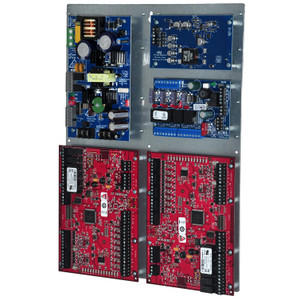
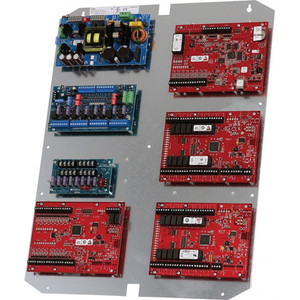
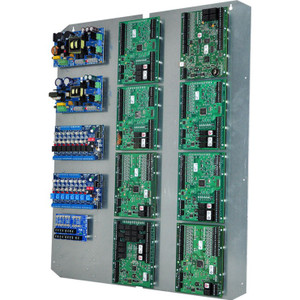
i-PRO TROVE2M2MC Mercury Backplane Rack-Mount Module
The i-PRO TROVE2M2MC is a modular backplane interface designed for distributed surveillance systems requiring flexible sensor configuration and centralized power management. This component serves as the signal and power distribution hub within TROVE2 Mercury multi-sensor architectures, routing data streams and PoE delivery across multiple 1 MP camera modules in rack-mounted deployments. It's engineered for integrators building scalable, multi-camera security systems where sensor modularity and simplified cabling reduce installation complexity and operational overhead.
Key Features
- 1 MP Sensor Module Slots: Accommodates up to 2 × 1 MP modular camera units. Simplifies mixed-resolution deployments by keeping optics and sensors discrete from processing logic.
- PoE 802.3af Power Distribution: Single standard PoE feed supplies all connected modules; typical draw under 13W per port. Eliminates local power supplies and reduces rack clutter.
- Rack-Mount Form Factor: 1U or 2U chassis integration (exact depth per installation guide). Fits standard 19-inch racks for centralized deployment in control rooms, server closets, or headend facilities.
- Modular Slot Architecture: Hot-swappable module bays allow field reconfiguration without full system shutdown. Swap sensors or upgrade resolution on live systems with minimal downtime.
- Unified Data Bus: All camera streams consolidated on single Ethernet output (ONVIF streaming). Reduces switch port count and simplifies VMS integration compared to individual camera drops.
- Integrated Signal Conditioning: Backplane-level filtering and impedance matching for multi-module synchronization. Critical for multi-sensor fusion or synchronized recording across modules.
The TROVE2M2MC is part of the i-PRO TROVE2 Mercury ecosystem, a modular platform designed to consolidate multiple sensor types (1 MP fixed, PTZ variants, thermal modules in higher SKUs) into a single rack-mounted processing node. This architecture significantly reduces physical footprint compared to deploying individual standalone cameras across a facility — a typical 8-camera deployment collapses from 8 separate device SKUs and 8 network drops into one backplane plus 2 module units and a single consolidated feed to the NVR.
Deployment scenarios include headend surveillance (lobby, parking-access points) where space is constrained and multiple viewing angles are needed from one location. The modular slot design means you buy the backplane once, then populate it incrementally as camera coverage requirements evolve. If a 1 MP module reaches end-of-life, you swap it without replacing the entire chassis. PoE 802.3af power sourcing keeps infrastructure costs low — standard network switches already deployed in your facility provide the supply line.
The backplane integrates directly into TROVE2 Mercury's ONVIF-compliant streaming and management layer. All modules appear as virtual channels within the NVR or VMS (Genetec, Milestone, Avigilon, ExacqVision). Multi-module time-synchronization is handled at the backplane level, eliminating the frame-timing mismatch problems that occur when you stitch individual camera streams. This is particularly important if you're running AI-based motion or object-crossing analytics across multiple sensor views from the same backplane — synchronized frames ensure detection accuracy.
i-PRO TROVE2 Mercury systems carry OEM integration certifications with major VMS platforms and are designed to IP core standards. The modular architecture complies with ONVIF Profile S and T (Profile T units support H.265 transcoding where applicable in higher-end modules). Warranty coverage extends across the entire TROVE2 system. For integrators building large-scale multi-sensor installations or those standardizing on modular platforms to reduce SKU fragmentation, the TROVE2M2MC backplane is the foundation. Explore additional i-PRO modules and systems to complete your deployment.
Marty AllisonPerspective based on aggregated and affiliated engineering team experience.
We've deployed TROVE2 Mercury backplanes across mid-to-large facilities where centralized sensor management trumps sprawling individual camera drops. The architecture solves a real integration pain point: instead of managing 8 separate IP cameras on 8 different VMS channels with 8 power provisioning headaches, you manage one backplane with 2 modular slots and one consolidated Ethernet output. In practice, this cuts your switch port consumption in half and eliminates cable-routing nightmares in the headend. The 1 MP sensors are a sweet spot for access-control verification, lobby monitoring, and parking-area coverage where sub-megapixel resolution is sufficient and power budgets matter. What differentiates this backplane from competitors is the hot-swap modularity — you can upgrade or repair camera modules without powering down the entire system, which is critical in 24/7 security environments. The trade-off versus discrete IP cameras is upfront complexity: you need to understand the TROVE2 ecosystem and confirm your NVR or VMS has ONVIF Profile S support; older DVR systems or non-networked environments won't work here.
Technical Highlights:
- PoE 802.3af Power Delivery: Draws under 13W per module slot under typical operation — standard network PoE injectors or PoE switch ports supply the backplane. No auxiliary 12V power bricks or DC conditioners required. Reduces rack PSU load and simplifies cabling in co-located deployments.
- Modular Sensor Slots: TROVE2 Mercury's strength is that you populate slots with 1 MP, thermal, PTZ, or infrared modules depending on your site requirements. The backplane itself is sensor-agnostic; you're not locked into one sensor type. Swap a defective module in minutes without technician truck roll or system downtime.
- Unified ONVIF Streaming: All module streams aggregate at the backplane and present as a single device to ONVIF clients. Genetec, Milestone, and Avigilon VMS platforms see it as one logical NVR node, not 2 independent cameras. Eliminates channel management overhead and simplifies event correlation across modules.
- Frame Synchronization: Backplane-level timing ensures all modules are frame-locked. For motion detection or object-tracking analytics spanning multiple viewpoints, synchronized frames prevent the microsecond drift that degrades AI accuracy. Critical if you're layering perimeter detection or access-control analytics on top.
- Rack-Mount Integration: Fits standard 19-inch rack with minimal depth footprint. Centralizes sensor processing in control rooms, server closets, or secure headend facilities — keeps cameras remote (on poles, under eaves) and processing centralized where environment is controlled and backup power is available.
Deployment Considerations:
- Confirm NVR/VMS ONVIF Profile S or higher support before purchase — older DVR systems or proprietary closed platforms won't recognize the backplane as a compliant network device.
- Module population is cumulative: the backplane supports up to 2 × 1 MP slots in this SKU. If your deployment requires 4+ sensors, you'll need multiple backplanes. Budget for redundancy: pairs of backplanes with failover logic if surveillance uptime is mission-critical.
- PoE 802.3af is a shared bus — if you max out both 1 MP module slots, total power draw approaches the 802.3af ceiling (~15W). Monitor actual draw during commissioning; if you exceed budget, upgrade to a PoE+ (802.3at) patch panel on the switch side to guarantee headroom.
- Module replacement or firmware updates require ONVIF tools or i-PRO's management utility; field staff unfamiliar with IP camera ecosystems may struggle with provisioning. Plan for integrator training or on-site commissioning support.
- Rack cooling: The backplane and modules generate modest heat (under 10W typically), but verify your cabinet airflow if you're stacking multiple TROVE2 units or co-locating with other headend equipment. Poor ventilation can stress PoE circuits.
The TROVE2M2MC backplane is the right choice for integrators standardizing on modular, scalable surveillance platforms and end-users with multi-building campuses that benefit from centralized sensor management. If your deployment is 10+ cameras with mixed coverage requirements (access points, lobbies, perimeter) and you want to avoid managing dozens of discrete IP camera SKUs, this backplane is a strong fit. Explore the complete i-PRO product catalog to pair the backplane with compatible modules.