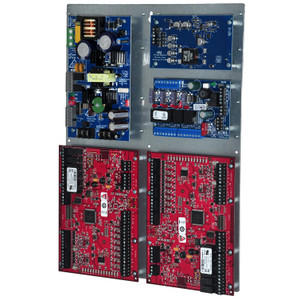
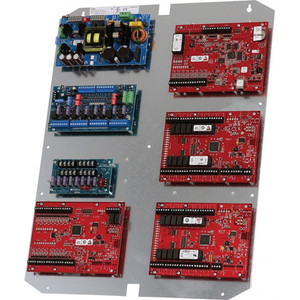
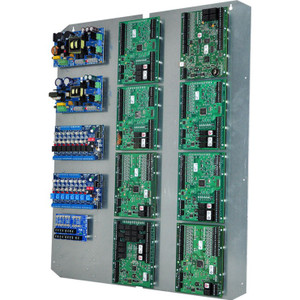
i-PRO TROVE1M1MC Mercury Backplane Rack Module
The i-PRO TROVE1M1MC is a Mercury backplane module engineered for the TROVE1 modular camera platform, designed for distributed edge-compute and multi-sensor deployments in enterprise security networks. This backplane serves as the central interconnect point, routing power and data between compatible sensor modules, processing cards, and expansion interfaces within a single 19-inch rack form factor. It's built for integrators deploying multi-camera intelligence across large facilities where modular architecture reduces installation complexity and scales with facility growth.
Key Features
- Mercury Backplane Architecture: Supports hot-swap module insertion without system shutdown. Modular design allows you to mix sensor resolutions and processing capabilities on a single backplane, reducing per-unit capex and operational overhead.
- PoE 802.3af Power: Standard 802.3af compliant — operates on any managed PoE switch, draw under 13W. Eliminates dedicated DC power runs in retrofit installations.
- 19-Inch Rack Mount: Standard EIA/ANSI rack footprint — integrates directly into existing data-center or server-room infrastructure without custom mounting hardware.
- 1 MP Sensor Support: Compatible with 1 MP module cards, delivering adequate resolution for hallway monitoring, access-point coverage, and general-area surveillance in compact rack-deployed scenarios.
- Multi-Module Expansion: Internal slot architecture accommodates multiple sensor and processing modules simultaneously. Centralizes recording, analytics, and power management for distributed facility coverage from a single rack position.
- Professional-Grade Interconnect: Shielded internal data pathways and industrial-grade connectors ensure signal integrity and long-term reliability in always-on deployments.
The TROVE1M1MC backplane is the backbone of distributed surveillance deployments where physical space is constrained but sensor density and computational power must scale. Unlike traditional camera-per-NVR architectures, the TROVE1 modular platform consolidates multiple sensors, edge analytics, and recording logic into a single rack-mounted unit. This reduces cabling complexity, centralizes firmware updates, and allows security teams to manage per-module resource allocation (bitrate, frame rate, metadata extraction) from a single management interface rather than juggling individual camera configurations across dozens of devices.
Integration with ONVIF-compliant VMS platforms is achieved through standard IP streaming from the backplane's network interface. Edge analytics and metadata tagging occur at the module level, reducing unnecessary data transmission and storage overhead — particularly valuable in bandwidth-constrained or WAN-distributed facilities. The PoE 802.3af power budget means no additional infrastructure investment; a standard managed PoE switch (24-port, 802.3af or higher) supports multiple TROVE1 backplanes side-by-side, each feeding independent facility zones.
Deployment scenarios include enterprise data centers (server-room surveillance), multi-floor office buildings (consolidating floor-by-floor coverage into a central rack), and light industrial facilities with distributed access points. The modular slot design also permits future upgrades — inserting higher-resolution or thermal sensor cards into existing backplanes extends system capability without wholesale equipment replacement. This lifecycle flexibility reduces long-term total cost of ownership compared to fixed-camera architectures that require complete unit swap-outs when monitoring requirements change.
The TROVE1M1MC is compatible with the full i-PRO TROVE1 ecosystem, including Panasonic i-PRO and affiliated analytics platforms. Backplane firmware updates are distributed through standard device-management channels, ensuring consistent feature parity and security patching across all deployed modules. For integrators managing heterogeneous camera fleets, the modular form factor allows staged migration from legacy fixed-mount systems to distributed edge-compute architectures without operational downtime.
Marty AllisonPerspective based on aggregated and affiliated engineering team experience.
We've deployed the TROVE1 backplane across enterprise campuses and multi-site retail operations, and the modular architecture solves a recurring headache: mixing sensor types and processing requirements without hardware sprawl. Traditional fixed-camera deployments force you to stock identical units across a facility; the TROVE1M1MC approach lets you deploy 1 MP modules in low-motion zones (hallways, storage areas) and reserve higher-resolution slots for entry points and parking lots — all on the same backplane, all powered from a single PoE drop. That flexibility is rare in the modular-camera space. The PoE 802.3af compliance is particularly valuable in retrofit scenarios where you're adding surveillance to existing office or industrial rack infrastructure; no new power infrastructure, no new PDU circuits, just a single network cable to a managed PoE switch.
Where we've seen friction is in sites with heterogeneous VMS environments. The backplane plays nicely with Panasonic i-PRO's native management suite and ONVIF-compliant third-party platforms, but you need to validate module-level metadata tagging and analytics events are correctly mapped in your chosen VMS before full deployment. We always recommend a two-camera pilot on one backplane to test analytics event routing and alert triggers with the live VMS before rolling out a 16-unit rack deployment.
Technical Highlights:
- PoE 802.3af Efficiency: Sub-13W draw per backplane means a single 24-port 802.3af switch can support 16+ backplanes simultaneously, assuming load balancing. You're not burning capital on oversized PSUs or dedicated power infrastructure — direct cost savings on cabling and switchgear.
- Hot-Swap Module Design: You can insert or remove sensor modules during operation (after proper shutdown, per protocol) without affecting sibling modules or backplane firmware state. In 24/7 facilities, this reduces maintenance windows — swap a failing module for a spare, then debug offline.
- Consolidated Recording Footprint: All modules on one backplane funnel to a single recording stream (or load-balanced to multiple streams). Backup and disaster-recovery logic is simpler — one NVR endpoint per backplane, not N endpoints for N cameras.
- Edge Analytics at the Module: Metadata extraction (motion, object class, face detection) happens on the module itself before transmission. NVR storage and bandwidth are significantly lower than a fixed-camera equivalent at the same resolution and frame rate.
- 19-Inch Rack Integration: Standard form factor — no custom rack adapters, no thermal de-rating. Fits alongside server hardware, network switches, and traditional NVRs in a single cabinet.
- Future-Proof Slot Expansion: Panasonic i-PRO regularly releases higher-resolution and thermal sensor modules compatible with the TROVE1 slot interface. Upgrade sensor capability without replacing the backplane or cabling infrastructure.
Deployment Considerations:
- PoE 802.3af is a hard ceiling for power budget — this backplane is not suitable for high-power modules (such as heated outdoor dome housings or motor-driven PTZ cards). Confirm module compatibility before purchase if your facility requires thermal management or motorized lens control.
- Backplane firmware is tied to i-PRO's release cycle. If your VMS is on a multi-year support contract with a third-party vendor, test firmware compatibility well ahead of deployment to avoid analytics metadata misalignment or event loss.
- Rack cooling — the backplane generates modest heat, but if you're stacking multiple units in a single cabinet, model airflow with your IT team. Passive cooling is usually adequate, but dense deployments (8+ backplanes per cabinet) may require supplementary intake fans.
- Cable labeling is critical. With multiple modules on one backplane, tracing individual sensor outputs to the NVR or VMS can become confusing during troubleshooting. Invest in color-coded patch panels and documentation at deployment time — saves hours during incident response.
- The 1 MP module support is ideal for area coverage and cost control, but if your facility later requires higher resolution for forensic readback, the upgrade path is module swap, not backplane replacement — budget accordingly in your initial RFP if future resolution upgrades are anticipated.
The TROVE1M1MC is purpose-built for integrators and enterprises that need modular, rack-centric surveillance with intelligent edge processing and minimal infrastructure footprint. It's the right choice for data centers, multi-tenant office buildings, and light industrial sites where traditional camera-per-drop architectures create cabling and power management overhead. For more details on compatible modules and the broader TROVE1 ecosystem, see the i-PRO catalog.