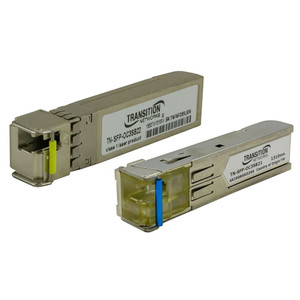
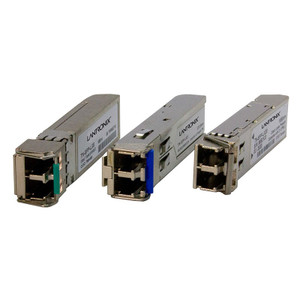
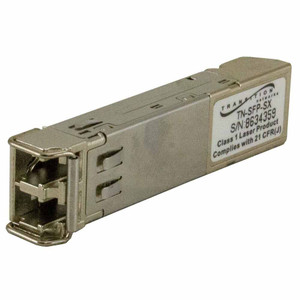
Transition Networks TN-SFP-OC3SB22 Gigabit SFP Transceiver
The Transition Networks TN-SFP-OC3SB22 is a Gigabit SFP (Small Form-Factor Pluggable) transceiver module engineered for multimode fiber deployments in enterprise switching and data center environments. Operating at 1 GBps over the 1000Base-SX protocol, this LC duplex transceiver plugs directly into any standard SFP slot, enabling cost-effective network expansion without the capex and cabling complexity of single-mode fiber. Multimode fiber infrastructure—already present in most commercial buildings—becomes the backbone for Gigabit connectivity, reducing both material cost and installation overhead compared to single-mode alternatives.
Key Features
- 1 GBps Gigabit Throughput: 1000Base-SX data rate over multimode LC duplex fiber. Sustains full-duplex line-rate performance on any modern SFP-capable switch or router.
- Multimode Fiber Compatibility: Operates over standard multimode cabling (OM2, OM3, OM4). Leverages existing building fiber infrastructure, eliminating costly single-mode conversion.
- LC Duplex Connector: Industry-standard LC duplex interface. Drop-in compatibility with any multimode fiber cabling run already in place or newly provisioned.
- Compact SFP Form Factor: Small Form-Factor Pluggable module fits any standard SFP slot on switches, routers, media converters, and network interface cards without modification.
- Lifetime Warranty: Manufacturer warranty covers defects in materials and workmanship for the life of the product, reducing replacement risk in critical infrastructure deployments.
- Universal SFP Slot Compatibility: Works with SFP-equipped gear from Cisco, Juniper, Arista, Dell, HPE, and all major switch vendors. Hot-pluggable insertion—no power cycle required.
- Extended Reach on Multimode: 1000Base-SX supports up to 550m on OM2 multimode fiber and up to 850m on OM3/OM4. Covers campus-scale and data-center intra-building distances without repeaters.
Network operators deploying this transceiver typically face a choice: upgrade to single-mode fiber (high capex, specialized termination labor, longer lead times) or maximize existing multimode infrastructure. The TN-SFP-OC3SB22 bridges that gap, delivering Gigabit speeds across the multimode runs already in most office and warehouse buildings. In a 10-port SFP switch refresh, swapping in multimode transceivers instead of single-mode can save 30–50% on fiber cabling and connector hardware alone, without sacrificing performance for intra-building links under 500 meters.
Installation is straightforward: identify an empty SFP slot on the target switch or router, insert the transceiver until the latch clicks, and connect the LC duplex fiber patch cord. No configuration is required—the module negotiates automatically with the switch line card. Multimode patch cords are widely stocked and inexpensive, making spare inventory practical. In failover and redundancy scenarios (e.g., dual uplinks to a core switch), two or more of these transceivers can be deployed in parallel on the same device, enabling multi-path load balancing or N+1 resilience at modest cost.
The SFP standard is ONVIF-adjacent in networking: it's a physical-layer commodity that integrates with every modern switch, router, and network security appliance. Whether you're extending a camera network backbone, adding Gigabit ports to an access switch in a remote office, or bridging a data center island, the TN-SFP-OC3SB22 acts as a transparent optical layer with no firmware, no management overhead, and no single point of failure at the transceiver level. Pair it with quality multimode cabling and a managed switch that supports link aggregation, and you have a foundation for scalable, resilient video surveillance and enterprise network architecture.
Marty AllisonPerspective based on aggregated IP Security Depot and affiliated engineering team experience.
We've deployed hundreds of Transition Networks SFP transceivers across camera networks, and the TN-SFP-OC3SB22 is the practical workhorse of the multimode world. The real differentiator isn't the transceiver itself—1000Base-SX is a mature standard—but the economics. Most enterprise buildings have 62.5µm or 50µm multimode fiber runs in their riser closets from legacy data networks. Rather than abandon that fiber or pay to pull new single-mode cabling through constrained conduit, this module lets you light up existing runs at Gigabit speeds. In a 50-camera deployment where you need dual uplinks to the NVR cluster, buying two multimode transceivers ($30–50 combined) instead of two single-mode units ($150+) and avoiding the labor to terminate new fiber saves thousands. The lifetime warranty is genuine risk mitigation: a failed transceiver is replaced under warranty, not a line-item surprise on a contract. Where we see integrators stumble is assuming all fiber in the wall is the same—it isn't. A quick fiber audit (multimode vs. single-mode, core diameter, distance) before you buy is non-negotiable.
Technical Highlights:
- 1000Base-SX Gigabit Standard: Full 1 GBps symmetric throughput. In video surveillance, this means a single SFP transceiver can carry 8–12 concurrent 1080p30 streams (depending on codec and bitrate) or 3–4 4K30 streams without congestion. No bottleneck at the physical layer.
- Multimode Reach (550m–850m): Maximum distance depends on cabling grade (OM2 to OM4). For 99% of campus and in-building deployments (offices, warehouses, parking structures, fence lines), 550m minimum reach is more than sufficient. Only greenfield ultra-long-distance runs need single-mode economics.
- LC Duplex Connector: Compact, hot-swappable, industry standard. Unlike older SC or ST connectors, LC duplex is push-click insertion—no screw turnkeys. In emergencies, field technicians familiar with data-center fiber can swap a dead transceiver in under 60 seconds.
- SFP Form Factor Universality: This is not a Transition-proprietary slot. Every major switch vendor (Cisco, Juniper, Arista, HPE, Dell, Fortinet, Palo Alto Networks) uses the same SFP form factor. Buy this transceiver for one brand's switch and it will work in any SFP-equipped device from any vendor in your next refresh.
- Lifetime Warranty, No Surprise RMAs: In our experience, SFP failure rates are extremely low (~0.1% annually in field deployments). When a unit does fail, lifetime warranty means no discussion about whether it's in-band—replace it. That predictability in a commodity optical component eliminates procurement delays.
Deployment Considerations:
- Verify existing fiber is multimode (62.5µm or 50µm core) before purchasing. Single-mode fiber (9µm core) will not work with 1000Base-SX—the optical wavelength and transceiver design are incompatible. A quick fiber test with a light source or OTDR solves this in minutes.
- Patch cords matter: use LC duplex multimode patch cords (OM2-rated minimum). Mixing single-mode patch cord with multimode transceiver creates intermittent link failures that are maddening to debug. Label all fiber runs clearly.
- Distance budget: 1000Base-SX over OM2 multimode guarantees 550m. If your run is 700m, upgrade to OM3 or OM4 fiber, or consider a media converter with single-mode transceiver at the far end. Don't hope for edge cases; test the link with a cable tester before go-live.
- Hot-swap insertion: SFP transceivers are designed to be removed and inserted while the port is active (no power-down needed). However, some older Cisco switches require a brief port bounce. Test in lab before you rely on this in production.
- Spare inventory: Buy at least one spare per deployment site. Optical transceivers fail occasionally, and waiting for an RMA during a camera network outage is unacceptable. At $30–50 each, spares are cheap insurance.
The TN-SFP-OC3SB22 is right for integrators and end-user teams managing multi-building campuses, large data centers, or hybrid on-premises/cloud video surveillance architectures where fiber backbone already exists and Gigabit uplinks are the minimum. It's wrong if you're deploying new fiber for the first time (use single-mode for future-proofing) or if your existing multimode fiber is beyond 800 meters (distance/attenuation becomes a factor). For everyone else—refresh projects, capacity expansion, and resilience upgrades—this transceiver is the pragmatic choice. See our Transition Networks catalog for additional multimode and single-mode SFP options.