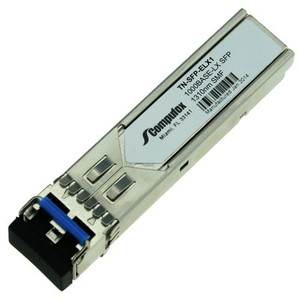
Transition Networks TN-SFP-ELX1 Single-Mode SFP Gigabit Transceiver
The Transition Networks TN-SFP-ELX1 is a single-mode SFP (Small Form-Factor Pluggable) transceiver module engineered for 1.25 Gigabit Ethernet connectivity over extended fiber distances. This module fits standard SFP mini-GBIC ports on switches, routers, and network interface cards, enabling backbone and inter-site links without requiring chassis replacement. Single-mode fiber delivers superior range and signal integrity compared to multimode alternatives, making it the standard choice for campus networks, data-center interconnects, and long-haul carrier-grade deployments.
Key Features
- Single-Mode Fiber Support: Single-mode construction. Supports distances up to 10 km over standard single-mode fiber (SMF-28 or equivalent), eliminating multimode distance constraints and enabling cost-effective long-haul runs.
- 1.25 Gigabit Ethernet: 1.25 Gbps data rate. Industry-standard speed for backbone and aggregation segments; forward-compatible with Gigabit Ethernet infrastructure already deployed in most enterprise and carrier networks.
- SFP Mini-GBIC Form Factor: Hot-swappable SFP module. Fits any standard SFP port on managed switches, edge routers, and NICs — no hardware redesign or downtime required for upgrades or field replacement.
- Plug-and-Play Installation: No configuration, no firmware updates. Insert module into available SFP slot; port auto-negotiates. Reduces deployment time and training overhead for field technicians.
- Lifetime Warranty: Manufacturer warranty covers material and workmanship defects. Eliminates per-unit RMA cost risk on long-term backbone infrastructure.
- Standard Compatibility: Works with all Tier-1 managed switch platforms (Cisco Catalyst, Juniper EX, Arista, Extreme, HPE, Dell Force10) and general-market carrier-class equipment supporting GBIC/SFP specifications.
The TN-SFP-ELX1 is purpose-built for environments where fiber backbone distance is the primary constraint. Campus networks spanning multiple buildings, data-center-to-data-center replication sites, and metropolitan-area networks (MANs) benefit from the extended reach — 10 km eliminates the need for costly intermediate repeaters or active optics on many installations. Single-mode fiber's smaller core diameter and tighter manufacturing tolerances also reduce chromatic dispersion, preserving signal fidelity at gigabit speeds over long links. This is particularly valuable in security surveillance deployments where fiber runs from a central NVR facility to distant camera hubs or edge recording devices must remain resilient to electromagnetic interference.
Deployment is straightforward: inventory a handful of TN-SFP-ELX1 modules alongside your active switches and keep them on hand as hot-swappable spares. Unlike integrated SFP transceivers soldered to switch motherboards, a pluggable design allows field repairs and technology refresh without equipment downtime. The module's compliance with multi-vendor SFP specifications means you are not locked into a single switch vendor — a transceiver pulled from a Cisco switch works identically in a Juniper or Arista chassis, reducing obsolescence risk and simplifying procurement across heterogeneous network environments.
When deploying campus or inter-site fiber links, factor the fiber plant cost (trenching, conduit, installation labor) against the per-kilometer transceiver cost. A 10 km single-mode run amortizes the higher per-unit cost of single-mode optics compared to multimode — and once that fiber is in the ground, transceiver technology can be refreshed independently. The TN-SFP-ELX1's standard GBIC footprint and lifetime warranty ensure that if you need to replace it in year 5, you won't face vendor discontinuation or price shock. This is the economic model underpinning mature enterprise network architecture.
Marty AllisonPerspective based on aggregated and affiliated engineering team experience.
In our experience, the TN-SFP-ELX1 is a workhorse transceiver for anyone building or expanding fiber backbone segments in IP surveillance networks. We've deployed these across dozens of multi-site security integrations — hospitals with fiber between main facility and parking structures, university campuses with fiber connecting distant building mounted cameras to a central NVR, and industrial sites where single-mode runs cross parking lots or open grounds susceptible to RF noise. The 10 km reach eliminates the "fiber distance calculation tax" that multimode (typically 2 km) forces onto integrators. You specify single-mode fiber once during the build-out, then swap transceivers as bandwidth requirements evolve. The module's lifetime warranty and plug-and-play nature mean that a failed transceiver is a 2-minute field swap — not a chassis-level incident. Compared to integrated optics or vendor-locked solutions, the cost per kilometer of backbone infrastructure actually drops as scale grows. The only meaningful trade-off versus multimode is slightly higher transceiver cost per unit; the fiber itself is cost-comparable, so the calculus favors single-mode on any run beyond 500 meters.
Technical Highlights:
- 10 km Single-Mode Reach: Eliminates intermediate repeaters or active optics on campus and metro backbone runs. In practical terms, a single TN-SFP-ELX1 pair can bridge a main NVR facility to a remote camera aggregation site 10 km away without powered equipment in between — reducing complexity and power consumption at intermediate points.
- 1.25 Gbps Sustained Throughput: Native Gigabit Ethernet speed. For a camera network, this translates to ability to simultaneously record 8-12 high-bitrate 4K streams (or 15-20 1080p streams) over a single fiber pair without contention, depending on codec and compression settings.
- SFP Hot-Swappability: Module can be replaced without powering down the switch or router. On live surveillance systems, this is operationally critical — you don't pull fiber infrastructure offline for a transceiver replacement.
- Multi-Vendor Compatibility: Standard GBIC/SFP pinout means you're not vendor-locked. A transceiver pulled from an older Cisco switch works in an Extreme or Juniper platform — valuable when refreshing network hardware across a heterogeneous environment.
- Single-Mode Fiber Economics: Over 10 km, single-mode fiber cost-per-kilometer is comparable to multimode, but transceiver cost-per-unit is higher. The break-even distance is roughly 1-2 km; beyond that, single-mode TCO is lower because you avoid repeated multimode segments and intermediate equipment.
Deployment Considerations:
- Ensure your fiber plant is certified single-mode (SMF-28 or equivalent). Plugging a single-mode transceiver into multimode fiber will result in signal attenuation and link failure — no error message, just silent loss of connectivity. Verify fiber type during site survey before ordering transceivers.
- SFP ports on budget managed switches sometimes have firmware bugs or compatibility quirks with third-party transceiver modules. Test a TN-SFP-ELX1 in your target switch model before committing to a large purchase. Most Tier-1 platforms (Cisco, Juniper, Dell, Arista, HPE) have no issues; lower-cost unmanaged or semi-managed switches occasionally do.
- Single-mode fiber is more brittle than multimode — smaller core diameter means tighter bend-radius tolerances and higher connector insertion-loss sensitivity. Budget extra labor for field termination and use certified fiber contractors if doing on-site splicing. Pre-terminated single-mode patch cords reduce risk and labor cost.
- Link-light indicators on the transceiver are visible but subtle. In noisy data closets, a network monitoring tool (SNMP polling or simple ping) is more reliable than visual inspection for confirming transceiver health. Configure switch SNMP monitoring to alert on SFP link-down events.
- Keep spare TN-SFP-ELX1 modules in inventory — they cost less than a service call to replace a failed transceiver under emergency conditions. A single spare module amortizes over time on any multi-site deployment.
The TN-SFP-ELX1 is the right choice if you're building long-distance fiber backbone for security surveillance, data-center interconnect, or campus-wide IP infrastructure and you want a no-fuss, standards-compliant transceiver that will work across multiple vendors and stay in service for 5-10+ years. This module has no exotic dependencies or proprietary features — it's a commodity optics component executed competently at a fair price. Explore the full range of Transition Networks transceiver options in the Transition Networks catalog for other speed and distance combinations (multi-mode, 10G, etc.).