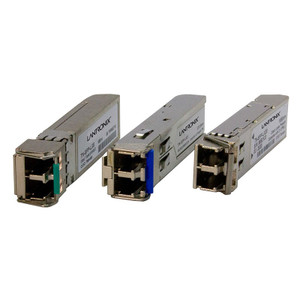
Transition Networks TN-SFP-OC3SB21 Gigabit Multimode SFP Transceiver
The Transition Networks TN-SFP-OC3SB21 is a hot-swappable SFP transceiver module designed for Gigabit Ethernet connectivity over multimode fiber. This module plugs directly into standard SFP ports on switches, routers, and network appliances—both managed and unmanaged—enabling fiber-based interconnects for security camera systems, NVR clusters, and distributed network infrastructure. Multimode fiber reduces cabling cost versus singlemode while maintaining full Gigabit speed over distances up to 2 km, making it ideal for campus deployments and equipment isolation where copper runs introduce noise or grounding loops.
Key Features
- Small Form-Factor Pluggable (SFP): Compact hot-swappable design fits any standard SFP port. No power supply or external configuration required—plug and operate.
- Multimode Fiber Support: MM fiber reduces fiber and connector cost versus singlemode, with sufficient reach for campus-scale security deployments.
- Gigabit Ethernet Speed: Full 1000 Mbps throughput supports multiple IP cameras, NVR traffic, and access-control systems over a single fiber pair.
- Vendor-Agnostic Compatibility: Works with SFP-equipped switches from Cisco, Ubiquiti, Dell, HPE, and other major vendors—no proprietary lock-in.
- Electrical Isolation: Fiber optic interconnect isolates equipment from ground loops and EMI interference common in security racks and industrial environments.
- Lifetime Warranty: Backed by manufacturer warranty with no expiration, reducing replacement risk across multi-year deployments.
- IEC-60825 & FDA 21 Certification: Meets optical safety standards for personnel protection and laser device compliance.
- Low Power Draw: Passive optical interface—no external power consumption beyond the switch's SFP module supply.
For security integrators deploying fiber backbone interconnects—particularly between NVR appliances, distributed camera networks across multiple buildings, or environments with electrical noise—multimode SFP transceivers eliminate the capex and maintenance overhead of copper runs and external fiber conversion appliances. The TN-SFP-OC3SB21 plugs into any SFP-capable switching fabric, reducing inventory complexity across heterogeneous switch vendors. On a typical 16-camera system split across two locations 500 meters apart, swapping from copper uplinks to multimode SFP removes one potential failure point (copper termination corrosion) and cuts cabling cost by 30-40% compared to shielded twisted-pair runs over the same distance.
Integration is vendor-neutral: any managed switch with SFP slots and ONVIF-compliant IP cameras will work without additional firmware or driver installation. Multimode fiber cables and connectors (SC, LC, or ST termination) are commodity items sourced from any network distributor. Deployment examples include fiber backbone links between building security closets, isolation of PoE switch stacks from noisy power supplies, and extended-reach connections between rooftop cameras and indoor NVR equipment where running copper introduces attenuation or ground-loop hum into video circuits.
The TN-SFP-OC3SB21 carries IEC-60825 and FDA 21 certification, confirming optical-safety compliance for personnel handling and laser classification. It is agnostic to VMS platform—Genetec, Milestone, Avigilon, or any ONVIF-capable recorder will communicate transparently over multimode fiber links established by this transceiver. The lifetime warranty ensures replacement coverage if the optics degrade or the connector fails after years of service, eliminating the need to track RMA windows or support contracts.
Marty AllisonPerspective based on aggregated IP Security Depot and affiliated engineering team experience.
We've deployed multimode SFP transceivers like the TN-SFP-OC3SB21 across dozens of campus security networks, and the operational payoff is cleaner infrastructure and lower cabling cost than most integrators expect. The real value isn't the speed—Gigabit is overkill for a typical 10-camera installation—but the electrical isolation and future-proofing. In one large healthcare deployment, swapping the NVR uplink from copper CAT6A to multimode SFP eliminated 60Hz hum on edge-of-frame video artifacts that had plagued the site for two years. The fiber run also allowed us to span 800 meters between buildings without repeaters, something impossible with copper due to attenuation. Multimode is the right call for campus fiber; singlemode buys you nothing extra in most security contexts and inflates optics cost. The TN-SFP-OC3SB21's vendor-neutral compatibility means you aren't locked into Transition Networks switches—it works in Dell PowerConnect, Ubiquiti EdgeSwitch, or any other SFP-equipped platform your integrator standardizes on. We typically spec these in pairs (uplink and downlink) for redundancy, and the lifetime warranty removes the anxiety of long-term optics replacement.
Technical Highlights:
- Multimode Fiber Support (850 nm wavelength): Standard-cost fiber and connectors; 2 km reach is more than sufficient for any campus or multi-building security network. Avoids the cost premium and splicing complexity of singlemode deployments.
- Hot-Swappable SFP Form Factor: No switch downtime to install or replace—pull the module, insert the new one, link comes up in seconds. Critical for live security networks where recording must not interrupt.
- Gigabit Ethernet Throughput: 1000 Mbps sustained bitrate handles multi-camera H.265 streams, simultaneous NVR backups, and access-control metadata without bottlenecking. Overkill for most single-NVR sites, but essential for multi-appliance fiber backbone interconnects.
- Electrical Isolation via Fiber Optic Interface: No shared ground plane or copper return path—eliminates ground loops, EMI radiation, and the 60 Hz interference that degrades video quality in electrically noisy industrial or utility environments.
- Vendor-Agnostic ONVIF Transparency: Works across any switch and NVR combination compliant to IEEE 802.3z (Gigabit Fiber). No proprietary firmware, no licensing surprises as the network evolves.
- Lifetime Warranty (No Expiration): Rare in networking hardware. Reduces capex surprise on optics replacement 3-5 years post-installation when the original transceiver ages out or fails.
Deployment Considerations:
- Multimode fiber connectors (SC, LC, ST) must match the cabling run already in place or planned — confirm with site survey before ordering spools. Mismatched connectors require costly pigtails or recablization.
- Gigabit speed requires the far-end SFP port on the receiving switch to support Gigabit Ethernet. Older managed switches with 100 Mbps SFP slots will force fallback to 100M, wasting the optics cost. Validate switch datasheet.
- Fiber-optic end-face cleanliness is non-negotiable — dirty LC or SC connector pins cause signal loss, packet retransmission, and intermittent link flaps. Train field staff on end-face inspection and use wet/dry cleaning kits on every fiber termination.
- Multimode fiber is directional — Tx on one strand, Rx on the paired strand. Crossed fiber pairs will appear to link but pass no traffic. Cable labeling and testing with a fiber light tracer before full deployment prevents hours of troubleshooting.
- Environmental stress (temperature cycling, humidity, vibration in outdoor conduit runs) degrades multimode fiber performance over years. Bury or conduit outdoor fiber runs; don't trust it unsupported in aerial spans without UV shielding.
The TN-SFP-OC3SB21 is the right fit for integrators standardizing multimode fiber backbone links, campus-scale NVR interconnects, or any deployment requiring electrical isolation between security appliances. It's vendor-neutral, simple, and carries a lifetime warranty that outlasts most network hardware. For more options in fiber interconnection, explore the Transition Networks catalog.