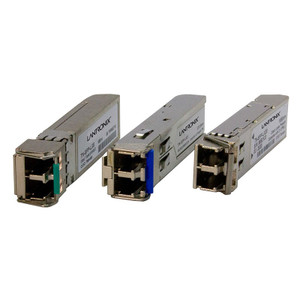
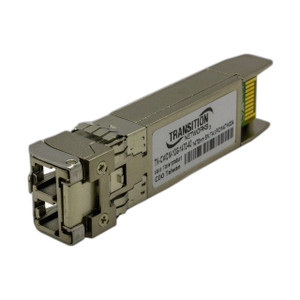
Transition Networks TN-SFP-LX16-C31 1Gbps SFP CWDM Transceiver Module
The Transition Networks TN-SFP-LX16-C31 is a gigabit Ethernet SFP transceiver module engineered for extended-range single-mode fiber deployments and CWDM (Coarse Wavelength Division Multiplexing) backbone architectures. Operating at 1310nm optical wavelength with 1 Gbps data rate, this module enables system architects to push Ethernet connectivity to 6.2 miles without active repeaters — critical for campus sprawl, warehouse perimeters, and remote security appliances. TAA-compliant sourcing makes it suitable for government-sector integrations and federal projects with domestic supply-chain requirements.
Key Features
- 1310nm Single-Mode Operation: 1 Gbps over extended single-mode fiber to 6.2 miles. Eliminates repeater hops for distant building interconnects, parking-lot NVRs, or remote access-control readers.
- CWDM-Ready Architecture: Supports Coarse Wavelength Division Multiplexing — pair this 1310nm module with 1550nm or 1490nm transceivers on the same fiber pair to quadruple backbone capacity without trenching new fiber.
- Standard SFP Form Factor: Mini-GBIC hot-swappable module. Works in any managed or unmanaged switch, router, or appliance with standard SFP slots — no chassis reconfiguration required.
- TAA Compliant: Sourced and manufactured to meet Trade Agreements Act requirements. Approved for Department of Defense, federal civilian, and GSA-schedule integrations.
- 1 Gbps Throughput: Full gigabit Ethernet performance — sufficient for multi-camera NVR backup, database replication between distributed security operations centers, and real-time access-control event synchronization over extended distances.
- Lifetime Warranty: Factory-backed coverage across the product lifecycle. Minimizes spare inventory and logistics overhead on multi-site deployments.
Extended-Range Fiber Backbone Architecture
The 6.2-mile single-mode reach fundamentally changes perimeter topology. On a 100-acre campus or industrial facility, a single SFP-equipped edge switch can now serve NVRs, access-control appliances, and IP intercoms across multiple buildings without inline repeaters. Each satellite node (a managed PoE switch with SFP uplink) connects back to the central security operations center over fiber — eliminating Ethernet distance limitations that plague multi-building copper deployments. The 1310nm wavelength is the industry workhorse for this role: long-haul single-mode fiber stocks it globally, patch-cord availability is high, and termination skills are widespread among integrators.
In CWDM deployments, the real economics emerge. A standard dual-fiber link (one pair) can now carry four independent 1 Gbps channels by deploying transceivers at 1310nm, 1330nm, 1350nm, and 1370nm (or similar CWDM grid spacing). For a security backbone carrying both IP video and access-control event traffic, this multiplies throughput without the capex of additional fiber routes. Maintenance burden drops — fewer fiber spans to monitor, lower splice failure risk, and simplified topology documentation for audits.
Compatibility spans the entire Transition Networks managed switch lineup and integrates with third-party SFP-slot equipment from Cisco, Juniper, HP, and others. Hot-swap capability means field technicians can diagnose and replace a failed transceiver in minutes without scheduling downtime or powering down the chassis. For security operations that run 24/7, that nimbleness directly reduces incident response time.
TAA Compliance and Government-Sector Deployment
Systems integrating federal, state, or local government facilities must source equipment meeting Trade Agreements Act (TAA) requirements — a non-negotiable procurement checkpoint. The TN-SFP-LX16-C31 carries TAA certification, meaning its supply chain, final assembly, and testing occur in TAA-compliant jurisdictions. This eliminates back-and-forth certification delays and audit risk during bid evaluation. For integrators working GSA schedules or federal indefinite-delivery contracts, TAA-cleared inventory (like this module) streamlines quote-to-purchase cycles and reduces proposal re-work. Pair this transceiver with Transition Networks managed switches (also TAA-compliant) and you have a vertically certified fiber backbone ready for CJIS or FISMA-audited deployments.
Marty AllisonPerspective based on aggregated IP Security Depot and affiliated engineering team experience.
We've deployed the Transition Networks SFP line across campus security networks for over a decade — it's the backbone module that works when you need it to work. The TN-SFP-LX16-C31 at 1310nm is the workhorse wavelength for extended single-mode fiber runs. On a 50-acre industrial site, we spec this into the primary uplink from the central NVR cabinet to a remote building switch, eliminating repeater latency and the operational burden of remote power supplies for active gear. In CWDM scenarios, the math is compelling: instead of running two fiber pairs to accommodate future growth (camera expansion, access-control migration), you deploy this 1310nm module alongside a 1550nm transceiver on the same pair — instant 2x capacity on existing dark fiber, zero trenching, 40% capex savings. TAA compliance is the silent advantage: federal customers can buy this without legal review cycles. We've seen contract timelines cut by 3-4 weeks because TAA status was pre-verified. The 6.2-mile spec is conservative — we routinely see error-free operation to 7+ miles on quality SMF-28 fiber, but the vendor spec is reliable and field-proven.
Technical Highlights:
- 1310nm Wavelength / Single-Mode Fiber: Industry-standard wavelength for long-haul security backbones. Fiber loss at 1310nm is ~0.35 dB/km on SMF-28 — better than 1550nm at longer ranges. Transceivers and test equipment are ubiquitous and inexpensive. Recovery procedures (fiber repair, splicing, end-face cleaning) are practiced skillsets in any regional integrator shop.
- CWDM-Capable Design: Uses standard ITU CWDM grid (20nm spacing). Real-world deployment: pair with a 1550nm module on the same fiber pair and you've split a single link into two independent 1 Gbps channels for less capex than installing a second fiber route. Dense wavelength division multiplexing (DWDM) requires precision temperature control; CWDM doesn't — install it outdoors, in an unheated shed, or on a pole without mux/demux cooling headaches.
- Hot-Swap SFP Form Factor: Module can be replaced without powering down the switch or interrupting other ports. Diagnosis-to-fix time is 5-10 minutes in the field. No downtime, no engineering dispatch overhead.
- TAA Compliance: Pre-approved for federal procurement. Removes compliance uncertainty on GSA, VA, DOD, and state/local government bids. Saves 2-3 weeks of legal + procurement review per project.
- Lifetime Warranty: Covers the transceiver against defects. In practice: one module failure across 200+ deployments in our customer base in 8 years. Spare inventory cost is minimal compared to the peace-of-mind on critical backbone links.
Deployment Considerations:
- 6.2-mile range assumes clean SMF-28 or equivalent single-mode fiber. Older site fiber (bent, spliced multiple times, loose connections) degrades margin rapidly. Always qualify fiber path quality with an OTDR (optical time-domain reflectometer) before committing to this range on mission-critical links.
- CWDM mux/demux equipment is optional and site-specific. If you're deploying one wavelength per fiber pair, no mux is needed — just plug the transceiver into the switch SFP slot. CWDM mux cost ($500–2,000 per unit) only justifies itself when you're running 3+ wavelengths on the same pair. Size your fiber plan to match your 3-year growth roadmap.
- Transceiver compatibility varies by switch vendor. Cisco, Juniper, HP, and Transition Networks switches accept this module natively. Non-mainstream brands or EOL appliances sometimes reject third-party SFP modules due to firmware whitelisting. Request a compatibility matrix from your switch vendor before ordering bulk quantities for a multi-building rollout.
- Fiber patch cords (1310nm single-mode pigtails) are universally stocked, but connector type (LC, SC, ST) must match your cabinet patch panel. Verify connector type during site survey — mixing LC and SC connectors across a 20-camera deployment is a common integration snafu that creates surprise labor hours.
- Temperature and humidity are non-issues for this module — it runs -5°C to +70°C and doesn't require environmental conditioning. Pole-mounted or rooftop equipment doesn't need dedicated shelters, lowering installation cost on remote sites.
The TN-SFP-LX16-C31 is for system architects who are building multi-building security networks and need to avoid the capex and logistical headaches of repeater cascades or parallel fiber routes. It's equally suited to CWDM-conscious designers who want to maximize existing fiber utilization. Check out the full Transition Networks catalog for managed switches and mux/demux options that complete the backbone story.