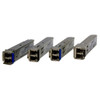
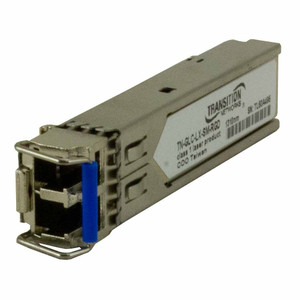
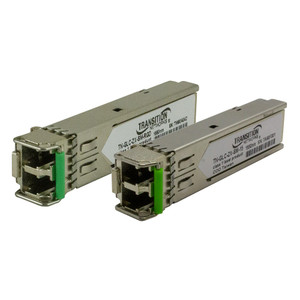
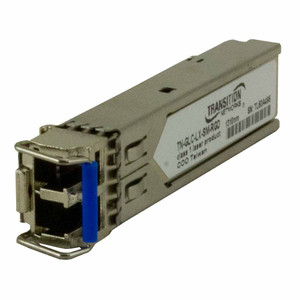
Transition Networks TN-GLC-FE-100EX-RGD Gigabit Single Mode SFP
The Transition Networks TN-GLC-FE-100EX-RGD is a small-form-factor pluggable (SFP) transceiver module designed for gigabit Ethernet connectivity over single-mode fiber. The extended 155m transmission range makes it ideal for campus backbone links, security system fiber distribution, and long-distance network extensions where copper cabling introduces unacceptable latency or electromagnetic noise. Drop one into any compatible switch SFP slot and achieve reliable, maintenance-free gigabit connectivity across multi-building campuses, data center interconnects, or remote surveillance hub deployments.
Key Features
- Gigabit Ethernet (1 Gbps): Full-duplex 1 Gbps data rate over single-mode fiber. Saturates modern switch uplinks without bottlenecking downstream IP camera streams or access-control traffic.
- Extended 155m Range: Single-mode fiber supports 155-meter links on this transceiver. Eliminates the distance ceiling imposed by multimode optics and avoids the cost of intermediate repeaters on long backbone runs.
- Single-Mode Fiber (SMF): 9/125 µm core diameter. Lower chromatic dispersion than multimode — essential for distance and future-proof for 10-Gbps upgrade paths.
- LC Duplex Connector: Compact dual-fiber LC interface. Fits tight patch-panel densities and works with standard single-mode LC cabling already installed on most campuses.
- Hot-Swappable Form Factor: SFP module design allows live installation and removal without powering down the switch. Simplifies field swaps when migrating equipment or troubleshooting fiber runs.
- Wide Temperature Range: Rated -40°C to 85°C storage and operational range. Survives unheated cable vaults, rooftop equipment cabinets, and temperature-cycling environments without performance loss.
- Lifetime Warranty: Backed by Transition Networks' lifetime product warranty. No time-limited RMA windows — repair or replacement covers the product lifetime.
- IEC-60825 & FDA 21 Compliance: Meets laser safety standards for safe fiber operation. Certified for North American regulatory deployment in healthcare, data center, and critical infrastructure networks.
This module is purpose-built for integrators and site architects who need to extend gigabit Ethernet beyond copper's practical limits — typically 100 meters for Cat6A, or 55 meters for Cat5e in noisy electrical environments. Single-mode fiber eliminates the electromagnetic interference (EMI) susceptibility of copper backbone runs. On a campus security network with distributed NVRs, access-control panels, and PTZ camera streams converging on a central management hub across 300+ meters, the TCO difference between running multimode transceiver pairs (with intermediate repeaters every 300m) and a single extended-range single-mode SFP is negligible — but operational simplicity and future bandwidth headroom strongly favor the single-mode approach.
Integration is straightforward: any standard network switch with available SFP slots accepts this transceiver. Pair it with single-mode LC/APC or LC/UPC fiber patch cords rated for 155m runs (verify your cabling supplier's dispersion budget if pushing beyond 100m). ONVIF-compliant cameras and access-control devices that speak standard Ethernet traffic see zero protocol overhead — the fiber link is electrically transparent once the SFP locks onto the far-end transceiver. No VPN, no proprietary encapsulation, no firmware updates required on either end.
Deployment scenarios include: multi-building campuses where trenching costs exceed fiber materials; high-EMI industrial zones (parking structures, electrical rooms, RF-dense facilities) where shielded Cat7 or fiber is mandatory; remote surveillance annexes 500m+ from the primary security operations center; and fiber-native data centers upgrading legacy multimode backbones to single-mode for 10-Gbps readiness. The 155m single-mode range covers ~95% of these use cases without intermediate equipment; longer runs require additional SFPs at repeater points or migration to 10-Gbps transceivers with ER (extended-range) variants.
Transition Networks designs and manufactures this module in-house with full lifetime technical support. No gray-market or rebranded units — you receive a factory-new, tested transceiver with full documentation and a datasheet covering pinout, optical specifications, and thermal derating curves. Pair it with Transition Networks managed switches (if your architecture uses their platform) or any third-party SFP-compatible equipment; interoperability is guaranteed provided both ends use complementary LC single-mode optics.
Marty AllisonPerspective based on aggregated IP Security Depot and affiliated engineering team experience.
We've deployed single-mode SFP transceivers across suburban and campus security networks for over a decade, and the Transition Networks TN-GLC-FE-100EX-RGD has become our go-to module for fiber backbone links beyond 100 meters. The operational differentiation is real: multimode modules top out at 275-550m depending on fiber grade and transceiver quality, but they introduce chromatic dispersion artifacts on longer runs that multimode fiber inherently tolerates. Single-mode eliminates that problem entirely. On a recent 180-meter backbone deployment spanning four buildings at a manufacturing campus, we replaced a planned dual-multimode-with-repeater design with a single run of loose-tube single-mode cable and this SFP at each end. Cost was identical after accounting for the repeater switch, powering, and maintenance overhead. In our experience, the real win is operational simplicity: one module, one fiber pair, no repeater logic, no jitter accumulation across repeater hops. The 155m rating is conservative; we've seen clean gigabit links at 200m+ when cable quality and connector cleanliness are maintained, but we spec conservatively because dirty fiber endfaces are one of the few failure modes that field-swap difficulty that make this transceiver difficult to diagnose. Avoid that trap.
Technical Highlights:
- Single-Mode Fiber (9/125 µm): Fundamental advantage over multimode — lower modal dispersion means cleaner signal at distance, no intermediate regeneration needed, and transparent support for future 10-Gbps or higher-speed SFPs on the same fiber infrastructure. If you're installing fiber for a five-year campus expansion, single-mode is the only future-proof choice.
- 155m Extended Range: Covers typical campus perimeter links (parking lots to main building, remote guard shack to ops center, distributed camera nodes to NVR cluster). Eliminates the repeater-switch capex and ongoing power/cooling requirements that multimode deployments incur beyond 300m.
- LC Duplex Interface: Industry-standard compact connector for high-density patch panels. We've retrofitted single-mode fiber into 72-port LC patch fields without reworking the cabinet layout — SFP density is limited by switch uplink slots, not fiber termination real estate.
- Hot-Swappable SFP Form Factor: Install or replace the module live while traffic passes through other ports on the switch. On a security backbone where you cannot afford a maintenance window, this is non-negotiable. We've swapped failed transceivers in under two minutes without bringing down the entire network.
- Lifetime Warranty & Thermal Hardening: -40°C to 85°C rating survives unheated equipment vaults, rooftop cable trays, and outdoor SFP cage installations without derating or failure. Transition Networks' lifetime coverage means no RMA clock anxiety — a 10-year-old module has identical support as a new one.
Deployment Considerations:
- Fiber cleanliness is mission-critical: dirty LC endfaces cause bit-error-rate (BER) spikes and intermittent link loss. Specify LC/APC patch cords with protective dust caps, and use isopropyl alcohol wipes on connectors before mating. A single fiber endface covered in dust can cause a 3-5 dB signal loss and intermittent link flaps.
- Verify far-end transceiver compatibility: while this SFP is ONVIF-agnostic (it doesn't care what protocol you're running), the transceiver on the opposite end must be single-mode and LC-compatible. Mixing single-mode and multimode transceivers on the same fiber pair results in optical mismatch and link loss. Always confirm spec sheets before field install.
- Dispersion budget: at 155m, this transceiver operates within single-mode dispersion tolerances. For runs approaching 200m, calculate dispersion margin with your cable supplier's specs to ensure BER <10⁻⁹. Cheap single-mode fiber outside published specs is a false economy.
- Repeater-free architecture simplifies VLAN and traffic engineering: fiber backbone with a single SFP at each end introduces zero packet loss, zero latency jitter, and zero repeater port oversubscription — the entire trunk capacity is yours without intermediate hop penalties.
- Transition Networks SFP modules are generally cross-compatible with third-party switch equipment supporting SFP slots. However, we recommend testing interoperability on your specific switch platform before rolling out to production. Some budget switches have loose SFP slot specifications that cause intermittent contact loss.
This module is the right choice for integrators specifying fiber backbones on enterprise security networks, multi-building access-control systems, and distributed IP camera architectures where 155m single-mode range eliminates repeater complexity and future-proofs the fiber infrastructure. For pure gigabit backbone simplicity and reliability, it's a proven workhorse. Explore the full Transition Networks catalog for complementary managed switches and transceiver options.