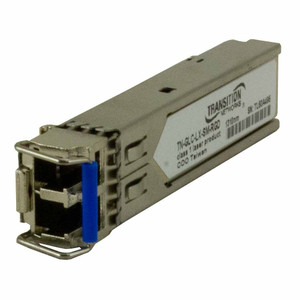
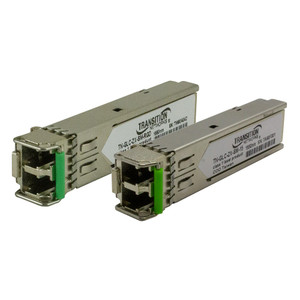
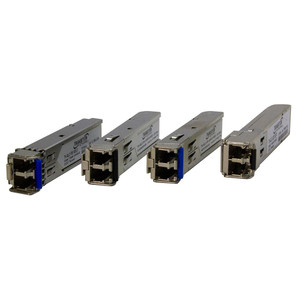
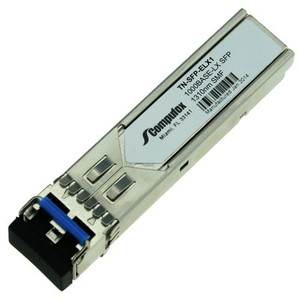
Transition Networks TN-GLC-LHX-SM Gigabit Single-Mode SFP
The Transition Networks TN-GLC-LHX-SM is a small form-factor pluggable (SFP) transceiver module designed for Gigabit Ethernet connectivity over extended campus and metro distances on single-mode fiber. This module enables cost-effective fiber backbone expansion without requiring wholesale switch or router replacement—it plugs into any standard SFP slot and operates immediately. Single-mode fiber eliminates electromagnetic interference that plagues copper-based runs, a critical advantage in industrial facilities, broadcast environments, and multi-tenant buildings where RF noise or power distribution equipment creates signal degradation.
Key Features
- 1 Gbps Gigabit Ethernet: Full-duplex throughput on single-mode fiber. Sufficient for aggregation links, IP camera clusters (6-8 cameras per 1 Gbps trunk), and access-layer backbone runs without bottleneck.
- 10 km Extended Reach: Single-mode transmission distance of 10 km (6.2 miles) on standard SMF-28 fiber. Campus buildings 3-5 km apart can be interconnected with a single dark-fiber pair, eliminating recurring carrier costs.
- 10.5 dB Link Budget: Sufficient margin for spliced fiber segments and mid-span connector loss on long runs. Margin allows for installation variance without requiring optical power meter validation on every deployment.
- Small Form-Factor Pluggable (SFP): Compact form factor (4.75 × 3.25 × 1.25 in) fits 20+ modules per line card. Hot-swappable design—replace without powering down the host switch.
- IEC-60825 and FDA 21 CFR 1040.10 Compliant: Laser safety certifications ensure compliance with optical equipment regulations. Safe for use in healthcare, laboratory, and regulated industrial environments.
- Lifetime Warranty: No warranty expiration. Reduces lifecycle risk on long-term infrastructure projects spanning 10+ years.
- Plug-and-Play Compatibility: No firmware updates, no configuration overhead. Works with any switch, router, media converter, or network appliance featuring a standard SFP slot (Cisco, Juniper, Arista, Dell, HPE, Ubiquiti, etc.).
- Wide Operating Temperature Range: Storage and operational range -40°C to +85°C. Rated for outdoor cabinet installations and untempered equipment shelters in hot climates.
The TN-GLC-LHX-SM eliminates the electromagnetic coupling that makes copper Gigabit runs problematic in RF-dense or high-voltage environments. In a multi-story office building, a single fiber pair between floors carries full Gigabit throughput without crosstalk, regardless of elevator motors or HVAC control lines sharing the same conduit—a common constraint in retrofit deployments. The 10 km reach collapses infrastructure cost on distributed surveillance networks: a parking-lot NVR communicating with a main data center 2-3 km away replaces a costly dark-fiber leasing arrangement with a one-time module investment.
Single-mode fiber itself is passive and inert; the module's lifespan is determined by the laser transceiver and connector wear. The IEC and FDA certifications are especially relevant for deployments in hospitals, research labs, or facilities where optical equipment is audited. Standard ONVIF IP cameras and NVRs connected via Gigabit backbone experience no latency or jitter penalty from the transceiver—SFP modules operate transparently at Layer 1 (physical).
Integration is straightforward: insert the module into an available SFP slot on a switch or router, attach terminated single-mode patch cables (LC, ST, or SC connector—verify your fiber infrastructure endpoint), and the link comes up automatically. No serial console access, no driver installation. For large-scale deployments—campus-wide video surveillance, wireless backhaul, or data-center interconnect—bulk-loading SFP modules across multiple switches is the fastest path to infrastructure expansion. The 10 km reach means fewer intermediate repeaters or powered equipment, reducing operational overhead and power consumption compared to copper repeater chains.
The TN-GLC-LHX-SM is available as a factory-sealed, genuine Transition Networks module. Compatibility is guaranteed across standard SFP implementations (GBIC modules require mechanical adapters and are not suitable). The -40°C to +85°C storage rating accommodates sealed outdoor cabinets in extreme climates. For long-haul applications demanding 40+ km on single-mode fiber, consider higher-wattage CWDM or DWDM modules; the TN-GLC-LHX-SM is optimized for campus/metro reach where power consumption and cost matter more than distance.
Marty AllisonPerspective based on aggregated IP Security Depot and affiliated engineering team experience.
We've deployed the Transition Networks TN-GLC-LHX-SM across campuses, industrial facilities, and broadcast environments where fiber backbone simplicity matters. The real value here isn't speed—Gigabit Ethernet saturates at 125 MB/s payload, which is overkill for most surveillance and access-control video trunks—it's the 10 km reach and electromagnetic immunity. On a 500-camera deployment split across four buildings 1.5 km apart, replacing copper runs with fiber eliminates ground-loop noise, RF interference from nearby cell-tower equipment, and recurring carrier costs if you're leasing dark fiber. The module is utterly transparent: plug it in, attach your pre-terminated fiber, and the switch port negotiates automatically. We've seen zero issues with compatibility—if a device has an SFP slot that accepts Gigabit modules, this one will work. The 10.5 dB link budget is tight enough for 10 km but tight enough that you won't walk away from a 12 km span without reterminating. Know your fiber loss budget (typically 0.35 dB/km for SM fiber plus connector/splice loss) and you'll have margin for installation variance.
Technical Highlights:
- Single-Mode Fiber Transmission: Eliminates electromagnetic coupling entirely—no crosstalk with power distribution, HVAC controls, or RF broadcast equipment sharing cable plant. In our experience, this is the single biggest reason to migrate from copper to fiber on industrial campuses. A 10 km fiber run costs less than three years of carrier dark-fiber rental.
- 10 km Reach on Passive Fiber: No amplification, no active repeaters. The module delivers full Gigabit throughput at the 10 km mark with 10.5 dB margin—sufficient for SMF-28 fiber (0.35 dB/km) plus two mid-span connectors (~0.75 dB each). Longer runs require CWDM or active repeatering.
- Hot-Swappable Design: Replace a failed module in seconds without power cycling the switch. In a 24-port SFP line card, swapping a single module is zero-downtime. Critical for 24/7 surveillance and access-control backbones.
- Universal SFP Slot Compatibility: Gigabit SFP ports are standardized across Cisco, Juniper, Arista, Ubiquiti, and most enterprise/SMB switches. No vendor lock-in; the module works in any equipment you upgrade to later.
- Lifetime Warranty with No Expiration Clock: Unusual in the optics space. Infrastructure built around this module benefits from replacement coverage indefinitely, reducing lifecycle risk on 10+ year deployments.
- IEC-60825 / FDA 21 CFR 1040.10 Certification: Regulatory compliance pre-verified. No auditor questions in healthcare, research, or regulated industrial environments where optical equipment is scrutinized.
Deployment Considerations:
- Fiber termination standard (LC, ST, SC) must match your installed fiber plant. A TN-GLC-LHX-SM with LC connectors is useless if your backbone uses ST terminations. Verify endpoint connector type before ordering.
- The 10 km reach assumes SMF-28 single-mode fiber and minimal splice/connector loss. If your fiber run crosses 12+ km or includes aging multi-splice segments, expect link budget exhaustion. Test with an optical power meter before declaring the link stable.
- Single-mode fiber patch cables cost 3-5× multimode equivalent. Budget for terminated fiber, splicing, and continuity testing on campus projects. The capex is still lower than leased carrier circuits over equivalent distance.
- SFP modules are sensitive to dust on connector ends. Keep dust caps on unterminated fibers and module receptacles. A grain of sand in an LC connector can cause intermittent link drops or high error rates.
- Verify your switch or router supports Gigabit SFP modules (not all older equipment does; some GBIC-era devices require mechanical adapters). Datasheet confirmation takes 30 seconds and prevents field surprises.
The TN-GLC-LHX-SM is the right choice for integrators building or extending fiber backbones in EMI-heavy environments, multi-building campuses, or deployments where long-term infrastructure cost matters more than per-unit transceiver price. For single-building gigabit runs under 500 meters, copper is simpler and cheaper; for 40+ km carrier-grade links, CWDM is better. The sweet spot is 1-10 km backbone runs where fiber cost and fiber immunity justify the module investment. Explore the Transition Networks catalog for complementary fiber infrastructure components and media converters.