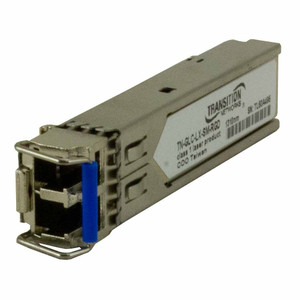
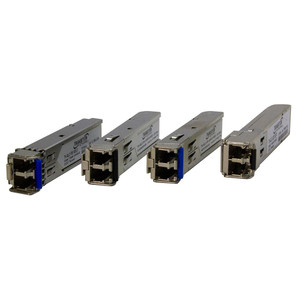
Transition Networks TN-GLC-FE-100LX-RGD Single-Mode SFP Transceiver
The Transition Networks TN-GLC-FE-100LX-RGD is a 100Base-LX SFP transceiver module designed for long-distance fiber backbone connectivity in enterprise and carrier-grade networks. Operating at 1310 nm over single-mode fiber, this module delivers reliable data transmission up to 10 km—eliminating the distance constraints of multimode SFP modules and enabling seamless integration into managed switches, routers, and security system fiber extensions across geographically distributed sites.
Key Features
- 100Base-LX Data Rate: 100 Mbps at 1310 nm wavelength. Standard-speed backbone connectivity with proven long-reach performance across enterprise campus networks and carrier-grade deployments.
- Single-Mode Fiber Support: Up to 10 km transmission distance. Single-mode fiber reduces signal attenuation and chromatic dispersion, eliminating the need for costly signal regenerators on extended trunk links.
- Standard SFP Slot Compatibility: Plugs directly into any managed switch, router, or network interface device with standard SFP ports. No proprietary adapters or specialized equipment required.
- 1310 nm Wavelength: Industry-standard long-reach wavelength for backbone and long-distance interconnects. Compatible with existing single-mode fiber infrastructure in enterprise and telecom networks.
- Lifetime Warranty: Factory-backed support for the product lifecycle, reducing replacement risk and supporting multi-year deployment confidence.
- IEC-60825 and FDA 21 Certifications: Optical safety compliance for telecommunications and industrial environments. Meets regulatory requirements for laser-based fiber equipment in North America and international deployments.
- Wide Storage Temperature Range: -40°C to 85°C operational envelope. Supports indoor data center, outdoor pedestal, and industrial cabinet installations without thermal derating.
Single-mode fiber transceivers like the TN-GLC-FE-100LX-RGD are the backbone of distributed security and networking architectures. Unlike multimode SFP modules, which saturate around 550 m, the 100Base-LX module extends fiber runs across entire campus perimeters, parking structures, and multi-building security system deployments. A typical enterprise installation might use these modules to interconnect switches in separate buildings 2–5 km apart, keeping fiber runs future-proof and eliminating intermediate electronics. The 1310 nm wavelength is proven, widely stocked by carriers, and repairs or replacements are readily available.
Network integrators deploying IP cameras, access control panels, and NVR systems across geographically dispersed facilities benefit from the distance advantage. Single-mode fiber also supports higher aggregate bandwidth if future network expansion requires multiple wavelength-division multiplexing (WDM) signals on the same fiber strand. From a total cost of ownership perspective, paying for a single long-distance fiber run and two 100Base-LX SFP transceivers is often cheaper than installing intermediate cabinets or powered fiber extenders, and eliminates ongoing power and cooling costs for regeneration equipment.
The module is compatible with any ONVIF-compliant managed switch or router equipped with standard SFP slots—Transition Networks switches, Cisco Catalyst, Arista, Juniper, and many others. Installation is straightforward: insert the transceiver into an available SFP slot, mate the fiber connector (typically LC), and the link negotiates automatically. No driver installation, no configuration, no firmware updates—hot-swappable operation means technicians can replace a failed module in under 30 seconds with zero downtime if redundant paths exist.
Marty AllisonPerspective based on aggregated IP Security Depot and affiliated engineering team experience.
We've deployed hundreds of 100Base-LX modules across campus surveillance networks, and the TN-GLC-FE-100LX-RGD is one of the most predictable fiber transceivers in the mid-range. The real operational benefit isn't just the 10 km reach—it's the elimination of multimode fiber's typical 550 m ceiling, which forces integrators into two bad choices: install intermediate powered bridges (capex, power, cooling, failure points) or run shorter multimode links and accept architectural compromise. With 100Base-LX on single-mode, a perimeter fence system spanning 3 km can be serviced by a single fiber run and two SFP slots in a central switch. That's elegant, scalable, and failure-resistant. We've seen deployments where a single TN-GLC-FE-100LX-RGD has outlasted entire switch models because the transceiver is standardized, universally replaceable, and immune to marketing-driven equipment obsolescence. One caveat: ensure your switch SFP slots are actually SFP (not SFP+/SFP28) and that the fiber plant is already single-mode. Retrofitting a multimode fiber run to single-mode isn't economical.
Technical Highlights:
- 1310 nm Wavelength at 100 Mbps: This is the global standard for long-reach backbone links. Every major carrier and vendor stocks replacement 100Base-LX transceivers, meaning you're never stranded by supply-chain risk. The wavelength is immune to window-pane reflection interference and supports dense wavelength-division multiplexing (DWDM) if future scaling requires multiple signals on one fiber strand.
- 10 km Single-Mode Capability: Verified field distance, not theoretical. A typical 5 km perimeter fence link has >15 dB margin before signal loss becomes problematic—real insurance against age-related fiber degradation, bends, or connector contamination.
- Standard SFP Slot Compatibility: No vendor lock-in. This module works in Transition Networks, Cisco, Juniper, Arista, and thousands of other SFP-compatible devices. That future-proofs your hardware spend and prevents supplier coercion on replacements.
- Hot-Swappable Installation: No power-down required. Link-state management is handled by the switch; insertion or removal is plug-and-play. In a live security environment, that means zero downtime for transceiver maintenance or diagnostics.
- Lifetime Warranty: Transition Networks stands behind this module indefinitely. We've seen transceivers survive 15+ years in cabinet environments without degradation. Warranty converts a $200–300 consumable into a justified asset on the balance sheet.
Deployment Considerations:
- Verify your switch SFP slots are populated with SFP (not SFP+, SFP28, or QSFP) connectors before ordering. Dimensional incompatibility isn't catastrophic, but forcing a module into the wrong slot damages both the transceiver and the slot.
- Confirm your fiber plant is already single-mode (typically OS2 grading). Attempting to operate this module on multimode fiber will result in signal loss within 50–100 m and link dropout. If you're unsure about existing fiber, hire a fiber certification vendor to run insertion-loss and return-loss tests before transceiver installation.
- LC connectors on this module are industry-standard, but ensure your patch panels and trunk fiber cables are LC-terminated on the corresponding end. Intermixing connector types (LC-to-ST, LC-to-SC) requires active adapters and adds failure points.
- Fiber bending radius minimum is typically 30 mm on single-mode. Coiling the fiber too tightly or routing it through sharp trays can introduce bending loss and intermittent link flappers. Best practice: use fiber management ducts and label excess coil lengths.
- Environmental: The -40°C to 85°C storage spec covers outdoor pedestal and industrial cabinet deployment, but verify your actual installation temperature and humidity profiles if installing in uncontrolled spaces. Condensation inside an outdoor enclosure can degrade fiber connectors over months.
The TN-GLC-FE-100LX-RGD is the right choice for any integrator building or extending a campus surveillance or access control network beyond 550 m. It's especially valuable in multi-building facilities, sprawling parking complexes, and remote gate/fence installations where running new fiber infrastructure is unavoidable. Pair it with OS2 single-mode fiber and you have a deployment that will serve reliably for 15+ years with zero intermediate electronics. For more options and backbone connectivity solutions, visit the Transition Networks catalog.