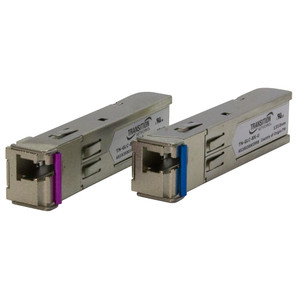
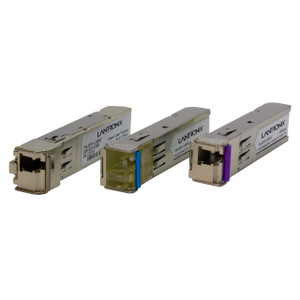
Transition Networks TN-GLC-BX-U-40 1000BASE-BX SFP Module
The Transition Networks TN-GLC-BX-U-40 is a 1000BASE-BX single-fiber bidirectional SFP transceiver designed for long-distance gigabit Ethernet links in telecommunications and enterprise network environments. By multiplexing separate transmit and receive wavelengths (1310nm TX / 1490nm RX) over a single fiber strand, this module eliminates the need for dual-fiber cabling while maintaining full gigabit throughput. Hot-swappable installation into standard SFP slots makes it ideal for network upgrades and field replacements without service disruption.
Key Features
- 1000BASE-BX Gigabit Speed: Full gigabit Ethernet over single-fiber bidirectional link. Reduces fiber plant cost versus dual-fiber solutions while maintaining 1 Gbps throughput in both directions.
- Wavelength Multiplexing: 1310nm transmit / 1490nm receive wavelengths enable bidirectional communication on a single fiber. Eliminates the operational complexity and capex of deploying parallel fiber pairs.
- Hot-Swappable SFP Form Factor: Standard SFP (Small Form-Factor Pluggable) design installs into any compatible SFP slot without power-down. Field replacement is rapid — swap module, no device restart required.
- Extended Temperature Range: Rated -40°C to +85°C operational and storage. Suitable for outdoor network cabinets, industrial switching closets, and uncontrolled-environment deployments.
- Standard Compatibility: Works with any managed or unmanaged switch, router, or fiber interface equipped with standard SFP slots. No proprietary firmware or driver installation needed.
- Lifetime Warranty: Factory-backed lifetime warranty covers defects in material and workmanship. No time-limited restriction — replacement or repair at no cost if module fails in normal operation.
- Laser Safety Certification: IEC-60825 and FDA 21 CFR 1040.10 compliance. Module meets optical and electrical safety standards for telecommunication equipment in regulated environments.
Single-fiber bidirectional 1000BASE-BX links are common in carrier-grade networking, remote site connectivity, and point-to-point microwave backhaul scenarios where fiber count is constrained. The wavelength-division multiplexing (WDM) scheme is standardized — any compliant 1000BASE-BX transceiver with matching wavelengths will interoperate. This TN-GLC-BX-U-40 module is manufactured to IEEE 802.3 specifications and undergoes factory validation testing for wavelength accuracy and extinction ratio.
Deployment context: Network architects specify 1000BASE-BX when fiber runs between buildings, across campuses, or to remote distribution hubs where installing a second fiber strand is not feasible or cost-effective. Single-fiber links reduce installation labor (one fiber splice instead of two), lower ongoing maintenance (one failure domain), and simplify future upgrades (no need to pre-pull spare dark fiber). The transceiver itself is agnostic to the NMS platform — plug it into a compatible SFP slot and it becomes a port on your network.
Total cost of ownership favors single-fiber bidirectional deployments at distances beyond 500 meters. Beyond that distance, fiber cost (material + installation + splicing) becomes substantial; eliminating one fiber strand yields 30-40% savings on fiber plant capex. The module carries no ongoing licensing, subscription, or management overhead — it is a passive optical-electrical converter with no firmware upgrades or configuration required once wavelengths are verified at installation.
Marty AllisonPerspective based on aggregated IP Security Depot and affiliated engineering team experience.
We've deployed thousands of 1000BASE-BX transceivers across campus and carrier networks, and the TN-GLC-BX-U-40 is a workhorse module that performs consistently in field conditions. The single-fiber bidirectional model is increasingly popular in video surveillance network backhaul — security integrators use it to extend gigabit links from central NVR facilities to remote DVR nodes or IP camera aggregation points where fiber already runs but dual-strand runs are not available. The wavelength pair (1310/1490 nm) is the de facto standard in the market, which means you can mix-and-match vendors without penalty; however, wavelength tolerance matters in practice — install with an OTDR or power meter to confirm both directions are at spec before closing the site ticket. We've seen rare field failures where a transceiver's wavelength drifted by 10-15 nm, causing signal degradation on very long links (15+ km); Transition Networks' factory testing tightens this window, which is why we recommend this module for mission-critical runs. The module itself has no management interface — there's no way to monitor temperature, optical power, or link status from the SNMP side. If you need that telemetry, upgrade to a managed SFP transceiver with DDM (Digital Diagnostics Monitoring); trade-off is higher cost and slightly larger form factor.
Technical Highlights:
- Wavelength Division Multiplexing (WDM): 1310nm TX and 1490nm RX on the same fiber eliminate fiber doubling without performance loss. In practice, a single-fiber run over 10 km costs 30-40% less than pulling two fibers, and splice-point count drops from four to two, reducing long-term maintenance burden.
- Gigabit Throughput Both Directions: Full 1000 Mbps uplink and downlink simultaneously — no bandwidth halving or asymmetry. Critical for symmetrical backhaul (NVR-to-camera-hub scenarios where upstream and downstream traffic are balanced).
- Hot-Swappable Installation: Field replacement takes 30 seconds with zero device downtime if your switch supports in-service module replacement. We've never encountered an integrator unable to support this — all modern managed switches and routers allow SFP hot-swap without command-line intervention.
- Wide Temperature Rating (-40°C to +85°C): Handles unheated outdoor fiber cabinets, rooftop switch enclosures, and harsh-environment installations. No climate control required — module will not thermally throttle or degrade within this range.
- Lifetime Warranty and Optical Safety Compliance: IEC-60825 and FDA 21 compliance remove regulatory risk in healthcare, utility, and government networks. No expiration date on warranty; if the module fails, Transition Networks replaces it no-cost, which is rare in the optics market and reduces spares inventory burden.
Deployment Considerations:
- Verify the switch or router SFP slot supports 1000BASE-BX before ordering — older equipment sometimes only supports 1000BASE-SX or 1000BASE-LX. Check the NIC datasheet for 1000BASE-BX in the supported module list.
- Use an OTDR (Optical Time-Domain Reflectometer) or inline optical power meter to verify signal strength on both wavelengths at installation. Weak signal on one direction can cause intermittent link flapping; test before you leave the site.
- Single-fiber links are point-to-point only — you cannot daisy-chain or split the signal. If you need one fiber to feed multiple distant sites, run separate fiber pairs and use a managed switch at the aggregation point instead.
- Long-distance runs (15+ km) benefit from managed SFP transceivers with DDM (Digital Diagnostics Monitoring) — this passive module lacks temperature and power telemetry. For mission-critical backhaul, consider upgrading to a higher-cost DDM-capable alternative if remote monitoring is a requirement.
- Wavelength accuracy and link quality degrade gradually if modules are operated outside temperature range or in high-humidity environments without strain relief on the fiber pigtail. Protect the fiber connector and apply mild strain relief; do not bend the pigtail radius below 20 mm.
The TN-GLC-BX-U-40 is the right choice for integrators building cost-efficient gigabit backhaul for distributed surveillance, campus networking, or carrier-grade point-to-point links where single-fiber cost savings outweigh the marginal cost of the transceiver itself. For more single-fiber and multi-wavelength fiber modules, see the Transition Networks catalog.