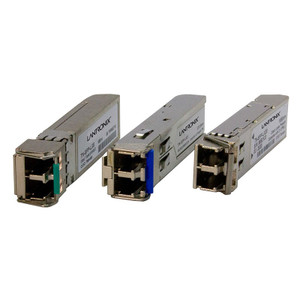
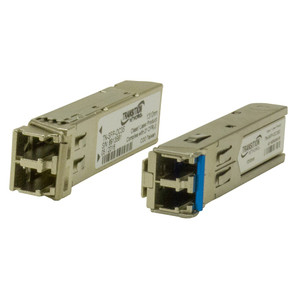
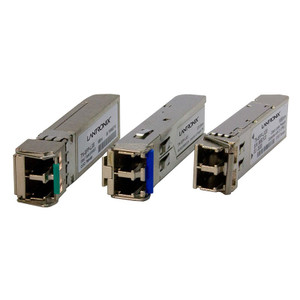
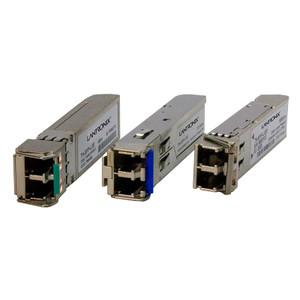
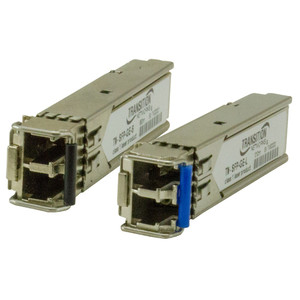
Transition Networks TN-SFP-LXB11T 1000Base-BX Gigabit SFP Transceiver
Overview
The Transition Networks TN-SFP-LXB11T is a 1000Base-BX small form-factor pluggable (SFP) transceiver engineered for gigabit ethernet over multimode fiber in extended-distance network segments. Operating at 1310 nm transmit and 1550 nm receive wavelengths in a bidirectional configuration, this module delivers 1 Gbps throughput across distances up to 6.2 miles — eliminating the need for expensive repeaters or intermediate active components on longer fiber runs. This makes it the right choice when your fiber plant already exists and you need to replace or add connectivity without pulling new cable or investing in singlemode infrastructure.
Key Features
- 1 Gbps Data Rate: Delivers full gigabit ethernet performance, so network latency and throughput are equivalent to copper — no performance penalty for the distance gain.
- Bidirectional Operation (1310/1550 nm): Transmits at 1310 nm and receives at 1550 nm on the same fiber strand, halving the fiber count required compared to traditional unidirectional transceivers. Cuts deployment cost when fiber is scarce or costly to install.
- 6.2 Mile Reach: Spans long distances — roughly 10 km — without active regeneration. Practical for campus backbones, remote warehouse segments, or inter-building links where copper or short-range fiber is insufficient.
- Multimode Fiber Compatibility: Works with standard multimode fiber already installed in most enterprise and industrial networks. No need to upgrade or replace existing cabling infrastructure.
- Hot-Pluggable SFP Form Factor: Installs directly into any SFP-capable switch, router, or network interface card. No firmware updates or special configuration — insert and link establishes. Makes it field-replaceable without powering down the host.
- Standard 1000Base-BX Protocol: Supports gigabit ethernet standards natively, integrating into existing VLAN, QoS, and spanning-tree deployments without protocol conversion or middleware.
Integration & Compatibility
The TN-SFP-LXB11T functions as a passive, standards-compliant transceiver in any network infrastructure that provides an SFP port — switches from Cisco, Juniper, Arista, or any vendor supporting the 1000Base-BX standard. No special drivers or licensing required. Pair with a matching TN-SFP-LXB11T on the far end to establish a point-to-point link, or combine with other multimode SFP transceivers in a mesh or star topology. Works equally well in enterprise data-center extensions, industrial automation networks, or security surveillance backhaul where fiber offers immunity to EMI and physical security advantages over copper.
When to Choose a Different Model
If your run exceeds 6.2 miles or you need higher data rates, consider singlemode 10 Gbps transceivers in the Transition Networks catalog — they extend to 40+ km at 10 Gbps. If you require multimode at shorter distances (under 500 meters) and cost is the driver, standard 1000Base-T copper SFP modules may be more economical. If you need redundancy or LACP load-balancing across multiple links, budget for a second pair of TN-SFP-LXB11T modules and matching fiber.
Frequently Asked Questions
Q: Can I mix the TN-SFP-LXB11T with other vendors' 1000Base-BX modules?
A: The 1000Base-BX standard is vendor-agnostic, so mixing is possible — but verify wavelength and fiber type compatibility first. Always test in a lab before production deployment.
Q: What is the typical latency added by the TN-SFP-LXB11T?
A: Fiber introduces propagation delay of roughly 4.6 microseconds per kilometer. At 6.2 miles (10 km), expect approximately 46 microseconds round-trip — negligible for most applications.
Q: Does the TN-SFP-LXB11T support auto-negotiation or autonegotiation?
A: No. 1000Base-BX is fixed-rate; both ends must be configured for 1000Base-BX mode. No speed negotiation occurs.
Q: How do I know if my existing multimode fiber supports 1000Base-BX over 6.2 miles?
A: Standard OM1 (62.5 micron) and OM2 (50 micron) multimode fiber are specified for 1000Base-BX to 550m and 2km respectively. For 6.2 miles, you require OM3 (50 micron optimized for laser) or OM4. Consult a fiber optics contractor to certify your plant.
Q: Is there any power consumption involved, or is this a passive transceiver?
A: The TN-SFP-LXB11T is passive — it consumes negligible power (milliwatts) from the host SFP port. No external power supply required.
Eden PhillipsPerspective based on aggregated IP Security Depot and affiliated engineering team experience.
The Transition Networks TN-SFP-LXB11T is a straightforward, low-risk solution for extending gigabit ethernet over existing multimode fiber without the complexity or cost of singlemode infrastructure. The 1310/1550 nm bidirectional wavelength scheme is the industry standard for 1000Base-BX, and the 6.2-mile reach (10 km) covers most enterprise and industrial campus backhaul scenarios where fiber is already in the ground.
Technical Highlights:
- Bidirectional 1310/1550 nm Wavelengths: Two wavelengths on one fiber strand cuts fiber deployment cost in half versus unidirectional (separate Tx/Rx fiber pairs). Over a 10 km run, that's a material savings in trenching, conduit, or aerial cable labor.
- 6.2 Mile Span without Regeneration: Eliminates the need for intermediate repeaters or media converters on moderately long runs. Reduces active components in the network, lowering power consumption and failure points.
- Multimode Compatibility: OM3 or OM4 fiber is standard in modern data centers and campuses. If your network is already on multimode, insertion is friction-free — no fiber plant redesign or singlemode certification required.
Deployment Considerations:
- Fiber Grade Matters: Standard OM1 and OM2 fibers cap out around 550m to 2km at gigabit rates. To hit 6.2 miles, you must use OM3 (laser-optimized 50 µm) or OM4. Request a fiber certification report from your contractor before installation — modal dispersion creep can silently degrade the link if the fiber doesn't match the spec.
- No Autonegotiation: Unlike copper gigabit links, 1000Base-BX has no speed negotiation. Both ends lock to 1000 Mbps — there's no fallback. If the link fails to come up, it's usually a fiber or wavelength mismatch, not a speed issue. Bring a light meter to troubleshoot.
The TN-SFP-LXB11T is the right pick for campus backbones, remote warehouse network extensions, or inter-building links where you already own good multimode fiber and want to avoid the cost and complexity of singlemode transceivers and line termination equipment.