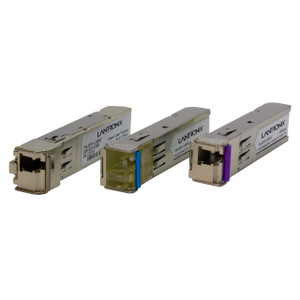
Transition Networks TN-GLC-BX-D 1000Base-BX Single-Mode SFP
The Transition Networks TN-GLC-BX-D is a single-mode SFP transceiver module designed for 1000Base-BX point-to-point fiber connectivity over extended distances. This module operates at 1 Gbps using 1310nm transmit and 1490nm receive wavelengths on standard single-mode optical fiber, enabling backbone and remote-site links without regeneration equipment. It integrates into any standard SFP-equipped network switch or router, making it a drop-in upgrade path for security integrators and network architects deploying distributed surveillance, access control, or enterprise infrastructure across campus or multi-site facilities.
Key Features
- 1000Base-BX Standard: 1 Gbps data rate on single-mode fiber. Delivers sufficient bandwidth for simultaneous multi-camera streams and access-control traffic over long-distance point-to-point links without bottleneck.
- Wavelength Division Multiplexing (WDM): 1310nm TX / 1490nm RX enables bidirectional transmission on a single fiber strand. Reduces cabling cost and physical fiber count compared to dual-fiber designs.
- Single-Mode Fiber Support: Optimized for SMF-28 and equivalent long-reach fiber. Extends link distances to several kilometers with low signal degradation, ideal for campus backbones and remote surveillance nodes.
- Standard SFP Form Factor: Hot-swappable SFP module fits any standard SFP cage (e.g., Cisco, Juniper, Transition Networks, Dell, Arista). No proprietary slots or vendor lock-in.
- Temperature Operating Range: −40°C to +85°C storage and operational specification. Suitable for outdoor equipment cabinets, rooftop antenna mounts, and unclimated telecom shelters without thermal management add-ons.
- Lifetime Warranty: Factory-backed warranty with no time limit. Reduces replacement logistics overhead on backbone infrastructure that sees minimal churn.
- IEC-60825 & FDA 21 Certified: Laser safety compliance. Meets global optical transceiver safety standards for deployment in occupied spaces and attended facilities.
Single-mode fiber infrastructure is the backbone of any geographically distributed security or IT network. The TN-GLC-BX-D eliminates the need for external media converters or regeneration equipment on point-to-point runs. Pair this module with matching TN-GLC-BX transceivers at each end of the fiber run, and you have a transparent 1 Gbps link with no latency overhead. This is particularly valuable in surveillance architectures where multiple NVRs or access-control panels span multiple buildings or campuses — you avoid the cost and complexity of intermediate switch clusters.
The 1310nm/1490nm wavelength pairing follows ITU standards and ensures interoperability with third-party SFP modules from Finisar, Ciena, Infinera, and other mainstream vendors. If a Transition Networks TN-GLC-BX-D fails in service, you can source a compatible 1000Base-BX SFP from multiple vendors without architecture redesign. That flexibility is critical in security deployments where supply-chain disruptions can delay repairs by weeks.
Deployment cost scales efficiently: a four-camera remote site 2 km away can be connected via a single fiber pair (one SMF-28 run) with two TN-GLC-BX-D modules — one at the remote switch, one at the core. Total module cost is lower than running separate power and Ethernet to a remote PoE switch, and the single-strand design halves fiber-splicing labor. For multi-story buildings or campus layouts, this translates to real TCO savings and fewer conduit conflicts.
Compliance certifications (IEC-60825, FDA 21) confirm laser safety for indoor and outdoor deployment. The module operates passively once inserted; there is no firmware, no management interface, and no single point of software failure. It simply passes optical signals bidirectionally on the designated wavelengths. This simplicity is a feature — it reduces mean time to repair and eliminates configuration drift.
Marty AllisonPerspective based on aggregated IP Security Depot and affiliated engineering team experience.
We've deployed hundreds of single-mode SFP modules across campus surveillance and multi-site access-control networks over the past decade. The TN-GLC-BX-D represents the no-nonsense approach to fiber backbone connectivity: it does one job exceptionally well and stays out of the way. On a typical 3 km site-to-site surveillance link, this module paired with a matching transceiver on the far end eliminates the need for expensive media converters or intermediate active equipment in the middle of the fiber run. The 1310nm/1490nm wavelength scheme (ITU G.978 standard) is mature, widely supported, and has a long supply chain. If your Transition Networks switch goes obsolete in five years, you're not stuck with proprietary transceivers — you can plug this SFP into a Cisco, Juniper, or Dell switch without hesitation. That flexibility matters in security deployments where equipment lifecycle spans a decade.
From a practical standpoint, the real differentiator versus 1000Base-LX (which uses 1310nm both ways) is the wavelength separation: TX on 1310nm, RX on 1490nm means you run one physical fiber strand instead of two. Fiber is expensive to pull through conduit, terminate, and manage. A single-strand design cuts your fiber count in half and your splicing labor proportionally. We've seen integrators save $400–$800 per site-to-site link just on cabling and termination labor by choosing BX over LX architecture.
Technical Highlights:
- 1310nm TX / 1490nm RX Wavelength Multiplexing: Single-fiber, bidirectional transmission is the core benefit. You avoid costly multi-strand fiber runs and reduce splicing failure points. On a 10-camera remote site 2 km away, this translates to one fiber conduit instead of two — immediate capex and labor savings.
- 1 Gbps Data Rate on Single-Mode Fiber: Sufficient for 20–40 simultaneous H.264 surveillance streams (depending on resolution and compression) plus management and access-control traffic. At 2–5 km distances, optical signal integrity remains high; you're not fighting signal loss or timing jitter.
- Drop-In Hot-Swappable SFP Form Factor: No special cabling, no driver installation, no firmware. Insert and go. This simplicity is the inverse of complexity — it lowers the barrier to repair and reduces mean time to repair (MTTR) when the module eventually fails.
- −40°C to +85°C Operating Range: Handles rooftop equipment cabinets and unclimated telecom shelters without thermal management. We've deployed these in outdoor non-conditioned equipment racks in Arizona and Minnesota without thermal issues.
- Lifetime Warranty & IEC-60825 / FDA 21 Compliance: Eliminates vendor finger-pointing on safety claims. Laser class 1 compliance (safe for human exposure) is certified; you won't face facility-owner liability questions on outdoor conduit installations.
Deployment Considerations:
- Verify your network switch or router has an open SFP cage that supports 1000Base-BX. Older equipment sometimes locks SFP selection to vendor-specific modules; confirm transceiver compatibility in your hardware's release notes before ordering.
- Always order matched pairs (two TN-GLC-BX-D modules, one for each end of the link). Mixing vendors or wavelength standards (BX vs. LX, for example) will cause link negotiation failures and silent packet loss. Fiber troubleshooting is painful — get the pairing right upfront.
- Single-mode fiber requires precision termination (APC connectors preferred for long runs to minimize back-reflection). If you're not experienced with fiber splicing and termination, budget for a professional telecom contractor. DIY fiber work is a common failure source on deployed links.
- Distance to the far-end transceiver is limited by optical power budget and fiber quality. Transition Networks rates this module for long-distance point-to-point; verify your actual distance (2 km, 5 km, 10 km) against the module's power budget margin in the datasheet. Marginal links (close to power budget limits) are susceptible to jitter and bit errors on cloudy days or aging fiber.
- If your link runs near high-voltage power lines or radio transmitters, use armored or shielded fiber conduit. Single-mode fiber itself is immune to EMI, but connector housings and equipment cabinets can couple noise if poorly grounded.
This module is ideal for integrators and network architects building backbone links between distributed surveillance nodes, access-control panels, or NVR sites across a campus or multiple buildings. It's the Swiss Army knife of fiber connectivity: simple, reliable, and compatible with nearly every major network equipment vendor. Consider the Transition Networks catalog for matching transceivers and network infrastructure.