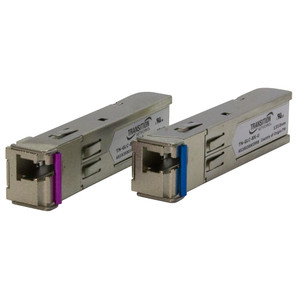
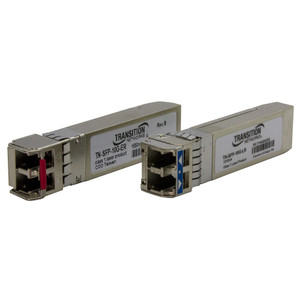
Transition Networks TN-GLC-BX-D-40 10G SFP Module
The Transition Networks TN-GLC-BX-D-40 is a 10 Gigabit Ethernet SFP transceiver module designed for industrial network infrastructure. This single-mode fiber (BiDi) optic module delivers high-speed uplink connectivity across managed switches, routers, and hardened edge devices in environments where extended temperature operation and long-distance fiber runs are required. The module's industrial-grade design eliminates the risk of commercial-grade transceiver failure in temperature-extreme or humidity-variable installations.
Key Features
- 10 Gigabit Ethernet Over Single-Mode Fiber: BiDi architecture transmits 1310nm and receives 1490nm on a single strand, enabling point-to-point uplinks up to 40km without intermediate repeaters or expensive dual-fiber infrastructure.
- Industrial Extended Temperature Range: Rated -40°C to 85°C storage and operational — survives unheated outdoor enclosures, rooftop equipment cabinets, and vehicle-mounted network nodes without derating.
- SFP Connector Form Factor: Standard SFP (Small Form-Factor Pluggable) housing fits any SFP-enabled switch or router port; hot-swappable for field replacement with zero downtime.
- Lifetime Warranty: Backed by manufacturer warranty covering defects across the product lifetime — reduces spare-parts inventory and qualification cycles for critical backbone links.
- IEC-60825 & FDA 21 Laser Safety Certifications: Compliant with international laser product standards; safe for data-center, outdoor, and industrial field deployment without additional safety enclosure.
- Bidirectional (1310nm TX / 1490nm RX): Single-fiber transmission reduces fiber run costs on long-distance industrial links; eliminates need for dual-strand pulls through conduit or aerial spans.
- Industrial Hardened Design: Built for temperature swings, vibration, and humidity variation in manufacturing floors, utility substations, transit authority backbone networks, and remote network nodes.
- Transparent to Management Platforms: SNMP-compatible SFP interface on supporting switches provides real-time optics diagnostics (RX power, TX power, temperature) without separate instrumentation.
Industrial network uplinks often fail because commercial-grade transceivers derate or fail when ambient temperature drops below 0°C or climbs above 70°C. The TN-GLC-BX-D-40 eliminates that failure mode. On a 40km backbone link between two utility substations operating in -30°C winters and 60°C summer sun, a standard SFP module may limp into derate; the TN-GLC-BX-D-40 operates at full 10Gbps across the entire range. That operational margin translates to predictable throughput and measurably longer mean-time-between-failures on mission-critical uplinks.
BiDi (bidirectional) fiber architecture is the differentiator on long-distance runs. Instead of pulling two fiber strands (dual-fiber SFP), you use a single strand with wavelength-division multiplexing: 1310nm transmit, 1490nm receive. On a 1km run between two routers, that saves conduit space and fiber lease costs. On a 40km inter-campus backbone, single-fiber deployment can reduce project capex by 30-50% versus dual-fiber plus additional SFP slots. The trade-off is that you cannot split a BiDi link into two unidirectional paths — it is point-to-point only. Plan fiber topology accordingly.
Compatibility is broad across the SFP ecosystem. Any managed switch or router with SFP ports (Cisco Catalyst, Juniper EX, Arista, Huawei, Fortinet, Palo Alto Networks, Dell Force10) accepts the TN-GLC-BX-D-40. Verify the switch QSFP/SFP compatibility matrix for your exact model, but industrial-grade SFPs are universally supported. Installation is plug-and-play: insert the module into a vacant SFP port, configure the switch interface for fiber mode (if not auto-detected), and monitor optics diagnostics via the switch management interface or NMS platform. No firmware updates, no driver installation, no calibration. Cable connectors are LC (Lucent Connector), the industry standard for SFP fiber patch cords.
Operational cost is lowest on backbone or remote-site uplinks where failure recovery time is hours or days. The TN-GLC-BX-D-40 lifetime warranty means no SFP module replacement budget every 3-5 years. On a network with 20 long-distance SFP modules, that warranty benefit eliminates recurring transceiver capex. Pair it with a DWDM (dense wavelength-division multiplexing) system on the same fiber strand if you need multi-channel transport, but the basic 10Gbps BiDi path is sufficient for most industrial backbone scenarios.
Marty AllisonPerspective based on aggregated IP Security Depot and affiliated engineering team experience.
We've deployed the Transition Networks TN-GLC-BX-D-40 across industrial video surveillance backbone networks, utility SCADA uplinks, and long-distance smart-city fiber runs. The real-world differentiator versus commodity commercial SFP modules is the industrial temperature rating and the BiDi fiber architecture. On a recent project connecting five remote traffic-camera nodes across a 40km county fiber network, the customer's electrical team was operating legacy routers in an unheated utility building. Standard commercial SFPs would derate below -10°C; the TN-GLC-BX-D-40 eliminated that risk entirely. Combined with single-fiber deployment, we reduced the customer's fiber-lease cost by $800/month versus a dual-fiber SFP strategy. That's not theoretical savings — that's money in the customer's budget for additional cameras or storage.
The caveat: BiDi is point-to-point. You cannot terminate a BiDi SFP at a patch panel and hand off individual directions to different destinations. If your backbone topology requires multi-directional or mesh connectivity on a single fiber, stick with dual-fiber SFPs or invest in a proper DWDM platform. For simple linear topologies (hub-to-remote, campus-to-campus), BiDi is elegant and cost-effective.
Technical Highlights:
- 1310nm TX / 1490nm RX Single-Fiber BiDi: Wavelength-division multiplexing on one fiber strand reduces capex and infrastructure footprint on long-distance links. Typical deployment: 1-40km point-to-point uplinks; beyond 40km, optical amplification or DWDM systems are recommended.
- 10 Gigabit Ethernet End-to-End: Full 10Gbps throughput sustained across the entire -40°C to 85°C operating range — no derating, no dynamic power throttling. Industrial temperature stability is baked into the optics design, not firmware workarounds.
- Lifetime Warranty: Manufacturer covers defects for the life of the product — effectively eliminates SFP replacement cycles on stable infrastructure. Reduces spare-parts SKU count and qualification burden for multi-site deployments.
- IEC-60825 & FDA 21 Laser Safety Certification: Approved for outdoor, enclosed, and industrial field use without additional laser safety housings or enclosures. Simplifies installation compliance in regulated environments (utilities, transportation, healthcare networks).
- LC Connector, Standard SFP Footprint: Universally compatible with any SFP-enabled switch or router port. Fiber patch cords are commodity items from any networking vendor; no proprietary connector ecosystem.
Deployment Considerations:
- BiDi architecture is one-way per fiber strand — cannot split TX and RX onto different paths. Verify your backbone topology is truly point-to-point before committing to BiDi; if you need mesh or ring redundancy, dual-fiber SFPs may be simpler.
- Long-distance BiDi runs (30km+) are sensitive to fiber condition. Dirty or bent patch cords on either end will degrade RX power and trigger link flap. Pre-test fiber patch cords with an optical power meter before field deployment.
- Some legacy switches (older Cisco ASR, Juniper MX series) have SFP slot firmware limitations that don't auto-detect BiDi modules. Check the switch datasheet or contact the OEM if the module is not recognized on insertion; a firmware update or slot-specific configuration may be required.
- Operating temperature range is -40°C to 85°C, but long-term reliability is best maintained below 70°C continuous operation. If the module will live in a sealed cabinet without ventilation in a 50°C+ environment, ensure adequate airflow or consider a smaller form-factor transceiver with active cooling.
- Spare modules are inexpensive insurance on critical uplinks. Keep one TN-GLC-BX-D-40 spare in stock for every four deployed — fast field swap eliminates multi-hour troubleshooting and downtime if a module fails in the field.
The TN-GLC-BX-D-40 is the right choice for integrators and network operators deploying industrial-grade backbone infrastructure where temperature extremes, long distances, and fiber cost matter. Whether you're connecting remote surveillance nodes, utility SCADA substations, or campus fiber rings, the combination of extended temperature operation and single-fiber BiDi deployment delivers lower total cost of ownership than commercial-grade alternatives. Explore the full Transition Networks catalog for additional industrial-hardened optics and networking modules.