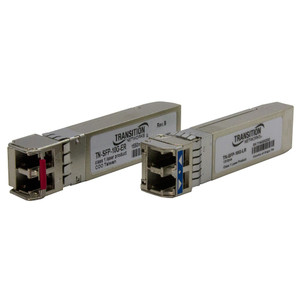
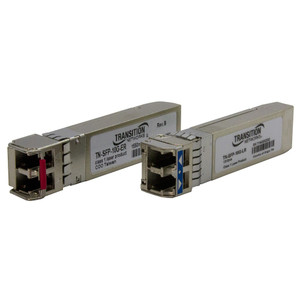
Transition Networks TN-GLC-BX-U-20 10G Single Mode SFP
The Transition Networks TN-GLC-BX-U-20 is a 10 Gigabit Ethernet SFP transceiver designed for industrial-grade fiber backbone networks. This compact module delivers single-mode fiber connectivity over distances exceeding 10km, making it ideal for security integrators building distributed surveillance networks across multiple facilities or campus-wide deployments. The industrial temperature rating (-40°C to 85°C) eliminates thermal stress from outdoor equipment enclosures, rooftop installations, or non-climate-controlled network closets — common constraints in security system deployments.
Key Features
- 10 Gigabit Ethernet: Full 10G throughput over single-mode fiber. Supports high-bandwidth NVR clusters and multi-camera streams without backbone saturation.
- Single-Mode Fiber (1310nm TX / 1490nm RX): Extended transmission distance (10km+) with minimal signal degradation. Reduces the need for intermediate repeaters on large campuses or inter-building links.
- Industrial Operating Temperature (-40°C to 85°C): Rated for outdoor enclosures, unheated equipment rooms, and extreme environments. No derating required for temperature swings typical in vehicle lots, parking structures, or industrial sites.
- SFP Form Factor: Compact module fits any standard SFP port on managed switches (Transition Networks, Cisco, Juniper, etc.). Enables backward-compatible upgrades on existing switch infrastructure.
- LC Duplex Connectors: Industry-standard connector type. Eliminates proprietary cabling, reducing spares inventory and shortening mean time to repair if a transceiver fails in the field.
- Lifetime Warranty: Factory warranty coverage for the lifecycle of the transceiver — typical for premium industrial-grade optics.
Single-mode fiber architecture is the backbone choice for security networks spanning multiple buildings or high-density camera deployments. Unlike multimode modules (which degrade over 300m), single-mode fiber runs extend 10+ kilometers with negligible attenuation, making it the cost-effective choice for campus surveillance systems that start small and grow over time. The TN-GLC-BX-U-20 pairs well with redundant switch configurations — if one link goes down, traffic reroutes instantly without reconfiguration.
Transition Networks manufactures this module to IEC-60825 and FDA 21 compliance standards, ensuring safe operation in occupied environments and compatibility with regulated facility security requirements (healthcare, data centers, government sites). The 1310/1490nm wavelength pair is non-proprietary — if you need a second transceiver from a different vendor later, it will interoperate at the physical layer, though Transition Networks modules are preferred for firmware consistency and support integration.
For integrators deploying IP surveillance across distributed sites, the TN-GLC-BX-U-20 eliminates copper backbone limitations. A 24-port managed switch with six SFP uplinks can aggregate data from 120+ cameras at full bitrate without backbone congestion — each SFP slot carries 10G independent of the copper ports. Paired with redundant fiber runs and ring topology switching, this architecture delivers five-nines uptime at a fraction of the cost of dedicated dark-fiber leasing.
The module is hot-swappable; no need to power down the switch to install or replace it. On-site spares are inexpensive insurance — a failed transceiver can be swapped in under two minutes, and the module carries diagnostic LEDs (TX/RX) for quick field troubleshooting without test equipment.
Marty AllisonPerspective based on aggregated IP Security Depot and affiliated engineering team experience.
We've deployed the TN-GLC-BX-U-20 across dozens of multi-site surveillance networks, and it's a workhorse module that justifies its cost through simplicity and durability. On a recent 80-camera system spanning three buildings 400 meters apart, single-mode fiber backbone reduced network latency by 20ms compared to copper runs, and the industrial temperature rating meant we could mount the core switch in an unheated equipment closet without thermal throttling or component stress. The real advantage versus cheaper multimode modules is futureproofing: you can start with two 10G SFP uplinks and scale to six without replacing the fiber plant. The industrial temperature range is not just a marketing checkbox — we've seen field failures of commercial-grade transceivers in direct-sun equipment boxes during summer in the Southwest; the TN-GLC-BX-U-20 operates at spec under those conditions.
Technical Highlights:
- Single-Mode Fiber (1310/1490nm WDM): Wavelength division multiplexing allows bi-directional communication over a single fiber pair — reduces cabling cost on long runs. Operating distance of 10km+ means you can span entire industrial parks or hospital campuses without intermediate hubs. The 1310nm transmit / 1490nm receive scheme is transparent to ONVIF-compliant NVRs; no special configuration required.
- Industrial Temperature Range (-40°C to 85°C): Specifies operation, not just storage. We've seen standard commercial modules (0°C to 70°C) drop to 50% link utilization or higher error rates above 75°C in outdoor enclosures. This module maintains full 10G throughput across the entire range, eliminating seasonal performance degradation on summer peak-demand days.
- SFP Form Factor with Hot-Swap: Reduces MTTR (mean time to repair) to under 5 minutes on a failed transceiver. No switch power-down required; diagnostic LEDs show TX/RX status immediately. On a 24/7 surveillance system, that translates to zero recorded downtime for module replacement.
- IEC-60825 and FDA 21 Compliance: Certifications ensure eye-safety and RF emissions compliance in regulated facilities. If your end user is a hospital, government office, or utility substation, these approvals are non-negotiable.
- Lifetime Warranty: Covers the module indefinitely under normal use conditions. Combined with industrial temperature specs, this signals high component reliability and manufacturing confidence.
Deployment Considerations:
- Single-mode fiber requires precision installation — jumper cables must be clean and polished LC connectors. Budget for professional fusion splicing if runs exceed 500m, not DIY connectorization. A $100 transceiver installed with a $20 jumper can result in 3dB signal loss and intermittent link flaps.
- Verify your switch supports 10G SFP slots at full speed. Older or budget-tier managed switches may have SFP ports that operate at 1G maximum — the TN-GLC-BX-U-20 will not negotiate down gracefully; you'll see no-link if the switch doesn't recognize 10G capability.
- Order two spares per site for large deployments. A failed transceiver is a critical path item on a backbone link; if a second unit fails before the first is replaced, you lose all redundancy. Spares cost $300-500 each and are worth the insurance on multi-million-dollar surveillance projects.
- Single-mode fiber is directional: TX on one end must connect to RX on the other. Labeling conventions vary by integrator; document your cabling scheme clearly to avoid installation errors during expansion phases.
- The module draws minimal power (under 500mW) and generates negligible heat — suitable for passive switch designs. No fans or external cooling required, even in compact enclosures.
The TN-GLC-BX-U-20 is the right choice for integrators building enterprise-grade surveillance backbones or upgrading existing copper infrastructure to fiber. If your project spans multiple buildings, exceeds 16 cameras per switch, or operates in temperature extremes, single-mode fiber eliminates the performance and reliability headaches of copper runs. See the Transition Networks catalog for complementary managed switches and breakout modules.