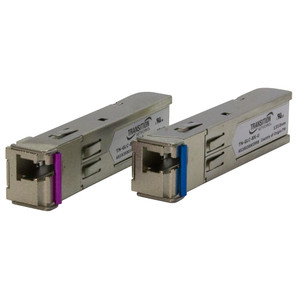
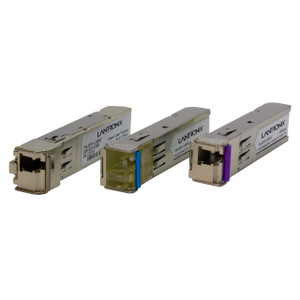
Transition Networks TN-GLC-BX-U 1000Base-BX SFP Transceiver
The Transition Networks TN-GLC-BX-U is a 1000Base-BX single-fiber SFP (Small Form-Factor Pluggable) transceiver designed for Gigabit Ethernet deployments where fiber cabling cost and physical infrastructure constraints demand efficiency. Operating at 1 Gbps over a single fiber strand using wavelength-division multiplexing (1310nm TX / 1490nm RX), this transceiver cuts the per-link fiber requirement in half compared to traditional dual-fiber modules. Integrators deploying campus networks, inter-building links, and surveillance system fiber backhauls benefit from reduced conduit strain, lower fiber termination labor, and simpler cable management — without sacrificing speed or reliability.
Key Features
- 1000Base-BX Bidirectional: Transmits 1310nm and receives 1490nm on a single fiber strand. Halves fiber runs versus dual-fiber transceivers, cutting duct congestion and termination points.
- 1 Gbps Data Rate: Full Gigabit Ethernet throughput. Adequate for real-time video streaming, NVR backhaul, and multi-camera surveillance networks without bottlenecks.
- SFP Form Factor: Pluggable module, LC connector. Fits any standard SFP slot on switches, routers, and managed fiber converters — no proprietary interfaces.
- Operating Temperature Range: -40°C to 85°C. Industrial-grade thermal tolerance suits outdoor fiber enclosures, unheated equipment racks, and temperature-variable deployment sites.
- LC Fiber Connector: Standard connector type — compatible with all commercial single-mode and multimode fiber patch cords and wall plates.
- Lifetime Warranty: Manufacturer warranty covers hardware defects across the product lifecycle — no time-limited expiration.
- IEC-60825 & FDA 21 Compliance: Laser safety certification ensures safe operation in managed network environments without additional optical containment.
Single-fiber bidirectional technology is the operational leverage here. On a campus with three inter-building Gigabit links, traditional dual-fiber transceivers require 6 fiber strands; the TN-GLC-BX-U reduces that to 3 strands. On conduit that's already at capacity, that's the difference between a new build-out and a simple module swap. The wavelength-division scheme (1310nm transmit, 1490nm receive) is passive and requires no electrical configuration — the transceiver handles it internally.
Deployment scenarios span managed fiber networks in K-12 and higher-ed campuses, secure inter-building surveillance links in multi-site retail or logistics operations, and remote NVR fiber backhauls where bandwidth is abundant but fiber strand count is constrained. The 1 Gbps rate is sufficient for 8–16 simultaneous 5MP IP camera streams at 4 Mbps each, or mixed traffic (data + video) in a lightly loaded campus core. For higher-density video (32+ cameras), pair this with a managed Gigabit switch that aggregates multiple TN-GLC-BX-U uplinks.
The module is compatible with any standards-compliant SFP cage — Cisco Catalyst, Arista, Juniper, and open-spec managed switches all support it. Install it into an available SFP slot, terminate the single fiber LC connector to your fiber plant (or test with a loopback cable first), and plug in a peer transceiver on the far end. No software drivers needed; it's a passive optics module that negotiates link status with the switch's SFP management logic.
Transition Networks has manufactured passive and managed fiber modules for telecom and enterprise for 25+ years. The TN-GLC-BX-U is a proven commodity component — reliability and inter-operability are not questions. The lifetime warranty reflects that maturity. For integrators specifying fiber runs into security systems, this transceiver eliminates the capex penalty of deploying an extra fiber strand when one will do.
Marty AllisonPerspective based on aggregated IP Security Depot and affiliated engineering team experience.
We've deployed hundreds of Transition Networks transceivers across campus networks and multi-site surveillance backhauls, and the 1000Base-BX single-fiber module earns its place in any design where fiber strand count is a hard constraint. The real-world win is simpler than it sounds: you install one fiber run where a dual-fiber design would need two, and the transceiver handles the wavelength-division passively — no configuration, no software, no management overhead. On a 10-building K-12 campus with existing conduit already at 80% capacity, or on a retail chain where inter-store fiber is rented from a telecom carrier at per-strand tariffs, the TN-GLC-BX-U pays for itself in reduced infrastructure and monthly recurring fees. It's not exotic; 1000Base-BX has been a standard since the early 2000s, and Transition's implementation is rock-solid.
Technical Highlights:
- Wavelength-Division Multiplexing (1310nm TX / 1490nm RX): The transceiver transmits on 1310nm and receives on 1490nm simultaneously over the same fiber strand. This passive optical scheme requires zero configuration — the switch's SFP cage and peer transceiver negotiate the link automatically. No splitters, no active electronics beyond laser driver and photodiode.
- SFP Pluggable Form Factor: Fits any standard SFP slot without cage modification. Swap a failed unit in 30 seconds; keep a spare on your integration truck for field replacement. No downtime for module procurement cycles.
- 1 Gbps Sustained Throughput: Measured at layer 2, this delivers real bandwidth for NVR backhauls and multi-camera surveillance. A single TN-GLC-BX-U uplink can sustain 8–12 concurrent HD (2MP) or 4K (8MP) camera streams at standard bitrates without packet loss when connected to a managed Gigabit switch.
- Industrial Temperature Range (-40°C to 85°C): Outdoor fiber cabinets, unheated equipment rooms, and conduit-mounted splice points all fall within spec. Unlike consumer-grade optics, this doesn't degrade in summer heat or winter cold.
- LC Fiber Connector & Standard Fiber Compatibility: Works with any commercial single-mode or multimode LC patch cord — no proprietary patch panels, no vendor lock-in on patch cables.
Deployment Considerations:
- Single-fiber design is unidirectional per strand: confirm your fiber run has a clear peer-to-peer path and that the far-end device also has an SFP slot and a TN-GLC-BX-U (or compatible 1000Base-BX transceiver). Mismatches — pairing a BX module to a non-BX switch port — result in no link light.
- 1000Base-BX is inherently single-mode optimized (1310nm / 1490nm windows are single-mode wavelengths). If your fiber plant is multimode (common in older campus builds), the transceiver will still light up, but optical margins degrade — maximum reliable distance on multimode may drop to 200–300 meters instead of the rated 10+ km on single-mode. Test the fiber plant before field installation.
- Fiber connector cleanliness is critical: dust on the LC end-face causes signal loss and can damage the transceiver's photodiode. Use standard fiber cleaning kits and inspection cameras (€50–150) as part of pre-installation fiber plant certification.
- In mixed transceiver environments (some ports 1000Base-BX, others 1000Base-T Ethernet copper), document which ports use fiber for troubleshooting — label your switch ports clearly. A technician unplugging a fiber module by accident and plugging it into the wrong port causes needless diagnostic time.
- Lifecycle planning: the TN-GLC-BX-U is in continuous production and carries a lifetime warranty — replacement and technical support from Transition Networks are reliable. Unlike EOL modules from defunct vendors, you can spec this in a 10-year network refresh cycle without risk of unavailability.
This module is purpose-built for integrators and IT teams who've hit the limits of dual-fiber deployments or are constrained by existing conduit and cabling budgets. It's not a luxury add-on; it's infrastructure optimization. For surveillance backhaul design across multi-site facilities, consider the Transition Networks catalog for complementary managed switches and long-reach modules.