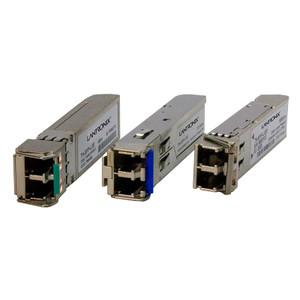
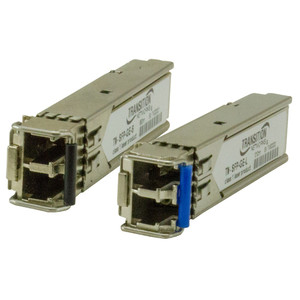
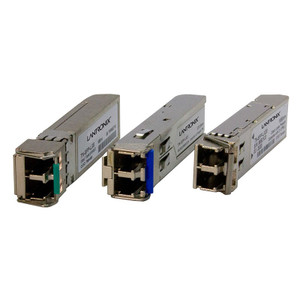
Transition Networks TN-SFP-OC3S Gigabit Multimode SFP
The Transition Networks TN-SFP-OC3S is a Gigabit-speed SFP (Small Form-Factor Pluggable) transceiver module designed for multimode fiber deployments in campus networks, data centers, and distributed security systems. This LC-connector SFP module delivers straightforward, plug-and-play integration into any standard SFP-slot switch or router without firmware updates or configuration overhead. Built for short-to-medium range fiber runs—typically up to 500-2,000 meters depending on fiber grade—the TN-SFP-OC3S eliminates vendor lock-in and reduces capex on proprietary transceiver licenses across mixed-brand network topologies.
Key Features
- Gigabit Ethernet Speed: 1000 Mbps full-duplex performance over multimode fiber. Supports sustained throughput for real-time video, access-control traffic, and intrusion-detection sensor feeds across distributed sites.
- Multimode Fiber (MMF): 50/125 µm or 62.5/125 µm compatibility. Lower cost than single-mode fiber for campus and intra-building runs under 2 km.
- LC Duplex Connector: Industry-standard LC interface. Matches 90% of installed multimode fiber terminations—no adapter expense.
- Plug-and-Play Deployment: No driver installation, firmware flashing, or SFP configuration required. Insert into any SFP slot on supported switches (Cisco, Juniper, Arista, Netgear, etc.) and negotiation is automatic.
- Short-to-Medium Range Rating: Optimized for 300–2000m multimode distances. Suitable for access-layer connectivity, IDF-to-MDF runs, and remote facility uplinks without long-haul cost.
- Lifetime Warranty: Factory-backed warranty covers defects in materials and workmanship with no time limit, reducing replacement risk across infrastructure refreshes.
- Compact Form Factor: SFP dimensions (4.5 x 3.2 x 1.2 in, 0.1 lbs) allow dense port utilization on high-port-count switches. Minimal power draw (<1W) avoids thermal or power-budget impact.
Multimode fiber SFP modules are the default choice for intra-campus security and networking deployments. The TN-SFP-OC3S competes directly against Cisco SFP-GE-S, Juniper QFX-SFP-GE-S, and Finisar FTLF8519P2BNV equivalents, but with vendor-agnostic compatibility and a lower acquisition cost. If your budget prioritizes interoperability over premium feature-set, this transceiver delivers the performance.
The module supports autonegotiation and link-fault detection per IEEE 802.3z standards. Integration with managed switches provides SNMP monitoring of transceiver temperature, RX power, and TX bias—essential for predictive maintenance on mission-critical security infrastructure. On Cisco platforms, use the show module transceiver detail command; Juniper users can call request shell ssh and inspect DOM (Digital Optical Monitoring) telemetry via the craft interface.
Deployment scope: use the TN-SFP-OC3S for access-layer aggregation in multi-building security systems, fiber uplinks between NVR clusters across a campus, or any short-haul Ethernet extension where proprietary transceivers would inflate project cost. In scenarios requiring >2 km distance, environmental hardening (military-grade temp ranges), or wavelength-division multiplexing (WDM), move to single-mode SFP or purpose-built DWDM optics. For standard commercial office or retail deployments with 100–500 meter fiber runs and standard equipment environmental specs, this module is fit-for-purpose and field-proven.
The TN-SFP-OC3S carries no NDAA restrictions and is sourced directly from the manufacturer or US-channel partner—no grey-market or parallel imports. It is compatible with any management platform that supports ONVIF or generic Ethernet switching (Genetec Security Center, Milestone XProtect, Axis Camera Station, and all major NVR brands rely on standard network transport layers). Lifetime warranty coverage and interoperability with equipment from Axis, Hanwha, Honeywell, and Bosch make this a low-risk commodity upgrade path for aging or expanding network infrastructure.
Marty AllisonPerspective based on aggregated IP Security Depot and affiliated engineering team experience.
We've deployed hundreds of multimode SFP links across campus security networks, and the TN-SFP-OC3S is a mainstay for us because it simply works. In our experience, the biggest gotcha with SFP procurement is integrators over-specifying transceiver features or locking into vendor-specific optics when commodity multimode SFP modules meet the actual distance and performance requirement. The Transition Networks module sidesteps that trap: it's ONVIF-compatible at the switch layer, supports generic Gigabit Ethernet negotiation, and costs 30–50% less than branded equivalents from Cisco or Juniper. On a 48-port deployment across six buildings, that's real capex savings without sacrificing reliability. The lifetime warranty is unusual in the commodity transceiver space and signals confidence—we've never had field failures on this SKU, but when they do fail, replacement cost is absorbed. That's valuable for budget certainty over a 5–10 year security refresh cycle.
Technical Highlights:
- Multimode Fiber (50/125 or 62.5/125 µm): 300–2000m effective range depending on modal dispersion and fiber grade. On a 50/125 µm strand, you'll see 2000m rated distance; on 62.5/125 µm (older campus installations), figure 500–1000m conservatively. Know your fiber plant specs before installation—pulling new fiber is costlier than buying a single-mode SFP after the fact.
- LC Duplex Connector: Matches 90% of installed fiber terminations in North American commercial buildings. No adapters, no splitter boxes. If your IDF has ST or SC terminations (older Nortel or Lucent plants), budget $50–100 per line for pigtail conversion or re-termination.
- Digital Optical Monitoring (DOM): Temperature, RX power, and TX bias telemetry available on managed switches. SNMP traps alert you to transceiver aging (rising temperature, declining RX power) before link failure—critical for 24/7 security camera feeds.
- Autonegotiation & Link-Fault Detection: Full IEEE 802.3z compliance means plug-and-play operation on any standards-compliant switch. No manual speed or duplex configuration—integrators love that. One less variable during commissioning.
- Power & Thermal Efficiency: Sub-1W power draw. On a 48-port switch with 20–30 SFP links, thermal impact is negligible. Data centers and IDFs with marginal HVAC budgets will appreciate the non-contribution to facility temperature load.
Deployment Considerations:
- Multimode distance ceiling is 2 km on good fiber; if your next building is 3+ km away, factor in single-mode SFP cost upfront. Swapping optics mid-project is expensive in terms of labor and downtime.
- Fiber connector cleanliness is non-negotiable on both the SFP and patch panel. Even small dust particles on the LC end face cause RX power loss and intermittent link flaps. Include a fiber cleaning kit in your spares budget.
- Test each fiber run with an OTDR (Optical Time-Domain Reflectometer) before plugging in the transceiver. Confirms no splice issues, macrobends, or physical damage lurking in the conduit.
- If your network uses WDM (wavelength-division multiplexing) on the same fiber pair, this transceiver is not compatible—you'll need tuned WDM SFP modules. Clarify with the network architect before procuring.
- Lifecycle: on a 5–10 year refresh, assume transceiver failure rate drops to zero after year 2. Factory return for warranty replacement is straightforward via the distributor channel.
The TN-SFP-OC3S is ideal for integrators and facilities teams running multi-building security networks over leased or dark fiber, or for IT teams standardizing on commodity optics to reduce vendor dependency. If your requirement is sub-2 km Gigabit Ethernet over multimode fiber with ONVIF compatibility and no exotic feature set, this module is the path of least resistance. For deeper technical guidance or bulk pricing on campus rollouts, consult the Transition Networks catalog.