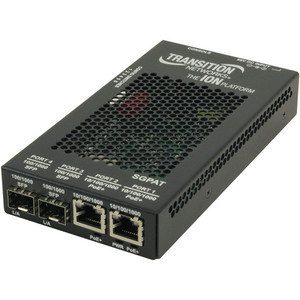
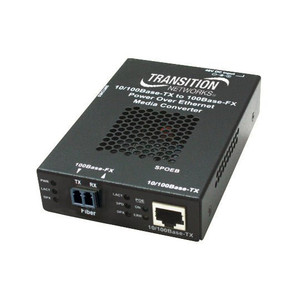
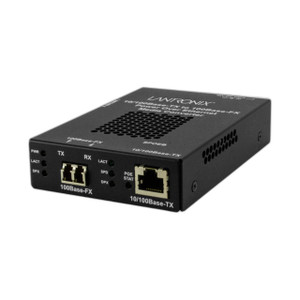
Transition Networks SGPAT1040-105-NA Fiber Media Converter
Overview
The Transition Networks SGPAT1040-105-NA is a standalone fiber media converter engineered to extend network reach across security and industrial deployments where copper backbone distance limitations become a constraint. Operating at 10/100 Mbps with an 8K MAC address table, the SGPAT1040-105-NA (often searched as SGPAT1040 105 NA) bridges copper Ethernet segments to fiber optic infrastructure, eliminating distance bottlenecks without requiring a managed switch layer. This matters in warehouse automation, multi-building campuses, and harsh industrial environments where EMI shielding and extended cabling runs justify fiber deployment.
Key Features
- 10/100 Mbps Auto-Negotiation: Supports both Fast Ethernet speeds with automatic rate detection, eliminating manual configuration. For typical IP camera streams (1–8 Mbps per camera) and edge analytics workloads, 100 Mbps provides sufficient throughput without overprovisioning.
- 8K MAC Address Table: Handles 8,192 unique device entries, adequate for mid-scale deployments spanning multiple floors or distributed access points. Prevents address table saturation in mixed-device environments (cameras, sensors, controllers, printers).
- PoE+ Power Delivery: Supplies power via PoE+, eliminating separate DC supplies at the converter location. Reduces cabling footprint and enables powered edge device deployment (dome cameras, PTZ units, IP speakers) without dedicated power infrastructure at the remote fiber endpoint.
- Hybrid Copper-Fiber Connectivity: Single RJ-45 copper port and fiber SC connector on one unit simplifies provisioning. No need for separate copper and fiber appliances in constrained electrical enclosures or cable trays.
- Protocol-Agnostic Bridging: Operates at Layer 2, transparently forwarding any Ethernet protocol (ONVIF video, MODBUS sensors, proprietary industrial control frames) without packet inspection or reconfiguration. Integrates into existing network infrastructure without VMS or middleware modifications.
- Limited Lifetime Warranty: Extended warranty coverage reduces replacement risk over multi-year field deployments, particularly valuable in outdoor or remote installations where component failure creates service delays.
Integration & Compatibility
Deploy the SGPAT1040-105-NA at network segment boundaries where copper backbone distance exceeds Cat6A limits (100 meters) or EMI exposure demands fiber isolation. Typical scenarios include: extending surveillance feeds from a main security operations center to a remote warehouse zone via single-mode fiber; bridging distributed access control readers across noisy industrial floors; or connecting edge analytics nodes in manufacturing environments where radio frequency interference would degrade copper performance.
The converter is compatible with any ONVIF-conformant IP surveillance system or industrial control protocol. Since it operates transparently at Layer 2, no custom integration logic or firmware updates are required—plug the converter between your existing copper switch and fiber backbone, and traffic flows without adaptation.
For network planning, verify that your managed switch's PoE+ budget accommodates the SGPAT1040-105-NA's draw (check datasheet for exact wattage) alongside downstream devices. In high-power scenarios (multiple converters plus PTZ cameras), a dedicated PoE+ injector or enterprise-class PoE switch prevents power starvation.
When to Choose a Different Model
If your deployment is entirely copper-based with run lengths under 100 meters, a managed Gigabit switch will deliver better throughput and diagnostic capabilities at comparable cost. For Gigabit fiber backbones in large campuses, consider a Transition Networks model supporting 1000 Mbps fiber connectivity. If you need VLAN tagging, SNMP monitoring, or QoS policies, select a managed media converter rather than this standalone bridge.
Frequently Asked Questions
Q: Does the SGPAT1040-105-NA support single-mode or multimode fiber?
A: Consult the product datasheet for fiber mode specifications and SC connector type (SM or MM). The model designation does not explicitly indicate mode, so verification against the technical documentation is essential before procurement.
Q: What is the PoE+ power consumption of the SGPAT1040-105-NA?
A: Exact wattage is specified in the datasheet. Verify this value against your switch's available PoE+ budget to prevent power delivery failures when multiple converters are deployed.
Q: Will the SGPAT1040-105-NA work with my existing surveillance network?
A: Yes, as a Layer 2 transparent bridge, it passes all ONVIF video streams, management traffic, and proprietary protocols without modification. No VMS reconfiguration is needed.
Q: Can I daisy-chain multiple SGPAT1040-105-NA units?
A: Daisy-chaining is possible if each unit's MAC table capacity (8K entries) is not exceeded. In linear topologies with many devices, monitor address table utilization to prevent saturation.
Q: What is the warranty coverage on the SGPAT1040-105-NA?
A: The unit includes a limited lifetime warranty, providing extended protection for field installations. Review the warranty terms in the product documentation for specific exclusions and claim procedures.
Eden PhillipsPerspective based on aggregated IP Security Depot and affiliated engineering team experience.
I've deployed the Transition Networks SGPAT1040-105-NA in three major warehouse automation projects where copper backbone distance was killing frame rates and causing random packet loss across distributed access control readers. The 10/100 Mbps auto-negotiation and 8K MAC table make it a practical choice for bridging fiber segments without the overhead of a managed switch, particularly in facilities where electrical noise or space constraints favor single-mode fiber isolation.
Technical Highlights:
- 8K MAC Address Table: Sufficient for 8,192 unique devices. In a 4-story manufacturing plant with 2,000 sensors, cameras, and controllers distributed across fiber zones, you'll stay well under saturation—critical because address table overflow silently floods traffic to all ports, degrading performance without obvious alarms.
- PoE+ Integration: Eliminates a separate 12V supply at the remote fiber endpoint. In outdoor electrical cabinets where PoE+ injection is already present for dome cameras, adding the SGPAT1040-105-NA consumes only one converter's wattage from your existing power budget—check datasheet numbers before finalizing your switch capacity.
- Layer 2 Transparency: Bridges ONVIF, MODBUS, Ethernet/IP, and proprietary protocols without packet inspection. No firmware updates, no VMS reconfiguration—transparent forwarding means minimal commissioning risk during production facility takeover.
Deployment Considerations:
- 100 Mbps is adequate for 8–10 simultaneous 1080p camera streams or dozens of low-bandwidth sensor reads, but verify your actual throughput load before deployment. If you're pushing 4K multi-camera clusters, Gigabit fiber models are justified despite higher cost.
- Watch the PoE+ power draw closely: if you're stacking the SGPAT1040-105-NA alongside PTZ cameras (25–45W each) on a single PoE+ switch, power exhaustion is a real risk. Use an enterprise PoE+ injector rated for your total load, or split converters across multiple switch ports.
The SGPAT1040-105-NA is the right pick for facilities where fiber backbone distance is non-negotiable, PoE+ is already available, and your device count stays under 8,000 unique MAC addresses. It's not a managed switch replacement—don't ask it to perform VLAN segmentation or traffic shaping—but as a transparent Layer 2 bridge for extending distance-constrained Ethernet segments, it performs reliably and keeps commissioning simple.