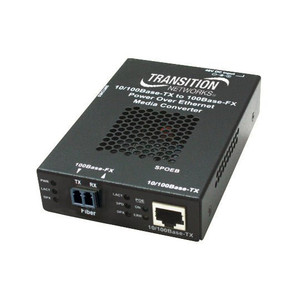
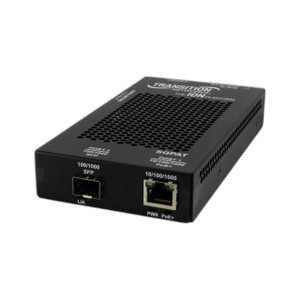
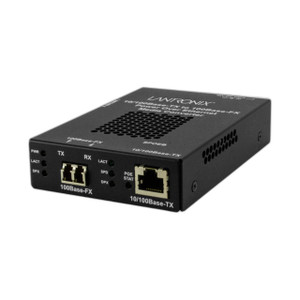
Transition Networks SBFTF1013-105-NA Fiber Media Converter
Overview
The Transition Networks SBFTF1013-105-NA is a standalone fiber media converter engineered to extend copper Ethernet networks across single-mode fiber infrastructure. It bridges 10/100BASE-TX twisted-pair connections to 100BASE-FX fiber runs, eliminating the need for costly fiber-optic NICs or switch line cards when extending surveillance, access control, or distributed sensor networks beyond copper distance limitations. The compact form factor fits seamlessly into network closets, equipment racks, or distributed field installations where fiber backbone infrastructure already exists.
Key Features
- 10/100BASE-TX to 100BASE-FX conversion: Connects standard copper Ethernet devices directly to single-mode fiber without requiring managed switches or active configuration. Saves money versus upgrading hardware endpoints to fiber-capable models.
- Single-mode fiber support: Operates over single-mode fiber runs, which tolerate greater distances than multimode — typically 2 km (6,560 feet) or more depending on the fiber segment and link budget. Essential for sprawling campuses, outdoor surveillance perimeters, or separating noisy electrical infrastructure from sensitive camera or sensor networks.
- Standalone operation: No management interface, no configuration, no IP address assignment required. Plug the copper RJ-45 into one port, fiber into the other, and power on. Ideal for integrators who want zero operational overhead on extended backbone links.
- Auto-negotiation support: Automatically detects link speed (10 Mbps or 100 Mbps) and adapts without manual intervention. Works with legacy 10BASE-T equipment as well as modern 100BASE-TX devices, reducing compatibility friction in mixed-age surveillance or security deployments.
- Low power consumption: Compact and efficient design minimizes thermal output and power-budget impact, important in cabinets or enclosures where space and cooling are constraints.
- Industry-standard connectors: RJ-45 on the copper side and standard SC or LC fiber connectors (depending on configuration) ensure spares and replacements are readily available across the supply chain.
Integration & Compatibility
The SBFTF1013-105-NA works with any network infrastructure that sends or receives 10/100BASE-TX Ethernet — IP cameras, NVRs, access control readers, intercoms, or any standard networked security device. Pair it with managed or unmanaged network switches on the copper end to distribute the converted signal across multiple devices, or use one-to-one for point-to-point backbone extension. No special driver, firmware, or VMS configuration required; the converter is transparent to all upstream and downstream systems.
Deployment Context
Security integrators frequently deploy media converters to solve distance and isolation problems: extending surveillance to remote building wings, bridging separated campuses over existing fiber conduit, isolating high-noise electrical equipment from sensitive camera or sensor feeds, or future-proofing infrastructure by installing fiber backbone now and converting to copper at endpoints as needed. The SBFTF1013-105-NA (often searched as SBFTF1013 105 NA) handles these scenarios with zero operational complexity, making it a standard tool in network design when fiber infrastructure is already in place.
Frequently Asked Questions
Q: What is the maximum distance this converter supports?
A: Distance depends on the fiber segment, link budget, and SFP optics installed. Single-mode fiber typically supports 2 km (6,560 feet) or more. Consult the installed fiber specifications and manufacturer SFP data for your specific run.
Q: Does the SBFTF1013-105-NA require power?
A: Yes, it requires external DC power (typically 12VDC or similar — refer to the product datasheet for the exact requirement). It cannot run on PoE alone.
Q: Can I use this converter on multimode fiber?
A: The SBFTF1013-105-NA is specified for single-mode fiber. Using it on multimode infrastructure may result in signal degradation or link failure. Verify your fiber type before deployment.
Q: What happens if I connect two converters back-to-back (copper-fiber-copper)?
A: This is a standard configuration — copper device → converter → fiber backbone → converter → copper device. No special configuration needed; the converters operate transparently.
Q: Is there a managed version of this converter with status LEDs or SNMP monitoring?
A: The SBFTF1013-105-NA is a standalone, unmanaged converter. For SNMP or advanced monitoring, consult the broader Transition Networks product line or alternative vendors offering managed media converters.
Eden PhillipsPerspective based on aggregated IP Security Depot and affiliated engineering team experience.
The Transition Networks SBFTF1013-105-NA fills a real gap in network extension design: it lets you preserve existing copper infrastructure and camera deployments while extending them across fiber backbone that's already installed. No NIC upgrades, no firmware surprises, no protocol negotiation — it just moves bits from copper to glass and back.
Technical Highlights:
- Auto-negotiation (10/100 Mbps): Detects link speed automatically, so a legacy 10BASE-T sensor network can share the same converter hardware as newer 100 Mbps camera feeds. One SKU covers both.
- Single-mode fiber topology: Fiber distance tolerance (typically 2+ km) is transformative for large campus designs — you can isolate EM noise from substations, run extended perimeter surveillance, or separate security zones without distance penalties.
- Zero management overhead: No IP address, no configuration, no monitoring. This converter vanishes from your network topology — perfect for integrators who want reliability without operational headache.
Deployment Considerations:
- Single-mode fiber requirement: Verify your fiber infrastructure is single-mode before ordering. Multimode fiber will cause link degradation or failure. This is non-negotiable.
- External DC power: Unlike cameras that run on PoE, this converter needs a dedicated power source. Budget for AC-to-DC supply or a dedicated 12VDC rail in your cabinet.
- Unmanaged is a feature and a limitation: No status LEDs, no SNMP alarms, no way to know remotely if the converter has failed. In mission-critical backbone runs, consider redundant paths or managed alternatives if visibility is a hard requirement.
The SBFTF1013-105-NA is best suited to backbone extension and noise isolation in larger surveillance or distributed security deployments — places where fiber infrastructure is already in place and you need to preserve copper device investments without introducing management complexity. If your network is all copper and you need only modest distance extension, consider copper repeaters or switches instead.