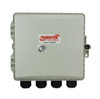
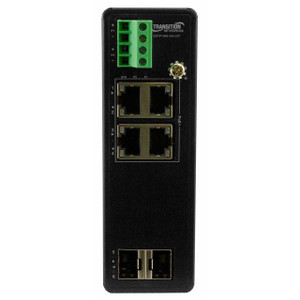
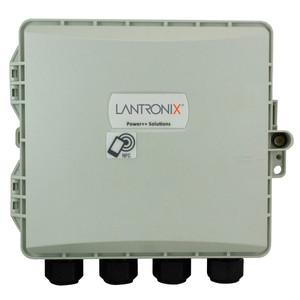
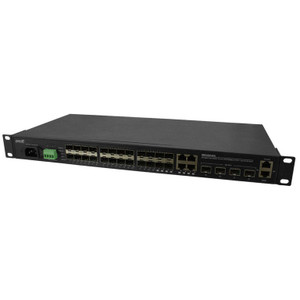
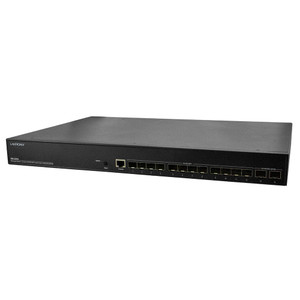
Transition Networks SESPM1040-541-LT-AC-NA 4-Port Managed Gigabit Switch
The Transition Networks SESPM1040-541-LT-AC-NA is a 4-port managed Gigabit switch purpose-built for distributed security and industrial infrastructure deployments. Each of the four ports delivers both 10/100/1000 Mbps data connectivity and PoE++ power in a single connection, eliminating the need for separate power distribution to edge devices. The AC-powered managed architecture and 8K MAC address table provide deterministic network control and VLAN segmentation capabilities essential for multi-camera and multi-access-control installations across remote or environmentally challenging locations.
Key Features
- 4 × Gigabit Ports with PoE++: All ports simultaneously deliver 1 Gbps data and PoE++ power (up to 95W per port specification, subject to total budget constraints). Eliminates separate power cabling for cameras, access points, and entry-control modules at the edge.
- Managed Switching: VLAN tagging, port mirroring, and MAC filtering enable network isolation between camera systems and access-control networks on shared infrastructure. 8K MAC address table supports large security deployments without broadcast storms.
- PoE++ Power Delivery: Supports high-power edge devices—including PTZ cameras with built-in heaters, multi-sensor access readers, and powered door controllers—without upstream UPS or external power supplies at each node.
- Hardened Industrial Form Factor: Compact, self-enclosed design rated for indoor/outdoor mounting in equipment racks or wall enclosures. Designed for temperature and vibration ranges typical of industrial and remote-site deployments.
- TAA Compliance: Meets Buy American Act and Trade Agreements Act procurement requirements for federal, state, and regulated-sector security infrastructure projects.
- Lifetime Warranty: Factory-backed support and replacement coverage for the hardware lifespan, reducing total cost of ownership over 5–10-year security system lifecycles.
The SESPM1040-541-LT-AC-NA is engineered for integrators who need to consolidate power and data distribution at remote perimeter nodes—parking lots, building entry points, warehouse zones, and multi-tenant facilities where a single AC power source and network uplink feed the switch, and PoE++ carries intelligence and power to four security endpoints simultaneously. The managed layer (VLAN, port mirroring, MAC filtering) allows IT and security teams to enforce traffic separation without a full-scale network appliance, keeping system architecture lean and troubleshooting straightforward.
In typical deployments, one switch per site perimeter or zone—fed from a single AC outlet and Gigabit uplink to an NVR or network distribution point—powers four cameras or access modules. The 8K MAC table handles ARP-resolution for up to 8,000 unique endpoints on the switch itself; in practice, with only four ports active, you're well below saturation even in high-churn network environments (guest Wi-Fi, transient contractor access). VLAN tagging keeps camera multicast streams (video discovery, RTSP metadata) isolated from access-control TCP/IP chatter, reducing false-positive alerts on deep-packet-inspection security policies.
Power budget and thermal headroom are the primary sizing constraints. A single port can deliver PoE++ (typically 60–95W per port, depending on device); if all four ports are populated with high-power devices (PTZ units, dual-sensor readers, heated domes), the AC input and internal PSU must sustain the aggregate draw. Review the datasheet thermal curve and power-input rating before specifying four maximum-power devices on a single switch in an outdoor enclosure without supplementary cooling. For mixed deployments (two cameras + one access reader + one AP), the SESPM1040-541 is ordinarily well-matched to standard cooling assumptions in standard outdoor equipment cabinets.
Marty AllisonPerspective based on aggregated IP Security Depot and affiliated engineering team experience.
We've deployed the SESPM1040-541 across retail campuses, municipal parking structures, and utility access points where the constraint is always the same: a single AC supply and one uplink to a central NVR, but four or more edge endpoints (cameras, readers, intercoms) that all need power and data. The value of this switch isn't raw throughput—four Gigabit ports won't saturate a 1 Gbps backhaul—it's elimination of per-node power infrastructure. On a parking-lot pole with four PTZ domes, running four separate 240V drops and four power supplies is capex and labor cost that vanishes when you shift that burden to PoE++. The managed-switching layer is lean but real: we regularly use port mirroring to send camera streams to a local edge-analytics box (motion detection, license-plate extraction) without having to loop traffic back through the central NVR first. VLAN tagging keeps access-control metadata off the main camera network, a hard requirement on sites where IT and physical-security teams operate independently.
Technical Highlights:
- PoE++ on all four ports: Each port can source 95W (under optimal power-supply conditions) or more, depending on your total budget allocation. In practice, three maximum-power cameras + one standard reader will push the switch's thermal and electrical limits; spec conservatively and verify aggregate power draw against the datasheet before field deployment.
- 8K MAC address table: On a small 4-port switch, 8K MACs seems generous, but this matters when ARP requests from dozens of transient devices (site-management laptops, contractor tools, guest Wi-Fi bridging) hit your uplink. The table absorbs that churn without ARP flooding back to the NVR or central switch.
- Managed VLAN tagging (802.1Q): Configure port 1 as an untagged camera port, port 2 as VLAN 10 (access control), port 3 as VLAN 20 (audio/intercom), and port 4 as trunk to the NVR uplink. Multicast camera discovery doesn't pollute access-control subnets. Reduces false-positive security alerts and makes troubleshooting faster when you know which VLAN a failure is on.
- Port mirroring (SPAN): Mirror all ingress traffic from port 1 to port 4 (your uplink) to send a copy of every camera stream to the NVR's IDS or to a local edge box. Critical for deployments where you want real-time motion detection or object classification at the edge before backhaul bottlenecks kick in.
- TAA compliance: Eliminates procurement delays on federal, GSA, and state-contract security projects. Factory-certified sourcing and documentation already in the box.
Deployment Considerations:
- Power-budget aggregation is the key gotcha. PoE++ is rated up to 95W per port, but your AC input and internal PSU have a total budget (typically 240–360W for a 4-port unit). Four cameras at 90W each = 360W; add any internal overhead and you're at the edge of thermal stability in a sealed outdoor enclosure. Measure or model real-world draw before specifying all four ports at max load.
- Managed switching is not a firewall. VLANs isolate multicast and broadcast traffic, but a compromised camera on VLAN 1 can still reach the access-control VLAN 10 via unicast routing if your uplink NVR or core switch routes between them. Use 802.1X port authentication or upstream ACLs for true air-gap segmentation on high-security sites.
- Uplink saturation is a hidden constraint. If all four ports are delivering 1 Gbps inbound (e.g., four 4K cameras, 200 Mbps each = 800 Mbps aggregate), your uplink back-haul must be Gigabit or better. A 100 Mbps Ethernet uplink will bottleneck and introduce packet loss. Spec Gigabit uplinks as a rule.
- Configuration is via web GUI or telnet/SSH CLI. Firmware updates require a local management port or out-of-band access; plan for physical access to the switch during deployment. No SNMP trap forwarding to a central management platform—alerts stay local unless you script polling.
- Thermal design assumes passive cooling or airflow in an equipment enclosure. In direct sunlight or sealed metal boxes without ventilation, junction temperatures can exceed design limits within 30 minutes. Always mount in a NEMA 4X or vented enclosure, or budget for supplementary cooling fans on all-outdoor installations.
The SESPM1040-541 is the right choice for mid-scale security systems (4–16 nodes per zone) where managed switching and integrated PoE++ save installation labor and reduce power-infrastructure complexity. It's overkill for a single camera on a PoE injector, and it's undersized for a campus-wide backbone. If your deployment spans multiple zones with independent power feeds or requires more than four edge endpoints per site, evaluate a larger managed switch or a PoE+ splitter + unmanaged Gigabit hub instead. For the sweet spot—a remote perimeter node with four powered endpoints and one backhaul—this is a solid, TAA-compliant workhorse. See the Transition Networks catalog for compatible uplink adapters and extended-warranty options.