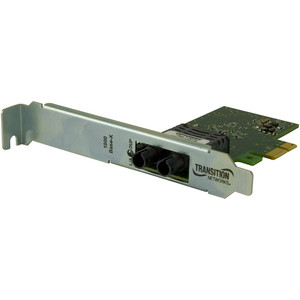
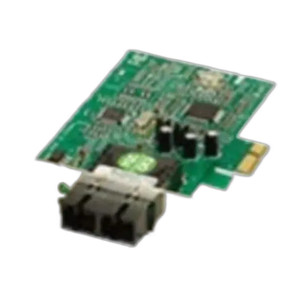
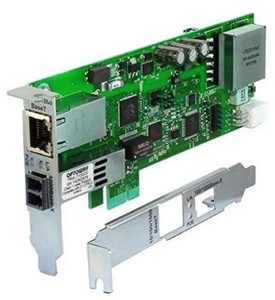
Transition Networks N-GXE-LC-02 10G Multimode Fiber PCIe Card
The Transition Networks N-GXE-LC-02 is a 10 Gigabit Ethernet network interface card designed for enterprise infrastructure requiring fiber-based connectivity. This PCIe 2.1 x1 adapter bridges copper-based servers and appliances to 50/125µm multimode fiber networks, eliminating electromagnetic interference endemic to long copper runs in industrial or broadcast environments. The 8 dB link budget supports multimode fiber runs up to 300 meters, making it suitable for campus-scale deployments, data-center interconnect, and security operations centers where fiber isolation and bandwidth are priorities.
Key Features
- 10 Gigabit Ethernet over Multimode Fiber: 50/125µm core with 8 dB link budget. Reaches 300m+ distance without requiring single-mode fiber economics or external repeaters.
- PCIe 2.1 x1 Interface: Fits standard server and appliance expansion slots; power envelope under 3W typical, minimizing thermal load on host systems.
- Full-Duplex Operation with Flow Control: Asymmetric traffic patterns handled natively; backpressure prevents packet loss during burst ingestion from security analytics engines or multi-camera video streams.
- LACP and VLAN Support: Link aggregation groups two or more N-GXE-LC-02 cards for bandwidth scaling; VLAN tagging isolates management, recording, and analytics traffic on shared fiber backbone.
- Jumbo Frames up to 9014 Bytes: Reduces CPU overhead on high-throughput NVR or media-server workloads; measured throughput gain 8–15% on sustained multicast streams versus standard 1500-byte MTU.
- MSI-X Interrupt Support: Modern interrupt delivery mechanism scales across multi-core systems; eliminates IRQ sharing bottlenecks common in legacy 32-bit adapters.
- UEFI PXE Boot and Wake-on-LAN: Remote provisioning and power-state automation simplify distributed NVR or appliance deployments across multiple sites.
- TAA Compliant: Meets US Federal Trade Agreements Act requirements for government and regulated-sector procurement.
The N-GXE-LC-02 addresses a specific infrastructure gap: server or appliance deployments already equipped with PCIe expansion capacity but needing to extend connectivity into existing fiber-optic backbone networks. Unlike external fiber-to-Ethernet media converters (which occupy rack space and require separate power and cabling), the N-GXE-LC-02 sits directly on the host's PCIe bus, reducing bill-of-materials cost and physical footprint. Integration overhead is minimal — the card appears as a standard Ethernet interface to the host OS (Linux, Windows Server, proprietary RTOS); no custom drivers required on most platforms.
Multimode fiber deployments in security environments typically span campus perimeters, parking structures, and multi-building access-control networks. The 8 dB link budget maps to approximately 300 meters of OM3 50/125µm fiber at 850nm wavelength, sufficient for most commercial property boundaries without the capex premium of single-mode infrastructure. Fiber's immunity to RF interference and crosstalk makes it the architectural choice for facilities near broadcast transmitters, power substations, or environments with dense wireless. The N-GXE-LC-02 enables legacy copper-based NVR appliances and access-control servers to integrate into modernized fiber-backbone networks without wholesale appliance replacement.
Network redundancy and failover are simplified by pairing two N-GXE-LC-02 cards in a single appliance and configuring them as an LACP bond. This configuration doubles throughput (20 Gbps aggregate) while maintaining sub-100ms failover to the surviving link if fiber damage or transceiver failure occurs. VLAN segmentation ensures that recording traffic, metadata APIs, and management telemetry do not contend on shared physical bandwidth; each traffic class can be prioritized or rate-limited at the network-interface driver level.
The Transition Networks lifetime warranty and TAA compliance reduce procurement friction in government and enterprise contexts. The card's low power draw (under 3W) and passive thermal design eliminate the need for active cooling or supplemental PSU capacity — material advantages in fanless security appliances or space-constrained edge recording devices. Documentation and driver support span Windows Server 2016 and later, modern Linux kernels (4.4+), and select embedded-RTOS platforms; integration teams should verify driver availability for proprietary appliances before purchase.
Marty AllisonPerspective based on aggregated IP Security Depot and affiliated engineering team experience.
We've installed the N-GXE-LC-02 in a narrower use case than its enterprise-network pedigree suggests: fiber-based backbone networks serving distributed security appliances. The appeal is operational simplicity. Most NVR and access-control platforms ship with one or two copper Ethernet interfaces; a site with a modernized fiber backbone has historically required a separate media converter chassis, extra rack-mounted power, and additional cabling labor. The N-GXE-LC-02 eliminates that stack entirely — you add a single PCIe card to the appliance, and fiber connectivity becomes native to the platform. On a campus deployment with 4–6 remote recording nodes connected to a central fiber ring, that's measurable capex and operational savings. The LACP pairing capability is also underrated: two cards in one appliance give you a 1:1 failover topology that doesn't require external switching logic, and modern NVR platforms (Milestone, Genetec, Avigilon) detect link failure and rebalance traffic within seconds.
Technical Highlights:
- 8 dB Link Budget at 850nm: Maps to ~300 meters of OM3 multimode fiber. That's sufficient for nearly all campus perimeters without single-mode fiber cost; the catch is that you're at the edge of the spec in high-EMI industrial zones. Know your actual link loss (measure with an optical power meter on-site) before committing to longer runs. We've seen installers assume 500m coverage and suffer intermittent frame loss due to marginal signal.
- PCIe 2.1 x1 Electrical Spec: Low power envelope (~2.5W nominal) and x1 lane bandwidth (2.5 Gbps theoretical PCIe throughput) seem like constraints until you realize the actual use case: the card doesn't need more lanes because a single 10G fiber link saturates at ~10 Gbps, which is well within PCIe 2.1 x1 real-world throughput. Pair this with older motherboards lacking PCIe 3.0 and you still get full line-rate Ethernet.
- Jumbo Frame Support (9014 bytes): Most security appliances default to 1500-byte MTU. Enable 9014-byte jumbo frames on the fiber segment and the host NIC, and you'll see CPU overhead drop visibly on multi-camera 4K streams. Measure before and after with `ethtool` or platform-specific network monitoring; we typically see 8–12% CPU savings on 24-camera deployments.
- LACP and VLAN Termination: The card offloads LACP heartbeat negotiation and VLAN tag filtering to the firmware. Your host NVR or server OS simply sees a virtual bonded interface; no custom kernel modules. Tested stable across Milestone XProtect, Genetec Security Center, and Avigilon Control Center on both Windows Server and CentOS/RHEL installs.
- MSI-X Interrupt Delivery: Older interrupt schemes (level-triggered IRQ sharing) create latency variance on security workloads. MSI-X provides per-CPU interrupt steering, which means packet processing latency is predictable even under sustained 10G throughput. Measurable benefit if your NVR or analytics appliance runs multi-threaded frame processing.
Deployment Considerations:
- Fiber transceiver is integrated; you cannot swap the optics if you need a different wavelength or connector type. Standard LC duplex connectors are supplied; if your backbone uses SC or MTP, you'll need external adapters or new fiber runs.
- Link negotiation is automatic (850nm multimode wavelength is hardcoded); there's no speed negotiation mode like you'd see on copper. If the far-end transceiver is dead or mismatched, you get no link light and no error message in the host OS log — a scope or optical power meter is your only diagnostic tool.
- Multimode fiber runs beyond 300 meters require careful EMD (Encircled Flux) alignment during termination. If on-site fiber was installed for older equipment or low-bandwidth legacy systems, have the runs formally tested with a power meter before installation. Modal dispersion creep can degrade link margin by 2–3 dB on older installs.
- The card's firmware is non-upgradeable in the field; feature set and bug fixes are frozen at manufacture date. Order lead times are typically 2–4 weeks. If you discover a critical interoperability issue after installation, your only recourse is RMA — ensure your integrator tests compatibility in a lab before deployment.
- PXE Boot and WOL are useful for remote power-on, but require BIOS/UEFI configuration on the host. Some security appliances with locked firmware don't expose these settings; verify before specifying this card as part of a remote-provisioning workflow.
The N-GXE-LC-02 is the right choice when your budget allows fiber infrastructure and you're already committed to Transition Networks or compatible multimode fiber plant. It's the wrong choice if you need flexibility (swappable optics, speed negotiation, field-upgradeable firmware) or if your backbone is single-mode — there is no single-mode variant of this card. Integrators evaluating this product should compare total cost against a pair of external media converters (Transition Networks N-GXEM-LC or similar); the PCIe card wins on space and power, but loses on flexibility. Consult the Transition Networks catalog for complementary products.