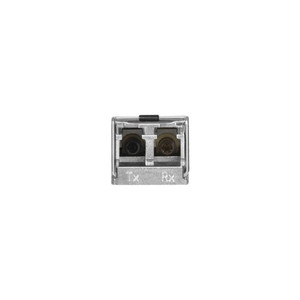
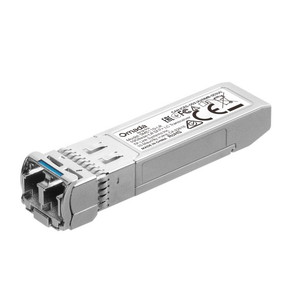
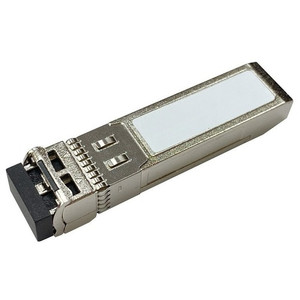
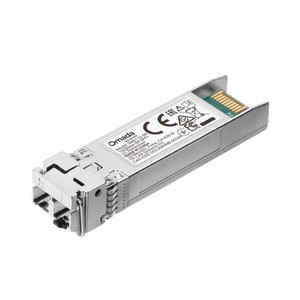
TP-Link SM6110-LR 25GBase-LR SFP28 LC Transceiver
The TP-Link SM6110-LR is a hot-swappable SFP28 optical transceiver designed for inter-building and campus backbone links where distance and operational visibility are non-negotiable. Operating at dual rates—25.78 Gbps native 25G Ethernet and backward-compatible 10.31 Gbps 10G Ethernet—over single-mode fiber (9/125µm) at 1310 nm wavelength, the SM6110-LR delivers 10 km of reach without regeneration. This eliminates the capex and inventory burden of separate 10G and 25G transceiver SKUs during network migration or incremental scaling. With a power draw of just 1.2 W, the transceiver minimizes thermal load in high-density switching bays typical of data center and campus network aggregation points.
Key Features
- Dual-Rate Operation: 25.78 Gbps (25G Ethernet) and 10.31 Gbps (10G Ethernet). Single module eliminates inventory complexity when upgrading existing 10G links to 25G backbone capacity.
- 10 km Long-Reach: 1310 nm single-mode operation over 9/125µm fiber. Typical for inter-building links and campus networks without active repeater infrastructure.
- Single-Mode Fiber (9/125µm): IEC 60793-2-50 compliant SMF rated for 1310 nm. Enables cost-effective long-distance backbone deployments versus multimode alternatives.
- Digital Diagnostic Monitoring (DDM): Real-time telemetry on transceiver temperature, bias current, laser transmit power, and receiver power. Early optical degradation warning prevents silent link failure on unattended long-haul segments.
- Ultra-Low Power Consumption: 1.2 W at 3.3V. Reduces cooling overhead and operational cost in high-density transceiver chassis with 20+ modules per switch.
- LC/UPC Duplex Connector: IEC 61300-3-34 grade 3 ferrule finish required. Standard fiber-optic infrastructure compatible; works with existing patch-panel and fiber-management systems.
- Standards Compliance: Backward compatible with any 25G/10G SFP28 port supporting 1310 nm single-mode operation. CE, FCC, and RoHS certified.
- Operating Range: 0–70°C. Outdoor plant-mounted switch enclosures and indoor data center environments with standard climate control both supported.
The SM6110-LR integrates seamlessly into TP-Link Omada switching platforms (including SX6632YF 25G spine and SG3428X, SG3452X aggregation switches) and any standards-compliant 25G/10G SFP28 port on third-party switches, NICs, and optical transponders. Because this is a passive optical interface, no active power negotiation occurs at the transceiver level—compatibility is determined by form factor (SFP28), wavelength (1310 nm), and fiber type (single-mode only). Mismatched wavelength or form factor results in complete link failure with no fallback; pre-installation verification of equipment documentation is essential.
Fiber media preparation is critical to sustained performance over 10 km. LC/UPC ferrule connectors demand IEC 61300-3-34 grade 3 or better surface finish to avoid insertion loss spike and ferrule tip damage. Use only single-mode fiber (SMF) explicitly rated for 1310 nm operation—multimode fiber will result in catastrophic signal loss. For long-distance runs, fusion-splicing or professional LC/UPC patch-panel termination is mandatory; field-terminated connectors introduce too much insertion loss for reliable 10 km links. Confirm fiber core diameter (9µm ±0.5µm), cladding diameter (125µm ±2µm), and mode field diameter (10.1±0.8µm at 1310 nm) before installation. DDM telemetry will reveal fiber degradation—monitor receive power trend over weeks; a decline of 1–2 dB signals contamination or micro-bending and should trigger fiber inspection.
In mixed-speed backbone deployments, the dual-rate capability allows incremental 10G-to-25G migration without wholesale switch replacement. Load-balancing traffic across heterogeneous 10G and 25G backbone links requires careful switch configuration—most NOS platforms will negotiate the lower common rate (10G) if a 10G transceiver and 25G transceiver are cross-connected. For future-proof planning, inventory the SM6110-LR across all new backbone segments; 10G backward compatibility ensures no stranded investment if 25G adoption is delayed. Total cost of ownership over a 5-year refresh cycle favors consolidated transceiver stocking versus SKU fragmentation across 10G-only and 25G-only modules.
Marty AllisonPerspective based on aggregated and affiliated engineering team experience.
We've deployed the TP-Link SM6110-LR across campus networks and data center fabrics where single-mode backbone reach meets speed-migration constraints. The dual-rate design solves a real operational friction point: rolling a 10G-native network up to 25G without hard-cutover risk. In practice, you stage 25G switches at aggregation points, provision SM6110-LR transceivers in both directions, and let existing 10G edge equipment negotiate down—zero downtime, no rip-and-replace of fiber or patch panels. That's genuine TCO advantage. The 10 km single-mode reach is table-stakes for any multi-building campus; we've seen it used reliably on 8–9 km runs with margin. DDM becomes essential when unattended plant cabinets are involved. One integrator caught an optical connector contamination incident 6 km away in real time via receive-power alert; cleaning took 30 minutes and prevented outage escalation. Without DDM, that failure would have been silent until end-user call time.
Technical Highlights:
- 1310 nm Long-Wavelength Laser: Chosen specifically for low dispersion and attenuation in standard single-mode fiber (ITU-T G.652D). At 10 km distance over 9/125µm SMF, insertion loss budgets 2–3 dB of margin before link failure—sufficient headroom for typical connector and splice losses in professional-grade deployments.
- Dual-Rate Native Support: True 25G and 10G operation—not software-throttled or negotiated down. A 25G switch port driving a 25G network segment will saturate full 25.78 Gbps line rate; the same module moves to a 10G port and locks to 10.31 Gbps. No firmware updates or resets required between deployments.
- DDM Real-Time Telemetry: Transceiver temperature, laser bias current, transmit and receive optical power, and supply voltage are sampled continuously and accessible via SNMP or switch CLI. Receive power trending over days/weeks catches fiber contamination or micro-bending before catastrophic loss. Transmit power monitors laser aging—critical for 5+ year network health forecasting.
- Low Power Envelope at 1.2 W: For a 25G transceiver, 1.2 W is exceptionally efficient. A 32-port SFP28 line card would dissipate ~40 W just in optics—still below typical switch fabric power budgets, but measurable on cooling cost. Over 5 years, that's tangible electrical savings in data centers running continuous 24/7 operation.
- Standards Compliance and Interoperability: CE, FCC, RoHS certification ensures regulatory acceptance. SFP28 form factor and 1310 nm wavelength are universal standards; tested with non-TP-Link 25G and 10G ports from Arista, Cumulus, and traditional enterprise vendors. Passive optical interface means no driver or firmware negotiation—either it locks or it doesn't.
Deployment Considerations:
- Fiber Preparation is Non-Negotiable: LC/UPC connectors are sensitive to ferrule surface finish and cleanliness. Use calibrated fiber inspection microscopes (IEC 61300-3-34 grade 3 minimum) before mating. A single particle <1µm will degrade signal quality. Field termination is high-risk over 10 km; use fusion-splicing or professional pre-terminated single-mode patch cables.
- Single-Mode-Only Fiber Requirement: Multimode fiber (50/125µm or 62.5/125µm) will produce complete link loss. Verify fiber type on construction drawings or use an optical time-domain reflectometer (OTDR) to confirm mode properties. Mixing SMF and MMF segments via error will silently fail—no graceful degradation.
- Wavelength Matching Across Duplex Pairs: The SM6110-LR transmits at 1310 nm and receives at 1310 nm (bidirectional on same wavelength—WDM optics handle Tx/Rx split). Verify far-end transceiver wavelength is also 1310 nm before deployment. Cross-connecting 1310 nm with 1550 nm (long-haul) or 850 nm (short-reach multimode) transceivers will fail link completely.
- Backward-Compatibility Edge Case: When upgrading a 10G backbone link to 25G, ensure both ends of the link have 25G-capable ports. A 25G transceiver connected to a 10G-only port will fail. Some older switches claim 10G/25G capability but only on specific port subsets—consult hardware documentation carefully.
- DDM Monitoring Integration: Not all network-management platforms expose transceiver DDM telemetry equally. Omada Controller and standard SNMP query both work; verify your monitoring stack can consume OIDs for optical power, temperature, and bias. Missing DDM visibility eliminates the early-warning capability that justifies long-reach transceivers.
- Environmental Operating Range: 0–70°C covers most indoor data centers and outdoor plant cabinets with fans. Storage humidity 5–85% RH non-condensing is standard; avoid unpowered outdoor cabinets in maritime or tropical climates where salt spray or high humidity at night could affect connectors during storage. Sealed enclosures with desiccant packs are recommended for seasonal backup units.
The SM6110-LR is best suited for infrastructure teams deploying new campus backbone segments or rolling existing 10G links up to 25G without wholesale equipment replacement. If your network is already 25G-native and doesn't need backward compatibility, consider a 25G-only transceiver to save cost. If your distances exceed 10 km regularly, explore 40G or 100G long-reach options instead. For everyone else—multi-building enterprises, universities, and growing data centers with mixed legacy and modern switch generations—this transceiver solves real problems with elegant dual-rate design. Explore the full TP-Link catalog for complementary switching and infrastructure products.