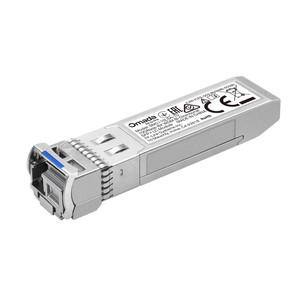
TP-Link SM5110LSB-10 10Gbase-BX Single-Mode WDM SFP+ Module
The TP-Link SM5110LSB-10 is a wavelength-division multiplexed (WDM) bi-directional SFP+ transceiver designed for long-haul campus backbone and inter-building fiber links. It delivers 10 Gigabit Ethernet over a single strand of single-mode fiber up to 10 km, with asymmetric wavelength pairing (transmit 1270 nm, receive 1330 nm) that eliminates the need for dual-fiber runs and simplifies cabling infrastructure. The LC/UPC connector standard and DDM (Digital Diagnostic Monitoring) support make this module a practical fit for network engineers who need low-cost long-distance aggregation without sacrificing full-duplex performance.
Key Features
- 10Gbase-BX WDM Bi-Directional: Carries 10 Gbps full-duplex over a single fiber strand. Transmits at 1270 nm, receives at 1330 nm — cuts fiber pair requirement in half versus duplex modules, reducing conduit and termination labor on long runs.
- Single-Mode Fiber, 10 km Range: OS1/OS2 certified cabling extends 10 km (vs. 300 m multimode). Ideal for inter-campus links, data center interconnect, and remote site backhaul without intermediate regeneration.
- LC/UPC Connector: Industry-standard low back-reflection termination; integrates with existing patch panels and eliminates adapter penalty. Requires precision cleaning and alignment — single-mode core (9/125 μm) has lower margin for contamination than multimode.
- Digital Diagnostic Monitoring (DDM): Real-time measurement of transmit power, receiver sensitivity, module temperature, and supply voltage. Alerts operator to signal degradation before service interruption occurs — critical for unattended remote links.
- SFP+ Hot-Swap Form Factor: Installs into any SFP+ slot on TP-Link Omada 10G switches (TL-SG3452X, TL-SG3728X-RP, and compatible models). No downtime for swap; push until it clicks.
- Low Power Consumption: ≤1 W at 3.3 V supply — negligible thermal load even in densely populated SFP+ bays. Extended operating range 0°C to 70°C (32°F to 158°F); storage -40°C to 85°C (-40°F to 185°F).
- Certifications: CE, FCC, RoHS — meets regulatory requirements for North American and European deployments. No hazardous materials or conflict minerals.
Single-mode fiber infrastructure demands attention to cleanliness and connector quality that multimode tolerates poorly. The 9/125 μm core is unforgiving: a single dust particle on the endface can degrade receiver sensitivity by 3–5 dB, turning a marginal link into a non-functional one. Before installation, inspect both the transceiver's LC/UPC port and the patch cable termination with a fiber inspection microscope (≥200× magnification). Use only lint-free wipes and isopropyl alcohol for cleaning; compressed air is acceptable only if a water trap is installed on the pump. When mating the connector, insert slowly and listen for a click — forcing a misaligned connection damages the UPC polish and requires recleaving and retermination of the patch cable.
On the network side, pair two SM5110LSB-10 modules (one at each end of the fiber run) to establish bidirectional service. This symmetric configuration is essential — do not mix transceiver types or wavelengths across a link. Use TP-Link Omada management software (Controller or standalone cloud access) to monitor DDM alarms: if receiver power drops below -21 dBm (typical sensitivity floor), investigate for connector contamination, fiber microbends, or splice loss before the link goes dark. The WDM multiplexer is passive — no electrical components in the fiber path — so link availability depends entirely on optical cleanliness and fiber integrity.
Total cost of ownership favors single-mode WDM on long runs: a 10 km inter-campus link costs roughly the same in fiber, labor, and termination as a 2 km duplex multimode run, but eliminates the need for a second fiber pair and associated conduit. Routing labor and future expansion capacity (multimode has exhausted its 10G ceiling with OM5 technology; single-mode scales to 400G+ without new fiber) make single-mode the pragmatic choice for distances beyond 1 km. Pair this transceiver with TP-Link Omada 10G switches that support SFP+ slots, a quality fiber contractor familiar with single-mode termination, and a fiber inspection kit — the module itself is bulletproof, but the installation context determines success.
TP-Link Omada management platforms (Controller, Omada Cloud, and Insight mobile app) expose DDM telemetry via SNMP traps and syslog — integrate these alarms into your NOC monitoring stack to catch fiber degradation before end users report a slowdown. Standard ONVIF-compatible network diagnostics via CLI and SNMP; no vendor lock-in. Refer to the SM5110LSB-10 datasheet for wavelength tolerances and eye-diagram specifications if you are engineering a link budget on a long or spliced run.
Marty AllisonPerspective based on aggregated IP Security Depot and affiliated engineering team experience.
We've deployed the SM5110LSB-10 across campus backbones, data center interconnects, and remote surveillance aggregation links where 10 Gbps over single-mode fiber replaces expensive multimode or copper alternatives. The WDM wavelength scheme is elegant — transmit 1270 nm, receive 1330 nm — which means you can light up a 10 km link with just one fiber strand instead of the usual pair. On a 500-meter run between two buildings, you save conduit cost, termination labor, and future-proof yourself for wavelength-division multiplexing if you ever need to layer additional services on the same fiber. The real differentiator versus competing single-mode SFP+ modules is TP-Link's DDM implementation: it surfaces optical power, sensitivity, and thermal state into the Omada controller without requiring external TAPs or optical test gear. That visibility catches a degrading link 48 hours before your users do — and that's the difference between a planned maintenance window and a 2 AM emergency call.
Technical Highlights:
- 10 km Single-Mode Range: Eliminates regeneration or signal boosting on inter-building links up to 6 miles. OS1/OS2 fiber handles this range with margin; link budget is typically -7 dB to -10 dB, giving you 10–15 dB cushion before signal failure. Contrast this to multimode, which tops out at 400 m with OM4 — you'd need four multimode runs or active equipment to span 10 km.
- WDM Wavelength Pairing (1270 nm TX / 1330 nm RX): Wavelength separation allows full-duplex traffic on one fiber; no signal contention or latency penalty. The 60 nm separation is standardized across the industry, so you can pair this module with any vendor's compliant transceiver at the remote end if you ever need to escape TP-Link infrastructure.
- DDM Monitoring via SNMP/Syslog: Transmit power, receiver sensitivity, module temperature, and 3.3 V rail voltage stream into Omada Controller or any standard syslog/SNMP collector. Drift in receiver power is the earliest warning of fiber contamination or microbends — acting on a -1 dB drift prevents the -15 dB catastrophe.
- Hot-Swappable SFP+ Form Factor: Mounts in any TP-Link Omada 10G switch (TL-SG3452X, TL-SG3728X-RP, TL-SG3728X, and newer). Push, click, done — zero downtime for module swap or upgrade. Supports N+1 redundancy on dual-switch designs without scheduled maintenance.
- Minimal Power Footprint (≤1 W): Even in a switch bay with 48 SFP+ slots populated, you're adding negligible heat. Thermal headroom matters in outdoor enclosures or confined equipment rooms — this module won't force you to right-size your cooling system.
Deployment Considerations:
- Single-Mode Fiber Installation Rigor: The 9/125 μm core is unforgiving. Dust on the endface costs 3–5 dB. Use lint-free wipes, isopropyl alcohol, and a fiber inspection microscope (200×+ magnification) before every connection. If you're used to multimode plug-and-play, single-mode requires discipline — but the payoff is 10 km range without boosters.
- Pair the Modules at Both Ends: You need two SM5110LSB-10 units (one per switch) for a complete 10 Gbps link. Do not mix wavelengths or transceiver types across a single-fiber run — WDM depends on matched TX/RX frequencies at each end.
- Verify Fiber Certification: Demand OS1 or OS2 cabling from your contractor, with full test reports (insertion loss, return loss, continuity). Spec LC/UPC connectors throughout — PC or APC polishes have different reflection characteristics and will degrade optical performance if mixed.
- Budget for Fiber Inspection and Cleaning Gear: A fiber inspection microscope (≥$400) and cleaning consumables are not optional. They're insurance against a failed installation. Include them in your project capex.
- Link Budget Planning: Typical transceiver sensitivity is -21 dBm; max transmit power is +2 dBm. A 10 km OS2 run incurs ~2 dB loss + 0.5 dB splices + 1 dB connectors = 3.5 dB total. You have 15 dB of margin — enough to tolerate a minor splice or a degraded connector without signal loss. Use a simple spreadsheet to model your link; if you're below 10 dB margin, rethink the routing or upgrade to a higher-power transceiver.
- Environmental Temperature Swings: Operating range is 0°C to 70°C (32°F to 158°F). If you're deploying in an outdoor pedestal or unheated building, verify your site temps stay in this window. Single-mode transceivers are sensitive to thermal drift in transmit wavelength (±0.1 nm per °C); if your link is already marginal, a 40°C temperature swing can push you out of spec. Add a thermostat to the enclosure if needed.
This transceiver is the right fit for network engineers who have single-mode fiber in the ground (or budget to lay it) and need 10 Gbps aggregation without the complexity of active equipment or the cost of multimode overkill on short runs. For 300 m to 2 km links, multimode is simpler and cheaper; for 10+ km links where you're tempted to buy boosters or regenerators, single-mode WDM pays for itself. Learn more about TP-Link's full Omada 10G switch lineup and compatible optics in the TP-Link catalog.