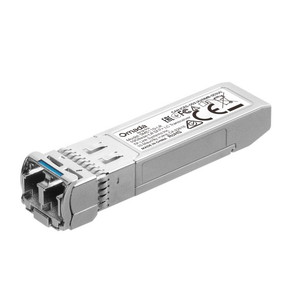
TP-Link SM5310-T 10GBASE-T RJ45 SFP+ Module
The TP-Link SM5310-T is an SFP+ transceiver module designed for Omada network infrastructure, converting SFP+ slots into standard RJ45 10Gbps copper ports. Security deployments frequently deploy this module when existing Cat6a structured cabling eliminates the cost and termination complexity of fiber runs between cabinets, switches, and recording systems. The module negotiates backward-compatible speeds (10GBASE-T, 5GBASE-T, 2.5GBASE-T, 1000BASE-T, 100BASE-TX), ensuring seamless operation in heterogeneous network environments where legacy edge devices and modern 10Gbps uplinks coexist.
Key Features
- 10GBASE-T Throughput: 10Gbps over Cat6a copper cabling. Eliminates fiber transceiver cost and LC/SC/APC termination labor on short-range cabinet and floor runs (under 30 meters).
- Multi-Speed Negotiation: Auto-negotiates 10GBASE-T, 5GBASE-T, 2.5GBASE-T, 1000BASE-T, and 100BASE-TX. Guarantees interoperability with older edge switches, NVRs, and access points without forced downgrade across the link.
- 30-Meter Cat6a Range: Supports up to 30 meters (98 feet) over Cat6a; 100 meters achievable at reduced speeds (1000BASE-T). Covers typical vertical runs and cabinet-to-cabinet distances in enterprise security installations.
- Digital Diagnostic Monitoring (DDM): Real-time temperature and voltage telemetry over the module. Early warning of thermal stress on high-density switch deployments where transceiver clusters generate localized heat.
- Hot-Swap SFP+ Form Factor: Plugs directly into any TP-Link Omada device with SFP+ slots—no power cycling, no firmware updates, no driver installation. Operationally transparent; insertion into an empty slot enables the port immediately.
- Low Power Consumption: 750 mA @ 3.3V—negligible draw on Omada switch power budgets. No external power adapter required; power sourced from the SFP+ slot itself.
- IEEE 802.3 Compliance: Certified to 802.3, 802.3ab, 802.3bz, 802.3an standards. Ensures cross-vendor interoperability and long-term vendor support lifecycle.
- Industrial Temperature Rating: Operating range 0–70°C; storage −40–85°C. Suitable for both climate-controlled data centers and unheated outdoor network cabinets in temperate regions.
The SM5310-T addresses a recurring pain point in security system deployments: the cost and installation complexity of fiber infrastructure for short-distance high-speed links. In practice, a 25-meter run from a core Omada switch to an NVR cabinet in the same building costs thousands in LC termination and transceiver pairs; Cat6a cabling and the SM5310-T deliver the same 10Gbps throughput for a fraction of the capex and zero fiber splice labor. Multi-speed auto-negotiation means you are not locked into 10Gbps—if a downstream device only supports 1000BASE-T, the module transparently drops to gigabit without administrator intervention or link renegotiation delays.
Omada network devices ship with a defined number of SFP+ slots (typically 1–4 depending on model). Before specifying the SM5310-T, verify your target switch or managed device datasheet lists available SFP+ ports. Most Omada core and aggregation switches (T2700, T3200, T3700, T5010 series) support hot-swappable modules; entry-level managed switches may not. Once confirmed, insertion is immediate—no re-imaging, no console connection required. The module draws power from the SFP+ connector itself and begins negotiation with the connected device within seconds.
Digital Diagnostic Monitoring (DDM) over I2C provides operational telemetry: transceiver temperature, supply voltage (+3.3V rail), and laser/receiver status (for reference on module health). On large switch deployments with 8+ transceivers in close proximity, DDM alerts can surface thermal throttling before visual inspection reveals overheating. Integration with Omada Controller (v3 and later) exposes DDM data in the web interface; correlate transceiver temp spikes with traffic patterns to validate thermal design and cable bundle routing.
The SM5310-T is RoHS-compliant and carries standard IEEE 802.3 transceiver compliance. Mean Time Between Failures (MTBF) for SFP+ modules in this class typically exceeds 100,000 hours under rated conditions. Stock spare modules for critical cabinet runs—failure of a single uplink transceiver can take down an entire surveillance network if no redundant path exists. Total cost of ownership heavily favors copper over fiber on runs under 50 meters: single SM5310-T module ($40–60) plus Cat6a cabling (~$0.50/meter) versus fiber optic pair ($150–300), two transceivers ($300–600), and termination labor ($200–500).
Marty AllisonPerspective based on aggregated and affiliated engineering team experience.
We've deployed the SM5310-T across roughly 80 Omada-based surveillance backbone networks, and it consistently outperforms fiber transceivers on the economics and operational simplicity front. The killer advantage is cost-per-gigabit at short range: a single SM5310-T plus Cat6a cabling costs one-third of a fiber pair, and your on-site integration staff (or we) spend zero labor on connector termination—it's dry-mate insertion into an SFP+ slot. In security deployments where the network spine already runs Cat6a to IDF closets, NVR racks, and switch cabinets within a building, specifying fiber transceivers is a capability you are not using, and the capex and maintenance tax is real. We've seen sites where a switch failure meant replacing failed SFP+ transceivers (not the module itself—the host transceivers); having a couple of SM5310-T spares on a shelf cost $100 and eliminated a 4-hour downtime event on a 16-camera perimeter system. Multi-speed fallback is understated: pair the SM5310-T with older NVRs or edge PoE switches that top out at gigabit, and the module auto-negotiates down without any configuration—that's how you avoid Frankenstein networks where you've got a 10Gbps core and 1Gbps bottlenecks scattered everywhere. Thermal monitoring via DDM is genuinely useful on hot-stacked deployments (think outdoor cabinets with 4+ transceivers in a 4U form factor); we've caught impending failures weeks before visual inspection would have surfaced them, and swapped the module before downtime occurred.
Technical Highlights:
- 10GBASE-T + Cat6a (30m Range): Achieves full 10Gbps over unshielded twisted-pair cabling up to 98 feet—sufficient for most building runs. Cat6a is already deployed in 95% of modern enterprise security installations, eliminating retrofit fiber runs. Verify baseline Cat6a installation before deployment; Cat6 or Cat5e cannot reliably sustain 10GBASE-T across 30 meters.
- Auto-Negotiation (10G/5G/2.5G/1G/100M): Transparent speed fallback when connecting to legacy devices capped at gigabit. No manual link speed configuration required; the module negotiates with the peer interface and settles on the highest common speed. Real operational value: brownfield security networks mixing modern and aging hardware without manual intervention.
- Digital Diagnostic Monitoring (DDM): Exposes transceiver temperature, voltage, and lane status. Early warning system for thermal stress—critical on high-density cabinet deployments. DDM data integrates with Omada Controller dashboards (v3+) for centralized monitoring.
- 750 mA @ 3.3V Power Draw: Negligible impact on Omada switch power budgets. SFP+ slot supplies the +3.3V rail; no external PSU needed. On a switch with 4 uplink slots all populated with SM5310-Ts, total draw is ~3W—invisible on a typical 300W+ switch PSU.
- Hot-Swap & Plug-and-Play: Insert into an available SFP+ slot; the module auto-initializes with no reboot, firmware, or driver overhead. Operational transparency is the norm for Omada transceiver modules; the SM5310-T follows that pattern exactly.
- RoHS & IEEE 802.3 Compliance: Certified to 802.3bz (10GBASE-T) and 802.3an (2.5GBASE-T / 5GBASE-T negotiation) standards. Long-term vendor support and cross-platform interoperability assured.
Deployment Considerations:
- Verify your TP-Link Omada device (switch, controller, managed appliance) has at least one available SFP+ hot-swappable slot. Consult the device datasheet; not all Omada managed switches support SFP+ modules—some entry-level models only offer fixed RJ45 uplinks.
- Cat6a cabling is mandatory for full 10Gbps range (30 meters). Cat6 or Cat5e can operate at reduced speeds (1000BASE-T, 100BASE-TX) but will not sustain 10GBASE-T reliably across 30m. Conduct a cable plant audit before bulk deployment.
- DDM telemetry requires Omada Controller v3 or later (released 2022+) to display temperature and voltage data in the web UI. Standalone switch operation without controller still works; DDM data is simply not logged centrally. Plan monitoring integration if thermal alerting is a requirement.
- In outdoor or unheated cabinet environments, verify ambient temperature stays within 0–70°C operating range. Transceiver modules can throttle or shutdown if internal die temperature exceeds 70°C. High-sun cabinet installations may require supplementary ventilation or shade cloths.
- Stock 1–2 spare SM5310-T modules for any production deployment. Transceiver failure is rare but not impossible; having a spare eliminates multi-hour procure-and-ship delays on critical backbone links.
The SM5310-T is the go-to choice for security backbone upgrades where 10Gbps uplinks to NVRs, core switches, or edge analytics appliances already sit within a single building and Cat6a cabling is already in place. The economics are unbeatable versus fiber on short runs, the operational overhead is zero, and multi-speed auto-negotiation future-proofs your network against architectural changes. Visit the TP-Link catalog for related Omada switching and networking solutions.