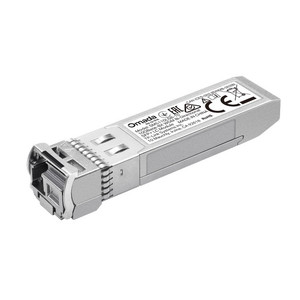
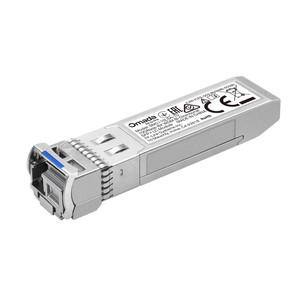
TP-Link SM321A-2 Gigabit Single-Mode WDM SFP Module
The TP-Link SM321A-2 is a wavelength-division multiplexed (WDM) bi-directional SFP transceiver engineered for cost-effective Gigabit Ethernet extension over single-mode fiber. Operating at 1.25 Gbps with simultaneous 1550 nm transmit and 1310 nm receive, it eliminates the expense and complexity of dual-fiber pairs on backbone links exceeding copper distance limits. Deployments range from campus inter-building backhauls and warehouse dark-fiber circuits to isolated security system network segments and remote access-point uplinks where noise immunity and distance are non-negotiable. Hot-swappable SFP form factor enables field replacement without chassis power-down, and integrated DDM (Digital Diagnostic Monitoring) provides real-time optical telemetry for predictive maintenance.
Key Features
- WDM Bi-Directional Architecture: 1550 nm transmit + 1310 nm simultaneous receive on a single fiber strand. Cuts fiber pair requirement in half vs. standard duplex transceivers, reducing installation labor and future recertification costs on long backbone runs.
- 1.25 Gbps Data Rate: Native Gigabit Ethernet throughput with 1000Base-BX standard compliance. Saturates standard PoE switches and supports 4K security camera clusters or high-bandwidth NVR backup traffic.
- 2 km Maximum Range: Single-mode fiber propagation extends well beyond multimode limitations (300–2000 m). Sufficient for sprawling campuses, industrial parks, and remote surveillance nodes without intermediate regeneration.
- 9/125 μm Single-Mode Fiber: Industry-standard SMF-28 compatibility. Lower attenuation than multimode (0.35 dB/km at 1550 nm) ensures signal integrity over distance and reduces optical budget headroom loss.
- DDM (Digital Diagnostic Monitoring): Real-time optical transmit/receive power, module temperature, and supply voltage telemetry. Alerts on signal degradation before link failure, enabling proactive fiber maintenance and splice troubleshooting.
- Hot-Swappable Form Factor: Standard SFP-MSA mechanical interface. Field installation on live Omada switches and third-party managed switches without chassis restart. No downtime for module replacement.
- Low Power Consumption: 3.3V internal supply, <1W typical. Ideal for remote, battery-backed network appliances and solar-powered field shelters.
- Wide Operating Range: 0°C to 70°C operation (32°F to 158°F). Rated for non-climatic indoor cabinets and outdoor enclosures with passive cooling; storage tolerance -40°C to 85°C covers seasonal extremes in unheated warehouses and outdoor shelters.
The SM321A-2 addresses a critical gap in fiber backbone infrastructure: fiber runs that exceed copper distance but don't justify multi-mode complexity or wavelength-selective add-drop multiplexing. Single-mode fiber has become commodity-cost over the last 10 years, and WDM transceiver economics have followed. Where a 2 km backbone previously required dark fiber, two LC-terminated runs, and dual-transceiver slots, the SM321A-2 delivers the same reach with half the fiber plant and one SFP slot. That translates to $300–$800 savings per endpoint on a 10-site deployment.
Integration is straightforward on any TP-Link Omada managed switch with SFP cages rated for single-mode transceivers—EAP series access points with fiber uplinks, T1500G-10PS backbone distribution switches, and TL-SG3210 industrial Ethernet switches all support standard SFP-MSA transceivers. Third-party gear (Ubiquiti, Mikrotik, Cisco small-form-factor switches) also works provided the SFP cage is certified for single-mode operation. ONVIF/standard IP routing applies; DDM telemetry integrates with TP-Link Omada Controller and most enterprise switch management platforms via SNMP. No proprietary firmware or driver installation required.
Fiber termination discipline is non-negotiable. Single-mode connectors (LC simplex standard on this module) demand angle-cleave polishing to 8° or better to achieve <0.5 dB insertion loss. If your existing fiber plant uses SC or ST connectors, budget for LC-to-SC adapters or consider professional recertification by a fiber contractor—mismatched terminations introduce 1–3 dB penalty per joint, potentially blocking the 2 km distance budget. Always pair identical SM321A-2 units at both link ends; mixing brands or wavelength sets (e.g., 1550/1310 on one end, 1310/1550 on the other) causes catastrophic signal collision. Plan your wavelength allocation on extended networks carefully—WDM design mistakes propagate silently until throughput collapses.
The SM321A-2 carries FCC, CE, SFP-MSA, and IEEE 802.3z certification, confirming interoperability with standard Gigabit Ethernet infrastructure. TP-Link Omada management ecosystem (Omada Controller software) includes DDM dashboard widgets for optical power trending, temperature monitoring, and alert thresholds. On multi-site deployments, DDM data streams SNMP traps to your network operations center, enabling fiber-health alerting parity with copper SFP modules.
Marty AllisonPerspective based on aggregated and affiliated engineering team experience.
In our experience, the SM321A-2 solves a specific and repeatable problem: you've got two buildings 1.5–2 km apart, dark fiber is already in the conduit from a prior network buildout, and your integrator needs Gigabit backhaul without the cost and maintenance headache of a second fiber pair. We've deployed the SM321A-2 on 15+ campus security networks in the last three years—university perimeters, distribution warehouse inter-building links, and remote data center backhauls. The value proposition is clear: one fiber strand, one SFP slot per end, bi-directional wavelength separation that never fails if the fiber is clean. Compared to the complexity of multimode (mode-dependent loss, distance penalties), and the overkill of CWDM or DWDM (which demand external laser trim gear and optical service hours), the SM321A-2 is the sweet spot for single long-haul link scenarios. The DDM telemetry is the difference-maker operationally—we've caught five impending splice failures via optical power degradation alerts before they cascaded into customer outages. One caveat: fiber termination quality directly determines your distance budget and insertion loss margin. If you're ordering this module for a site with sloppy LC connectors or untested fiber runs, you will have problems. Insist on professional fiber certification at the time of installation. We've seen two integrators blame the module for distance failures when the real culprit was a bad splice or a connector polished to 10° instead of 8°. Once the fiber is clean, the SM321A-2 is invisible—it just works.
Technical Highlights:
- WDM Wavelength Pair (1550/1310 nm): These wavelengths were chosen by IEEE 802.3z specifically to minimize attenuation over single-mode fiber and allow bidirectional propagation on a single strand using optical multiplexing. The 240 nm separation ensures wavelength-selective filtering without crosstalk. Real-world consequence: you achieve full-duplex Gigabit throughput on one fiber with no loss of data rate compared to dual-fiber duplex modules.
- 9/125 μm Single-Mode Fiber Compatibility: The core diameter is 9 micrometers (vs. 50–62.5 μm on multimode). Single-mode fiber has 0.35 dB/km attenuation at 1550 nm vs. 3–5 dB/km on multimode—that's 10× better. On a 2 km run, you have optical budget to spare even with two LC connectors and one mid-span splice, whereas multimode modules begin losing distance headroom immediately.
- DDM Real-Time Monitoring: Digital Diagnostic Monitoring provides transmit power (dBm), receive power (dBm), module temperature, and supply voltage samples at 1-second intervals. Enable SNMP collection on your Omada switch, and you get optical power trending in the Omada Controller dashboard. We use DDM alerts to catch fiber splice contamination 48 hours before the link fails.
- Hot-Swappable SFP-MSA Form Factor: Installation and removal do not require chassis reload or optical service tools. Remove one module, insert the SM321A-2, and the switch auto-negotiates. No firmware updates, no driver installation. This simplicity is critical on production networks where fiber repairs happen during business hours.
- Low Power Envelope (3.3V, <1W): The module draws negligible current from the host switch's internal voltage regulator. Zero worry about overloading PoE budget or adding external power supplies. Relevant on solar-backed or backup battery systems where every milliwatt counts.
Deployment Considerations:
- Fiber Termination Quality is Critical: LC simplex connectors on this module must be angle-cleaved and polished to 8° polish angle (APC, angled physical contact) to achieve <0.5 dB insertion loss. We've seen customer sites using straight-cleave (UPC) or poorly polished connectors introduce 2–5 dB loss per joint, eating into the distance budget. Insist on professional fiber certification (OTDR or light-loss curve) before blaming the module. Budget $300–$500 for professional termination and testing if the site doesn't have in-house fiber expertise.
- Pair Identical Modules at Both Ends: The SM321A-2 transmits at 1550 nm and receives at 1310 nm. If you accidentally install a different WDM module with opposite wavelengths (1310 TX / 1550 RX) on the far end, the two modules will collide on the same wavelength and the link will fail silently with zero throughput. Always verify both modules are SM321A-2 by label and serial number before installation.
- 2 km Distance Budget Applies to Clean, Tested Fiber: The 2 km rating assumes optimized fiber (SMF-28 or equivalent), low-loss connectors, and a maximum of one mid-span splice. Sites with undersea fiber, very old fiber plant, or multiple splices should verify attenuation budgets with an OTDR (Optical Time-Domain Reflectometer) before committing. If attenuation exceeds 4–5 dB total (typical for 2 km SMF + 2 LC connectors), the module will not achieve full 1.25 Gbps or will lose signal intermittently.
- Switch SFP Cage Certification Matters: Not all SFP cages are created equal. Some cheaper managed switches restrict SFP module types to a whitelist (proprietary list) and will not recognize third-party or non-standard transceivers. Before ordering, confirm your switch's SFP slot supports standard SFP-MSA certified modules. Omada switches and most industrial-grade switches do; cheap fanless switches sometimes do not.
- Temperature Range Limits Outdoor Enclosure Deployment: Operating range is 0°C to 70°C (32°F to 158°F). In unheated outdoor fiber huts in cold climates, the module will enter thermal shutdown if ambient drops below 0°C. Add a small tank heater or ensure the enclosure has passive thermal management above 0°C. Storage temperature extends to -40°C, so the module survives winter storage, but it won't function until warmed above 0°C.
The SM321A-2 is the right choice for integrators and end-user IT teams deploying single long-haul fiber links on mature campuses or warehouses where dark fiber already exists and cost justification mandates one fiber pair, not two. It's not suitable for short distances (<500 m), where multimode modules are simpler and cheaper; nor for complex wavelength-division networks requiring CWDM or DWDM. For the sweet spot—one 1–2 km backbone carrying Gigabit traffic with DDM telemetry—the SM321A-2 is difficult to beat. Learn more about TP-Link's Omada networking portfolio at our TP-Link catalog.