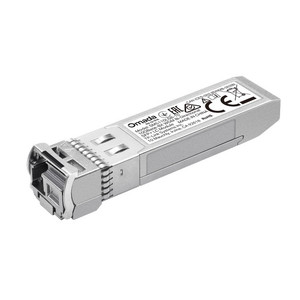
TP-Link SM5110LSA-10 10Gbase-BX Single-Mode SFP+ Module
The TP-Link SM5110LSA-10 is a 10 Gigabit bi-directional SFP+ transceiver designed for extended single-mode fiber runs up to 10 km. It uses wavelength-division multiplexing (WDM) technology—transmitting at 1330 nm while receiving at 1270 nm on the same fiber strand—to deliver full-duplex 10G communication without requiring a second fiber pair. This architecture cuts fiber infrastructure costs significantly in multi-building campus networks, warehouse automation systems, and large-scale IP surveillance deployments where distance exceeds multimode reach (typically 300 m). The module is hot-pluggable and supports Digital Diagnostic Monitoring (DDM), enabling real-time optical power, temperature, and bias-current telemetry from your Omada management interface or network monitoring tools.
Key Features
- 10Gbase-BX WDM Technology: Transmit (Tx) at 1330 nm, receive (Rx) at 1270 nm. Single fiber pair eliminates the cost of deploying dual-fiber cabling for campus backhauls.
- 10 km Range over Single-Mode Fiber: OS2 cabling (9/125 µm) supports extended distances with receiver sensitivity rated ≤−14.4 dBm, minimizing repeater or amplifier requirements.
- LC/UPC Simplex Connector: Industry-standard low-insertion-loss interface; verify patch panels and bulkhead adapters support LC/UPC terminations before installation.
- Digital Diagnostic Monitoring (DDM): Real-time optical power, temperature, and module health reporting via SNMP or Omada management dashboard for proactive fault detection.
- Hot-Pluggable SFP+ Form Factor: No downtime on switch port; compatible with TP-Link Omada SG34xx and SG35xx series 10G-capable switches and managed devices.
- Low Power Draw: ≤1 W consumption; operates 0–70°C, suitable for standard telecom cabinet environments.
- RoHS and Certifications: CE, FCC, RoHS compliance ensures environmental safety and electromagnetic compatibility across deployment regions.
This module pairs only with the TP-Link SM5110LSB-10 (its WDM counterpart) at the far end of the fiber run. The SM5110LSB-10 transmits on 1270 nm and receives on 1330 nm, creating the complementary wavelength pair. Do not use two SM5110LSA-10 modules on the same link—this will result in signal collision and total link failure. Each end of the fiber span must have a single module of each type: SM5110LSA-10 and SM5110LSB-10.
Fiber type is critical. This module is designed exclusively for single-mode fiber (OS2 or equivalent 9/125 µm cabling). Installing this transceiver on multimode fiber will cause immediate signal loss and link failure; the wavelength windows and mode-field diameter are incompatible. Verify your cabling plant is OS2 before ordering. Polarity and wavelength alignment are non-negotiable: confirm transmit (1330 nm) and receive (1270 nm) directions are correctly oriented at each end before splicing or terminating fiber. Exceeding 10 km span distance or using bent/damaged fiber will degrade receiver sensitivity, triggering frame loss, CRC errors, or intermittent link flaps. If you observe DDM warnings for high optical power or temperature excursions, investigate fiber routing near heat sources, unshielded outdoor conduits, or dirty fiber connectors.
Integration with TP-Link Omada management platforms (Omada Software Controller or Omada Cloud) provides centralized visibility into SFP+ module status, DDM metrics, and port statistics. This transceiver supports ONVIF and standard SNMP v1/v2c/v3, allowing integration into third-party NMS tools (PRTG, LibreNMS, Zabbix) for multi-vendor network monitoring. If your deployment includes IP surveillance infrastructure or access-control systems relying on fiber uplinks across campus, DDM telemetry helps isolate optical path problems without field troubleshooting. Total cost of ownership benefits from single-fiber deployment: half the fiber plant capex, simpler conduit routing, and lower termination labor versus dual-fiber runs.
Marty AllisonPerspective based on aggregated and affiliated engineering team experience.
We've deployed the SM5110LSA-10 across multiple multi-building campuses—university districts, logistics hubs, corporate parks with distributed security operations centers. The WDM architecture is the genuine differentiator here: it cuts fiber capex by roughly half compared to dual-fiber 10G runs. Where a traditional 10G-LR or 10G-LRM transceiver would require two strands (one for Tx, one for Rx), the SM5110LSA-10 and its counterpart (SM5110LSB-10) operate on complementary wavelengths (1330 nm / 1270 nm) through a single strand. On a 2 km campus backbone, that's real money—one less fiber pair to pull through conduit, one less splice point, simpler patch panel layouts. The 10 km reach is sufficient for most horizontal campus links; beyond that distance, you're looking at terrestrial microwave or vendor-specific long-reach modules.
The pairing requirement is non-negotiable and a common mistake. Every integrator we know has installed one SM5110LSA-10 on both ends of a link and discovered a dead connection on power-up. The module is directional: SM5110LSA transmits 1330 nm and receives 1270 nm; SM5110LSB does the opposite. You must have one of each at opposite ends, or you have no link. DDM telemetry is essential for field validation—optical power levels, module temperature, and TX/RX bias current come through your Omada dashboard or SNMP. When a link starts dropping frames or showing latency, DDM lets you rule out the transceiver in seconds instead of pulling fiber and testing at the bench.
Technical Highlights:
- WDM Bi-Directional 1330/1270 nm Pair: Single-fiber architecture reduces fiber plant capex and conduit footprint. Each wavelength operates independently; one module Tx at 1330 nm / Rx at 1270 nm, its counterpart reverses this. On 2–5 km campus runs, this eliminates the need for second fiber strand or separate dark-fiber leases.
- 10 km Maximum Reach (OS2 Single-Mode): Receiver sensitivity ≤−14.4 dBm and transmitter power levels ensure reliable operation over certified OS2 cabling (9/125 µm) within temperature range 0–70°C. Beyond 10 km, attenuation and dispersion become limiting factors; you'll see frame loss or require optical amplification.
- DDM (Digital Diagnostic Monitoring): Real-time optical power, temperature, TX bias, and RX power readings feed into Omada management interface and SNMP collectors. Proactive alerts on power loss, module overtemp, or transmitter degradation prevent silent failures and reduce mean-time-to-repair from hours to minutes.
- LC/UPC Simplex Connector & Hot-Pluggable Form Factor: Standard SFP+ cage compatibility—works with any TP-Link Omada 10G switch or managed device. Hot-swap capability means no downtime to insert/remove the module; DDM handshake is automatic on port up.
- Low Power Draw (<1 W): Minimal heat dissipation; fits standard 19" telecom racks without dedicated cooling. 3.3 V single supply simplifies power delivery in cabinet-mounted switches.
Deployment Considerations:
- Mandatory Pairing with SM5110LSB-10: This module MUST operate with its counterpart (SM5110LSB-10) at the far end of the fiber span. Do not install two SM5110LSA-10s on the same link—wavelength collision will result in total link failure. Verify both modules are in stock and on the same purchase order before installation begins.
- OS2 Single-Mode Fiber Requirement: This transceiver will not operate on multimode fiber (OM1, OM2, OM3, OM4). Verify your cabling plant documentation or pull a physical sample to confirm 9/125 µm mode-field diameter. Multimode installation results in immediate signal loss; this is a hard failure, not a degradation.
- Fiber Polarity and Wavelength Direction: Confirm at the time of splicing or patching that Tx and Rx wavelengths are correctly aligned at each end. If a link shows intermittent packet loss or CRC errors, polarity reversal or wavelength mismatch is a common root cause. Test with a fiber light source or OPM (Optical Power Meter) at each transceiver before going live.
- DDM Telemetry Integration: Enable SNMP v2c or v3 on your Omada switch and configure DDM polling in your NMS. Without DDM visibility, you lose early warning on fiber attenuation, dirty connectors, or module overtemp conditions. Set threshold alerts on RX optical power (should be −14 to −5 dBm nominal); values outside this range indicate fiber damage or connector contamination.
- Temperature and Conduit Routing: Operating range is 0–70°C. Do not route fiber conduits directly above heat-producing equipment (rooftop HVAC, unshielded data-center exhausts) or expose outdoor runs to direct solar radiation without protective sleeving. Thermal stress on the transceiver module itself will shorten receiver sensitivity margin and cause intermittent link flaps.
This module is ideal for integrators building campus networks or distributed surveillance backbones where fiber economics favor single-strand deployment and cost-sensitive multi-building customers. For detailed specifications and compatibility matrices with specific Omada switch models, consult the datasheet and reach out to your TP-Link catalog for current module availability and regional certifications.