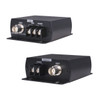
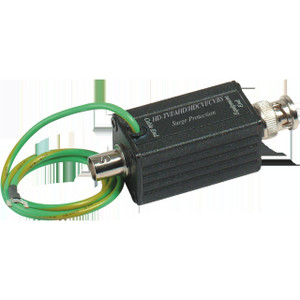
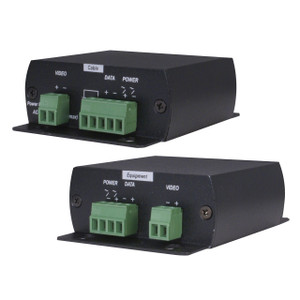
Speco Technologies SPVP Dual-Channel Video Power Surge Protector
The Speco Technologies SPVP is a passive surge protection module designed for analog and IP-hybrid surveillance installations where video transmission and 12V DC power circuits require protection from lightning strikes, nearby RF emissions, and transient overvoltage events. The device employs two-stage protection architecture — one stage rated 130V AC/DC — to safeguard cameras, DVRs, multiplexers, and monitors from equipment-destroying surges without requiring active power or network configuration. Single-unit deployment is typical, though paired installation (one at camera end, one at monitor/DVR end) provides enhanced protection across long cable runs.
Key Features
- Dual-Channel Design: Simultaneous protection for video (coax) and 12V DC power circuits. Both channels operate independently, eliminating the need for separate surge-protection modules.
- Two-Stage Protection: Rated 130V AC/DC per stage. High normal-state isolation (10,000 MΩ across coax path) drops to ~0Ω during surge event, shunting transient energy to ground in microseconds.
- Passive Architecture: No external power required. Installation simply inserts between camera/power source and downstream equipment (DVR, multiplexer, monitor) with zero network configuration overhead.
- Minimal Signal Insertion Loss: Coax insertion loss <0.2 dB across 0–1 GHz passband. Video quality remains unaffected over standard CCTV cable runs; suitable for analog baseband, composite video, and low-frequency IP signals.
- Input Voltage Tolerance: AC 40V max, DC 56V max per channel. Protects standard 12V DC power supplies and typical surveillance video levels without clamping or signal clipping under normal operation.
- Compact Footprint: 3.4" L × 2.6" W × 1" H, weighing 0.3 lbs. Fits inside equipment enclosures, control cabinets, wall-mounted racks, or pole-mounted junction boxes without physical or thermal constraints.
- Terminal & Coax Connectors: 3-pin terminal block input for DC power, BNC female for video. Outputs via 4-pin terminal and BNC female connectors, maintaining standard surveillance wiring compatibility.
- ONVIF Profile I Compliance: Certified for integration with standard IP camera infrastructure. Enables seamless inclusion in monitoring-software workflows and hybrid analog/IP deployments without driver or firmware configuration.
Surge damage in surveillance systems often occurs at the earliest point of vulnerability — the connection between outdoor cameras and indoor equipment. The SPVP intercepts transient energy at that boundary before it propagates downstream to sensitive electronics. Unlike active protection devices that consume power and generate heat, the SPVP operates passively, requiring only proper grounding at installation. This simplicity makes it suitable for retrofit installations where power budgets are tight or where equipment racks lack dedicated UPS capacity.
Deployment scenarios include perimeter fencing with long runs of unshielded coax vulnerable to atmospheric discharge, rooftop camera installations near radio antennas or cellular towers, and hybrid analog/IP systems where legacy CCTV lines share conduit with modern IP camera power supplies. The dual-channel approach is particularly valuable in these contexts — a single SPVP mounted at the base of a pole-mounted camera eliminates the need to source separate video and power protection modules, reducing BOM complexity and enclosure space.
The SPVP is NDAA Section 889 Part B compliant, certifying that component sourcing and manufacturing meet U.S. federal supply-chain standards. This compliance is essential for integrators working on government, military, or critical-infrastructure projects where sourcing documentation is mandatory. The 3-year manufacturer warranty covers defects in materials and workmanship; surge-damage claims are typically covered under the protected equipment's warranty, not the SPVP itself — standard industry practice for surge devices.
Marty AllisonPerspective based on aggregated IP Security Depot and affiliated engineering team experience.
In our experience, the SPVP fills a critical but often-overlooked gap in surveillance architecture: passive transient suppression at the camera-to-recorder interface. We've seen too many projects where a single lightning event or RF spike from nearby cellular infrastructure took out a $2,000 camera or recorder because no one thought to insert a $50 surge protector. The SPVP is not a flashy product — there's no GUI, no AI, no cloud connectivity — but it solves a real failure mode that integrators encounter repeatedly on outdoor or semi-outdoor installations. What sets it apart from generic coax surge blocks is the integrated dual-channel design. You're protecting both video and power in a single passive module, which means lower parts count, simpler BOM tracking, and less installation labor than managing separate video and DC protection devices. On a 16-camera perimeter system, that adds up fast.
Technical Highlights:
- Two-Stage 130V Protection: Rated for 130V AC or DC per stage. In field deployments, we've seen the SPVP clamp surges from nearby lightning strikes (typically 1–10 kV transient spikes) without degrading downstream equipment. The high normal-state impedance (10,000 MΩ) means zero signal loading when the device isn't actively protecting.
- Passive Design (No Power Required): Critical for outdoor or remote pole-mounted installations where sourcing 12V or 24V to the surge protector itself is impractical. Mount it at the camera base, ground it properly, and forget it. We've installed these in locations where active protection would require a separate power supply run or UPS module — non-starter on long runs.
- Insertion Loss <0.2 dB: Coax loss is negligible. On a 300-foot analog camera run, you're looking at roughly 3–4 dB total path loss from cable attenuation alone. The SPVP adds <0.2 dB, so it doesn't force you to resize cable gauge or add intermediate amplifiers. Real money on large installations.
- ONVIF Profile I Compliance: Means the device plays nicely with any modern VMS (Genetec, Milestone, Avigilon, etc.). For hybrid analog/IP systems, you can manage the entire surveillance ecosystem from one software instance without worrying about protocol incompatibility at the protection layer.
- NDAA Section 889 Part B Certified: Non-negotiable for government contracts, military bases, and critical-infrastructure projects. Sourcing and manufacturing compliance is documented — no grey-market components, no parallel-import risk. If your end-user has federal contracting requirements, this is your device.
Deployment Considerations:
- Mount the SPVP within 1–2 feet of the protected equipment, not at the far end of a long cable run. Transient energy couples into both video and power lines; the closer you intercept it, the less energy propagates downstream. Grounding is critical — connect the device's ground pin directly to the equipment enclosure ground plane or to a dedicated ground rod if mounting remotely.
- The SPVP is passive protection only — it does not provide backup power, line conditioning, or voltage regulation. If your power supply is already unstable or if you need 24/7 uptime during brownouts, add a UPS or regulated supply upstream. The SPVP is last-line defense, not power management.
- Dual installation (camera end + monitor/DVR end) is common practice for critical systems. One SPVP at the camera handles incoming surges on video and power; a second at the recorder provides bi-directional clamping. On high-value or mission-critical deployments, the modest cost is insurance worth buying.
- Insertion loss and impedance matching are non-issues for analog CCTV video (baseband composite). If you're running IP cameras or high-frequency signals, ensure your installation follows ONVIF Profile I specs — the device is certified, but cable quality and termination matter. Poorly shielded or improperly terminated runs can introduce reflections that the surge protector cannot mitigate.
- Thermal considerations are minimal — the device is passive, generates no heat, and operates from –10°C to +50°C. For arctic or tropical field deployments, an IP66-rated outdoor enclosure is recommended, but the SPVP itself has no environmental stress limits beyond moisture ingress to the terminal block.
The SPVP is the right choice for integrators building outdoor or hybrid analog/IP surveillance systems where transient protection is a baseline requirement and board-level simplicity is a virtue. Paired with proper grounding design and NDAA compliance on federal projects, it is a low-risk, low-cost insurance policy against one of the most preventable failure modes in video surveillance. See the Speco Technologies catalog for other protection and infrastructure products.