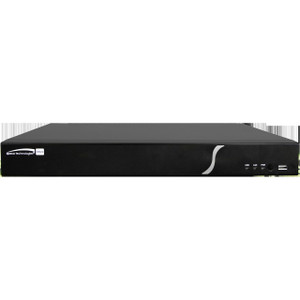
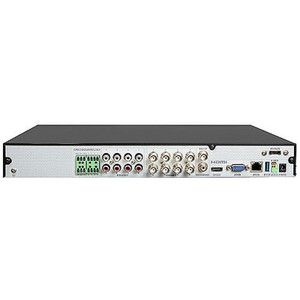
Speco Technologies H16HRLN4TB 16-Channel Hybrid Recorder 4TB
Overview
The H16HRLN4TB is a 16-channel hybrid recorder engineered for facilities managing both legacy analog TVI (Television over Coax) cameras and modern IP video systems on a single platform. The system combines 8 hybrid channels—each switchable between TVI signals or IP streams without hardware reconfiguration—plus 8 dedicated IP-only channels, giving you 16 total recording channels. With 4TB of internal storage and NDAA Section 889 compliance built in, the H16HRLN4TB eliminates the operational complexity and cost of running separate DVR and NVR systems during the transition from analog to IP infrastructure. For security integrators managing brownfield upgrades, this architecture means you can migrate cameras one at a time without purchasing new recording hardware at each stage.
Key Features
- 8 Hybrid Channels (TVI or IP): Each hybrid input accepts either a TVI video signal over standard coaxial cabling OR an IP stream via Ethernet—no hardware jumpers, no slot changes, no downtime to switch. This flexibility eliminates the cost and logistical burden of parallel recording systems during gradual migration from analog to IP.
- 8 Dedicated IP-Only Channels: Expand capacity for pure-IP camera zones without consuming hybrid channel resources. Deploy new IP surveillance in one area while retaining analog TVI cameras elsewhere, all recorded and managed in one interface.
- 4TB Internal Storage: Pre-installed and ready to deploy—no external NAS procurement or configuration. Recording retention depends on resolution, frame rate, and codec per channel. A 1080p TVI stream at 30 fps with standard H.264 compression will consume storage roughly twice as fast as the same resolution with H.265 compression, so bitrate planning matters when calculating 24/7 retention windows across 16 channels.
- NDAA Section 889 Compliance: Certified for federal, state, and critical-infrastructure procurement. This addresses supply-chain risk vetting requirements in government contracts and regulated environments—a compliance gate-pass that simplifies contract negotiations and eliminates the approval delays that often block non-compliant hardware.
- TVI + IP Coexistence: Integrates standard HD-over-coax analog cameras (1080p or SD resolution) alongside IP cameras at their native resolutions. Speco Technologies leverage coaxial plant already in the ground—no rewiring of existing coax runs required, which matters when you're retrofitting buildings with analog infrastructure already installed.
- Centralized Management Interface: Single unified recording, playback, and search across all 16 channels reduces operational overhead and training burden compared to managing a separate analog DVR and IP NVR system in parallel.
- ONVIF-Compatible IP Inputs: IP channels accept ONVIF-compatible cameras from a broad vendor ecosystem, preventing lock-in to a single camera manufacturer and protecting your investment across upgrades.
- Standard Coaxial Connectors: TVI inputs use industry-standard connectors compatible with existing analog camera plant, eliminating adapter costs and installation complexity in brownfield deployments.
Integration & Operational Considerations
The H16HRLN4TB accommodates both analog TVI and IP workflows on the same recording platform. TVI channels work with existing analog camera infrastructure and deliver HD-over-coax quality—useful when you have coaxial cabling runs already in place and budget constraints that prevent rewiring the entire site. IP channels accept ONVIF standard-compliant cameras via Ethernet, which means you can source cameras from multiple vendors without compatibility concerns.
The hybrid architecture is particularly valuable during phased infrastructure transitions. Instead of purchasing a complete new NVR when you upgrade the first building zone to IP, you can assign those IP cameras to the dedicated IP channels while keeping legacy TVI cameras on the hybrid channels. This staging approach spreads capital expenditure across your migration timeline and reduces risk—you're not forced into a large upfront hardware investment.
Storage consumption varies by stream configuration. A 1080p TVI camera at 30 fps occupies different disk space than a 4MP IP camera at the same frame rate and codec. Planning 24/7 retention requires an estimate of average bitrate per channel. Higher frame rates (60 fps vs. 30 fps) double storage consumption, and lower-resolution analog streams use less disk than high-resolution IP cameras, so a mixed deployment may have lower overall disk pressure than an all-IP installation at premium resolutions.
NDAA Section 889 certification confirms that the device's supply chain meets federal vetting requirements. For integrators selling into government agencies, military installations, or critical infrastructure operators (utilities, transportation, water treatment), this certification eliminates one of the largest procurement bottlenecks—the requirement to prove the recorder was not manufactured by, or sourced through, sanctioned vendors.
When to Choose a Different Model
If you require higher channel density—24, 32, or more channels—evaluate higher-capacity recorders in the Speco Technologies network video recorder line. If your deployment is IP-only with no legacy analog infrastructure, a dedicated IP NVR without hybrid input flexibility may offer better cost efficiency for the same channel count. If storage requirements exceed 4TB and external NAS expansion is not acceptable, look for models with larger factory-installed drives or modular storage architecture. For environments requiring advanced video storage and retention planning, consult retention calculators specific to your codec and frame-rate assumptions—the 4TB capacity is fixed, so miscalculating bitrate can lead to premature disk exhaustion.
Frequently Asked Questions
Q: Is the H16HRLN4TB NDAA Section 889 compliant?
A: Yes. The recorder is certified for NDAA Section 889 compliance, which means it meets federal supply-chain vetting requirements. This certification addresses manufacturing and sourcing restrictions imposed on government and critical-infrastructure procurement.
Q: Can I mix TVI and IP cameras on the same recorder without reconfiguration?
A: Yes. The 8 hybrid channels accept either TVI signals over coax or IP streams via Ethernet without requiring hardware changes. You switch input type via the management interface, not through physical reconfiguration.
Q: How long will 4TB store video from 16 cameras recording 24/7?
A: Retention time depends on resolution, frame rate, and codec per channel. A lower-resolution analog TVI stream at 30 fps will retain longer than a 4MP IP camera at 60 fps on the same drive. Use bitrate estimates for each camera to calculate total disk consumption. Higher bitrate streams fill the drive faster.
Q: Does the H16HRLN4TB work with IP cameras from any manufacturer?
A: The 8 dedicated IP channels support ONVIF-compatible cameras, which covers most mainstream IP camera vendors. Check the specific camera's ONVIF compliance documentation to confirm compatibility before deployment.
Q: Can I expand storage beyond the internal 4TB drive?
A: The H16HRLN4TB includes 4TB of factory-installed internal storage. Consult the product documentation or contact Speco Technologies technical support for guidance on external storage options or upgrade paths if your retention requirements exceed the internal capacity.
Q: What's the advantage of hybrid channels during an analog-to-IP migration?
A: Hybrid channels let you migrate one camera at a time without purchasing new recording hardware at each stage. Old TVI cameras stay on hybrid inputs while new IP cameras go on dedicated IP channels—all on one recorder, one management interface, one storage pool. This spreads cost and risk across your upgrade timeline.
Ted PerryPerspective based on aggregated IP Security Depot and affiliated engineering team experience.
The H16HRLN4TB solves a real problem: your customer has coaxial plant in the ground, analog cameras still working, but budget and business needs force a gradual IP migration. Running a separate DVR and NVR is operationally messy—two management interfaces, two storage pools, two sets of retention policies. The H16HRLN4TB's 8 hybrid channels eliminate that friction. Assign analog TVI cameras to hybrid inputs, new IP cameras to dedicated IP channels, and you have one unified 16-channel platform with a single management interface and 4TB of shared storage.
Technical Highlights:
- Hybrid Channel Flexibility: No hardware reconfiguration to switch a hybrid channel from TVI to IP or vice versa. The management interface handles input assignment. This matters in real-world deployments where you might add an IP camera in zone A while keeping TVI in zone B, then swap zones six months later when budget permits the full conversion.
- 4TB Internal Storage (Fixed Capacity): 4TB is adequate for mid-scale deployments (typically 7–15 cameras) at standard HD resolutions and 30 fps recording. A 1080p stream at 30 fps with H.264 compression averages roughly 2–3 Mbps; 16 channels of that run ~32–48 Mbps aggregate, which fills 4TB in 25–40 days depending on codec. H.265 compression cuts that roughly in half. This is not a limitation—it's a planning requirement. Know your bitrate budget before deployment.
- NDAA Section 889 Compliance Built In: This is a procurement gate-pass, not a performance feature, but critical in government and infrastructure sectors. It removes supply-chain vetting delays and rejection risk. If your customer has federal funding or operates critical infrastructure, this certification pays for itself immediately in contract turnaround time.
Deployment Considerations:
- Storage consumption scales with bitrate, not channel count. Eight analog TVI streams at 1080p/30fps consume far less disk than four 4MP IP cameras at 60 fps. Before you commit, estimate bitrate per source and model total consumption across your 24/7 retention window. A spreadsheet with bitrate × seconds in retention window ÷ 8 (bits to bytes) gives you a real number.
- ONVIF compatibility on the 8 IP channels is broad but not universal. Some older or proprietary IP camera models may not support ONVIF Profile S (the baseline). Verify compatibility on the specific camera model before you order. Mixing vendors is fine; just confirm each one's ONVIF profile beforehand.
- The H16HRLN4TB is not a failover or redundant platform. If the internal drive fails, you lose all footage. In critical infrastructure or high-security deployments, pair this with a backup NVR or network storage for important events. The 4TB is working storage, not archival.
Choose the H16HRLN4TB when you're managing a phased analog-to-IP migration in a facility where coaxial infrastructure is paid-off and operationally established. It's the right call for warehouse automation, retail chains with mixed-age camera fleets, municipal facilities under federal funding (NDAA compliance), and any deployment where the transition is measured in years, not months. It's not the choice for pure-IP or pure-analog environments—in those cases, a dedicated platform wins on cost and simplicity. But in the hybrid middle ground, this recorder earns its place.