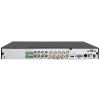
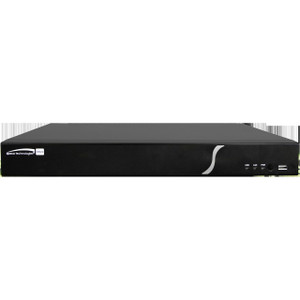
Speco Technologies H16HRLN2TB 16-Channel Hybrid Recorder
Overview
The Speco Technologies H16HRLN2TB is a 16-channel hybrid recorder designed for integrators managing mixed analog and IP camera infrastructure. It provides 8 hybrid channels (switchable between TVI or IP per channel) plus 8 dedicated IP channels in a single 2TB appliance. NDAA certification qualifies it directly for federal, state, and municipal procurement without requiring additional compliance vetting on your end—a concrete timesaver when responding to government bids. This is purpose-built for organizations that cannot retire legacy TVI systems overnight but need the flexibility to migrate incrementally.
Key Features
- Hybrid Channel Architecture (8 Channels): Each of the first 8 channels accepts either TVI (analog over coax) or IP video, configurable per channel without firmware changes. This means you can run 4 TVI cameras and 4 IP cameras on the hybrid ports simultaneously, or any mix—eliminates the forklift upgrade problem when coexisting analog and IP systems.
- Dedicated IP Channels (8 Channels): Beyond the hybrid ports, 8 additional IP-only channels accept any ONVIF-compliant camera or encoder. Total capacity is 16 concurrent streams, all recordable simultaneously at configurable frame rates and resolutions per channel.
- H.264 and H.265 Codec Support: H.265 (HEVC) compression cuts storage requirements roughly 40–50% compared to H.264 under equivalent scene complexity. On a 2TB baseline across 24/7 multi-channel recording, that translates to measurably longer retention—a real operational difference for compliance or forensic workflows.
- 2TB Factory-Installed Storage: Onboard hard drive supports extended recording across all 16 channels. Actual retention depends on resolution, frame rate, and codec choice per channel; H.265 on lower-resolution hybrid streams can extend retention 50% further than H.264 on the same drive.
- NDAA Compliance Certification: Pre-certified against DoD supply-chain restrictions (NDAA Section 889). No additional compliance review, attestation, or re-certification required—your bid response includes proof of compliance, shortening procurement cycles on federal projects.
- ONVIF Profile Support: Integrates with standard ONVIF-compliant VMS platforms (Milestone XProtect, Genetec, etc.) and third-party encoders. TVI channels work with any coaxial camera system using TVI standard—no proprietary encoding.
Integration & Compatibility
The H16HRLN2TB reduces system complexity by consolidating analog and IP recording into one appliance. Organizations running legacy analog infrastructure over coaxial cable can migrate cameras incrementally: decommission an analog camera, convert the hybrid channel to IP mode, and add an ONVIF IP camera—no recorder replacement, no downtime. This hybrid approach is particularly common in municipal and warehouse automation deployments where camera bases span 5–15 years of equipment lifecycle.
Integration with a network video recorder software ecosystem (like Milestone or Genetec) is straightforward via ONVIF. Cabling consolidation—no separate analog and IP appliances, no dual power supplies, no redundant rack space—reduces physical footprint and operational overhead. TVI channels tie directly to existing coaxial runs, while IP channels leverage standard Ethernet infrastructure.
Deployment Context
Built for 24/7 commercial and institutional operations. The H16HRLN2TB is well-suited to federal agencies, municipalities, and enterprise warehouses where NDAA compliance is mandatory and mixed-generation camera systems are operational reality. Recording configurations (frame rate, resolution, codec per channel) are user-definable, allowing administrators to balance retention, bandwidth, and storage cost on a per-stream basis—essential for deployments mixing high-resolution priority cameras with lower-priority area coverage.
Frequently Asked Questions
Q: Is the H16HRLN2TB NDAA Section 889 compliant?
A: Yes. The H16HRLN2TB carries NDAA certification, confirming that it does not contain restricted components and meets Department of Defense supply-chain security requirements. This certification is pre-loaded and qualifies the recorder for federal bid responses without additional compliance verification.
Q: Can I mix TVI and IP cameras on the same recorder?
A: Yes. The 8 hybrid channels support TVI or IP on a per-channel basis. You can configure channels 1–4 as TVI (connected to analog cameras over coax) and channels 5–8 as IP (connected to IP cameras), simultaneously. The remaining 8 dedicated IP channels extend capacity for additional IP-only devices.
Q: What codecs does the H16HRLN2TB support?
A: H.264 and H.265 (HEVC). H.265 reduces storage footprint roughly 40–50% compared to H.264, extending retention on the 2TB onboard drive. You configure codec per channel, so you can use H.265 on lower-priority streams and H.264 on high-priority forensic channels if needed.
Q: Does the H16HRLN2TB work with my VMS?
A: If your VMS supports ONVIF (Profile S or higher), yes. Standard ONVIF integration applies to the H16HRLN2TB. TVI channels record locally on the appliance and are accessible via the recorder's own interface; IP channels integrate directly with ONVIF-compliant VMS platforms like Milestone XProtect, Genetec, or others.
Q: How much storage do I get, and how long can I record?
A: The H16HRLN2TB ships with 2TB onboard storage. Retention depends on resolution, frame rate, and codec per channel. As a rough baseline: 16 channels at 1080p, 15 fps, H.265 will typically retain 7–10 days; the same configuration in H.264 will retain 4–6 days. Lower resolutions extend retention proportionally.
Q: Can I replace or upgrade the hard drive?
A: The 2TB drive is user-replaceable. Consult the manual for supported SATA HDD types and capacities before upgrade. Larger drives extend retention but follow the same codec and resolution trade-offs described above.
Ted PerryPerspective based on aggregated IP Security Depot and affiliated engineering team experience.
I have evaluated the Speco H16HRLN2TB during planning cycles for municipal and federal projects where NDAA compliance is a hard requirement. This recorder solves a real integration problem: organizations with mixed analog and IP camera bases need a single appliance that doesn't force forklift replacement. The H16HRLN2TB lets you run TVI and IP simultaneously on the same unit, which is a material advantage if your facility has 40 legacy analog cameras and a budget to add 10 IP cameras this fiscal year—no recorder swap, no downtime.
Technical Highlights:
- Hybrid Channel Switchability: 8 channels configurable per-channel as TVI or IP means you retire analog cameras incrementally. Swap one analog unit for an ONVIF IP camera, flip the channel mode in software, done. No rewiring the recorder, no new appliance purchase.
- H.265 Codec Efficiency: H.265 reduces storage footprint 40–50% versus H.264 across equivalent frame rates and resolution. On 24/7 recording across 16 channels, that's a measurable difference in retention days on the 2TB baseline—6 days in H.264 becomes 10+ days in H.265 at moderate settings.
- NDAA Pre-Certification: No compliance verification cycle required on your end. Federal procurement teams can pull the cert directly from the spec sheet, shortening bid response timelines by weeks on government contracts.
Deployment Considerations:
- Storage Planning is Non-Negotiable: The 2TB baseline is a starting point, not a guarantee. At 16 channels simultaneous recording, resolution and frame-rate choices on each channel drive retention dramatically. Use the codec-to-storage calculator during pre-sales engineering; don't guess. High-resolution cameras on IP channels will saturate 2TB in days if you're not careful about frame rates.
- TVI Channel Limitations: TVI is analog over coax—no analytics, no on-camera intelligence. If you're migrating cameras, plan to move toward IP-based platforms (with motion detection, object analytics, thermal, etc.) as TVI channels get decommissioned. This recorder is a bridge, not a long-term strategy for advanced analytics.
- ONVIF Compliance Critical: Verify your IP cameras are ONVIF Profile S or higher before assuming seamless integration. Some budget IP cameras claim ONVIF but with limited Profile support. Test interoperability in the lab, especially if you're mixing vendors.
Best Fit: Federal and municipal facilities with aging analog camera systems and incremental IP migration budgets. Also strong for warehouse and logistics operations where mixed-generation infrastructure is operational reality and NDAA compliance is required for government contracts. Skip this if you're building a greenfield installation—buy pure IP from the start and avoid the hybrid complexity. The H16HRLN2TB is designed for existing, messy environments, not new deployments.