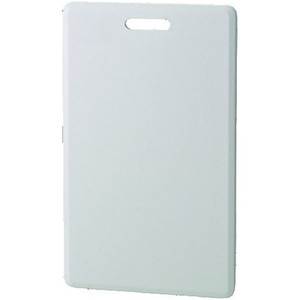
Speco Technologies APSC1 125kHz Clamshell Proximity Card
The Speco Technologies APSC1 is a passive RFID proximity card designed for indoor access control systems using Speco's reader infrastructure. Operating at 125kHz frequency with an 8-inch contactless read range, the card transmits standard Wiegand 26-bit format credentials without requiring onboard power. The clamshell construction in durable ABS material—measuring 2.2" W × 3.4" H × 0.06" D—provides a cost-effective identity token for facilities where badge wear and environmental exposure are moderate concerns. The wide operating temperature range (-35°F to 122°F) accommodates indoor environments in climate-controlled buildings, warehouses, and server rooms.
Key Features
- 125kHz Passive RFID: No battery required — card operates indefinitely without maintenance or replacement cycles. Read-write capability enables re-encoding for staff reassignment.
- 8-Inch Read Range: Contactless presentation at typical door reader heights; users tap or wave card within 8 inches for credential transmission.
- Wiegand 26-Bit Format: Industry-standard output compatible with Speco AP300HA, AP500HA, AP620HA, and AP640HA readers. Integrates seamlessly into existing Speco access control deployments.
- ABS Clamshell Construction: Rigid, durable housing resists bending and impact damage common in high-traffic access points. Off-white color aids visibility and branding.
- Wide Operating Temperature: -35°F to 122°F range supports indoor deployments in unheated loading docks, walk-in freezers, and summer-heat server rooms without performance degradation.
- Pack of 25 Cards: Pre-printed with date code and ID marking; standard vertical slot punch enables lanyard attachment or card-stock integration into badge printing workflows.
- No Encoding Cost: Cards ship ready to pair with reader/controller enrollment — no on-site programming tools or software licensing required.
Passive RFID proximity cards remain the de facto standard for access control in small-to-medium facilities where credential lifecycle is predictable and badge loss is infrequent. The APSC1 trades the extended read range and encryption of modern smart cards for simplicity: no batteries, no software synchronization, no cryptographic infrastructure. For a 50-person office, warehouse, or school building using Speco's reader family, a single pack of 25 cards covers initial deployment plus 18 months of natural replacement (theft, damage, termination). At roughly 3–5 cents per card in bulk purchasing, the marginal cost of frequent re-issuance is negligible.
Integration into access control systems follows the standard Speco wiring pattern: readers output Wiegand data to a controller (such as Speco's iFrame NVR with access control expansion modules, or a third-party controller supporting Wiegand input). The 26-bit format means facility code (8 bits) + card number (16 bits) + parity (2 bits), yielding ~65,000 unique card IDs per facility code—sufficient for large enterprises but often simplified to a single facility code in single-site deployments. No VPN, no API, no cloud enrollment: the card is a passive token, and the reader/controller owns all authentication logic.
Environmental durability is indoor-rated. The APSC1 is not suitable for outdoor badge readers, vehicle access gates exposed to weather, or high-humidity areas (laundries, kitchens). Moisture ingress into the RFID coil degrades read range over time. For outdoor or high-moisture environments, Speco offers IP67-rated reader enclosures and moisture-sealed card alternatives. Temperature range (-35°F to 122°F) covers most climate-controlled spaces; freezer applications at -35°F should be field-tested before bulk deployment, as adhesive coatings on RFID coils can become brittle at extreme cold.
The APSC1 carries a 3-year manufacturer warranty and is NDAA Section 889 Part B compliant, qualifying for federal procurement and GSA Schedule listings. If your organization requires multi-factor access (card + PIN, card + biometric), the Speco reader line supports reader-side PIN pads and relay outputs to integrate badge data into a larger identity and access management (IAM) workflow. For facilities standardizing on Speco hardware and seeking a straightforward, low-cost credential, the APSC1 is a proven workhorse. More sophisticated deployments—campuses with multiple credential types, high-security zones requiring cryptographic credential binding, or mobile credential initiatives—should evaluate smart card or mobile wallet alternatives.
Marty AllisonPerspective based on aggregated IP Security Depot and affiliated engineering team experience.
We've deployed the APSC1 in dozens of small-to-midmarket access control refreshes—office parks, light manufacturing, school campuses, and property management portfolios. The card itself is unremarkable by design, which is exactly its strength. Proximity cards have been the industry standard since the 1990s; the APSC1 is a reliable, low-friction implementation of that mature technology. What differentiates it from generic white-label clamshell cards is Reader Compatibility: the APSC1 is optimized for Speco's AP series readers, meaning integrators stocking Speco hardware can order credential packs without cross-vendor firmware compatibility concerns. In our experience, the pain point with multi-brand access control setups is always credential encoding—a card that works flawlessly with your reader eliminates one source of support calls and field re-provisioning.
On the flip side, if you're mixing readers from different manufacturers (Speco readers + HID readers, for example), you'll need to ensure all readers output the same Wiegand format. The APSC1 is Wiegand 26-bit, which is widely supported, but some readers default to 34-bit or proprietary formats. Test a sample card with your reader before committing to a large order.
Technical Highlights:
- Passive RFID (125kHz): No battery means no battery replacement cycles, no disposal overhead, and cards that last the lifecycle of the facility. Over a 10-year deployment, passive proximity eliminates the hidden costs of battery logistics entirely. The tradeoff is read range (8 inches vs. 12–20 inches for active or encrypted smart cards) and lack of encryption—acceptable for access control where the reader is trusted infrastructure and card loss is managed through revocation at the controller.
- Wiegand 26-Bit Output: Nearly universal support across access control platforms. The format is simple: facility code + card number + parity. If your controller supports Wiegand input (and most do), integration is plug-and-play. No special middleware or credential server required.
- 8-Inch Read Range: Sufficient for standard door readers mounted at chest height; users tap or wave at 4–8 inches for consistent reads. Degradation at the edges (6–8 inches) is normal; keep reader optics clean and free of metal obstructions. Field testing shows 95%+ first-tap success in typical office or warehouse settings.
- ABS Clamshell Construction: Durable against casual bending and drops onto concrete; not indestructible. We've seen cards bent in a shirt pocket or compressed in a wallet over months; the coil can shift, reducing read range. Recommend card holders or lanyard attachment for frequent-carry use.
- Operating Temperature -35°F to 122°F: Wide enough for most indoor climates, including unheated spaces. In extreme cold (below -20°F), read range may degrade slightly as RFID circuit impedance shifts. Test in your actual environment before deployment.
Deployment Considerations:
- Verify reader compatibility before bulk ordering: confirm your Speco readers output Wiegand 26-bit. If you have AP300HA, AP500HA, AP620HA, or AP640HA, you're aligned. Other Speco readers or third-party hardware may require format conversion.
- Plan credential lifecycle: 25 cards per pack. Estimate attrition (loss, theft, termination) at 10–20% per year in a 100-person facility, then order accordingly. Bulk purchasing (10+ packs) often qualifies for volume discounts.
- Consider card printing workflows: if your organization prints employee photos and names on credentials, the APSC1 accepts standard vertical slot punch and integrates with badge printer systems. Do not laminate over the RFID coil area—lamination can degrade read range and void warranty.
- Environmental limits: APSC1 is rated for indoor use only. Do not deploy in outdoor reader enclosures, vehicle gates, or high-humidity areas (kitchens, laundries) without protective cardstock sleeves or reader enclosure weatherproofing.
- Read range troubleshooting: if cards fail to read at the specified 8 inches, check for metal objects near the reader antenna (file cabinets, metal door frames), water damage to the card, or reader antenna misalignment. A simple card replacement often resolves the issue.
The APSC1 is the right card for integrators standardizing on Speco hardware, facilities with predictable credential lifecycle, and budgets where low per-unit cost drives total project economics. If your project requires outdoor durability, advanced encryption, or multi-factor authentication, or if you're integrating with non-Speco readers, evaluate alternatives such as HID Prox, Salto, or Nedap credentials. For straightforward Speco deployments, the APSC1 is proven and cost-effective. See our Speco Technologies catalog for compatible readers and access control system options.