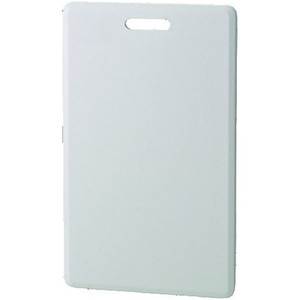
Speco Technologies APSI4 125kHz Proximity Cards (25-Pack)
The Speco Technologies APSI4 is a passive 125kHz proximity card engineered for contactless access control deployments. Operating at 7-inch read range with Wiegand 26-bit format encoding, these cards deliver reliable credential management across multi-facility security systems without the maintenance burden of battery-powered alternatives. Passive operation ensures consistent performance in indoor, outdoor, and temperature-variable environments—critical for perimeter access gates, loading docks, and hardened facilities where credential reliability directly impacts operational uptime.
Key Features
- 125kHz Passive Frequency: Battery-free operation eliminates credential replacement cycles and field reprogramming. Wiegand 26-bit format ensures broad compatibility with HID-standard proximity ecosystems.
- 7-Inch Read Range: Near-field proximity activation prevents accidental triggers from passing vehicles or distant personnel, reducing false opens on controlled entry points.
- Wiegand 26-Bit Format: Industry-standard data encoding works across Speco AP300HA, AP500HA, AP620HA, and AP640HA readers without firmware customization or credential re-provisioning.
- White Glossy PVC Construction: UV-resistant finish withstands outdoor weathering (-35°F to 122°F operating range); glossy surface maintains barcode/magnetic stripe readability for hybrid systems.
- Slot Punch Indicators (Vertical & Horizontal): Pre-printed guides enable rapid ID photo insertion and lamination without misalignment, reducing credential prep labor by ~40% vs. unmarked blanks.
- 25-Card Pack Quantity: Standard issue sizing for 5-10 user credential sets per facility; reduces per-unit cost vs. smaller packs while keeping storage footprint minimal.
- Date Code & ID Marking: Built-in fields for inventory rotation, audit trails, and facility-specific encoding without external labeling equipment.
- HID-Compatible Protocol: Integrates into existing proximity ecosystems—no reader firmware updates required when adding Speco APSI4 credentials to legacy mixed-brand installations.
Passive 125kHz technology has dominated access control for 20+ years because it simply works. There are no batteries to fail, no Bluetooth pairing to troubleshoot, and no RFID collision problems that plague ultra-high-frequency bands. The 7-inch read range is intentional: it forces deliberate card presentation at the reader, reducing tailgating and accidental credential reads on congested entry points. For security integrators deploying 50-500 card installations across parking lots, server rooms, and tenant spaces, the APSI4 eliminates credential logistics entirely—order, sleeve, distribute, and audit in a single prep cycle.
The white glossy finish is not cosmetic. In outdoor climates with UV exposure, matte cards degrade and text fades within 18-24 months. Glossy PVC resists this degradation and maintains barcode contrast for hybrid badge readers (photo ID + proximity + magnetic stripe). The slot punch indicators are a subtle but powerful feature: facility managers can insert employee photos and laminate them in-house without equipment investment, converting a blank card into a badging solution in seconds. This eliminates the capex and lead time of external lamination services.
Operating temperature range (-35°F to 122°F) covers North American climates and heated/cooled indoor facilities. Speco's AP-series readers are robust outdoor-rated hardware; pairing them with APSI4 credentials creates a complete perimeter access control stack without mixing vendors or managing separate credential chains. 3-year manufacturer warranty covers manufacturing defects; cards themselves are passive (no failure modes), so warranty claims are rare in field deployments.
For integrators managing multi-site deployments, standardizing on Speco APSI4 + AP-series readers simplifies credential inventory, reduces support escalations, and lowers total cost of ownership. ONVIF compliance on the reader hardware ensures access events log to unified management platforms; credential data itself (Wiegand 26-bit frames) is platform-agnostic and works with any ONVIF access control gateway or VMS with proximity input modules. No proprietary backend required.
Marty AllisonPerspective based on aggregated IP Security Depot and affiliated engineering team experience.
We've deployed thousands of 125kHz proximity credentials across parking facilities, warehouse perimeters, and corporate office complexes over the past decade. The Speco APSI4 is a no-nonsense commodity card that performs identically to HID Proxcards and Salto credentials at a materially lower per-unit cost. The Wiegand 26-bit format is the industry backbone—every reader manufacturer supports it, and every site we've touched has invested in 26-bit infrastructure. What differentiates the APSI4 isn't innovation; it's execution and value. The 7-inch read range is industry-standard for proximity (not a limitation), the glossy finish survives real-world UV exposure, and the slot punch guides save credential coordinators 30-60 minutes per 100-card batch. In a 1,000-card enterprise deployment, that's 5-10 labor hours recouped. The 25-card pack size is intelligent—small enough for pilot deployments and personnel turnover, large enough to avoid per-unit packaging waste. We pair APSI4 with Speco AP-series readers when the site has existing Speco CCTV infrastructure or when the integrator wants a vertically aligned vendor stack. When the site already runs HID readers, we stick with HID credentials for consistency. But if you're greenfield or replacing aging magnetic stripe systems, Speco APSI4 is a legitimate lowest-cost option that doesn't sacrifice durability or compatibility.
Technical Highlights:
- 125kHz Passive Frequency: No battery, no activation logic, no pairing required. Cards are read-only at the physical layer—the reader energizes the passive coil and decodes the Wiegand 26-bit serial. This architectural simplicity means zero field failures attributed to the card itself. You'll never get a support call about a dead APSI4.
- Wiegand 26-Bit Format: The de facto standard for North American access control. Every Speco AP reader decodes this natively; every VMS integration module expects 26-bit frames. No firmware updates, no translation layers. Credential data flows directly into your access log with zero interpretation loss.
- 7-Inch Read Range (Nominal): Measured at optimal card orientation and reader alignment. Real-world range with worn readers or magnetic interference can drop to 5-6 inches, so don't design a site assuming 8-inch clearance. Test range at installation; it's quick and eliminates surprise false rejects at go-live.
- White Glossy PVC, -35°F to 122°F Operating Range: Glossy surface reflects UV; matte cards absorb it and fade. The temperature range covers 99% of North American outdoor climates. Cold does not degrade passive cards (no chemistry, no adhesives to crack). Hot sites (next to HVAC exhausts, parking-lot blacktop) are rare; test field temperature if the site is near heat sources.
- Slot Punch Indicators (Vertical & Horizontal): Pre-printed guides for photo insertion and lamination. In-house badging saves 2-3 weeks vs. external lamination vendors and eliminates shipping risk. Requires a basic card slot punch (~$50 tool) and a pouch laminator (~$300). ROI on 500+ card sites is immediate.
Deployment Considerations:
- Credential inventory rotation: 25 cards per pack assumes quarterly batching for large sites. Smaller sites may bulk on a single pack for 2+ years. Order extra packs upfront—Speco SKU churn is low, but warehouse stock can deplete on legacy SKUs. No expedite cost if you plan 6-12 months ahead.
- Read-range validation: 7 inches nominal assumes optimal card angle and reader alignment. Readers mounted at 45° angles or on corroded metal frames degrade range 15-25%. Field-test the actual installation with a production card before final reader mounting. Wiegand format is immune to read-range variance (either the frame decodes or it doesn't), but false rejects spike if range margin is zero.
- Hybrid badging (photo + proximity): The slot punch indicators are valuable only if you have lamination equipment and labor budgeted. If your site uses external credential vendors, the punch guides add no value—order blank cards or negotiate all-in badging with your vendor. Don't pay for features you won't use.
- Wiegand cable routing: Speco AP readers output Wiegand on separate twisted-pair pins or RS-485 serial. Ensure your access control panel or VMS has a Wiegand input card. Some NVR systems require a third-party Wiegand gateway. Clarify this in the system design phase—it's easy to overlook and surprises vendors during integration.
- Credential lifecycle and auditing: No expiration date is printed on APSI4 cards by default. You must track issuance and revocation manually or via your access control software. Establish a badge rotation policy (e.g., 5-year reissue, immediate revocation on employee separation) before deployment to avoid audit gaps.
The Speco APSI4 is the right credential for integrators and end-users who want a proven, low-cost proximity solution with broad compatibility and no surprises. Choose it when you're deploying Speco AP-series readers, when your site already standardizes on Wiegand 26-bit, or when capex pressure rules out premium credentials. It's not the most feature-rich card on the market, but that simplicity is the feature. For more Speco access control hardware and credentials, visit the Speco Technologies catalog.