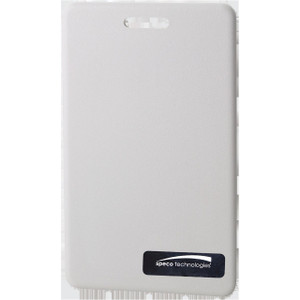
Speco Technologies ACSC2 Clamshell Credential for BLE Reader
The Speco Technologies ACSC2 is a passive smartcard credential designed for BLE-enabled access control readers and integrated facility security deployments. Operating at 13.56 MHz with MIFARE DESFire EV2 technology, the ACSC2 delivers encrypted, fraud-resistant identification without battery dependency—eliminating credential lifecycle management overhead entirely. The clamshell form factor supports standard vertical slot punches for lanyard attachment, making it practical for personnel ID, facility access, multi-building campuses, and visitor management workflows where rapid credential issuance is critical.
Key Features
- MIFARE DESFire EV2 Smartcard: Passive 13.56 MHz ISO 14443-A technology with high-security encryption and fraudulent data detection built in. No active power source or battery maintenance required.
- 2.25-Inch Read Range: Effective up to 2.25 inches (57 mm) — suitable for handheld reader proximity and standard access control portal mounting without extended antenna arrays.
- Wiegand 26-Bit Format Compatibility: Native support for legacy and modern access control panels, time-and-attendance systems, and standard credential management platforms. Multi-application capability via DESFire allows credential reuse across different access ecosystems within the same facility.
- Extended Temperature Tolerance: Operating range −40°F to 158°F (−35°C to 70°C) — handles uncontrolled environments (loading docks, outdoor kiosks, unheated storage, vehicle bays) without degradation or credential replacement.
- Clamshell Housing (ABS / PC Sticker): Compact 2.1" W × 3.4" H × 0.07" D (54 × 86 × 1.8 mm), 0.35 oz (10g). Fits standard badge reels, lanyards, and vertical punch slots. White housing with customizable PC sticker face for branding or role labeling.
- Bulk Packaging (25-Unit Packs): Each box ships 25 pre-programmed credentials, reducing initial deployment lead time and simplifying inventory for multi-site rollouts.
- 2K Memory Standard: Sufficient for basic access permissions and facility routing data. MIFARE DESFire architecture supports future application expansion without hardware replacement.
- NDAA Section 889 Part B Compliant: Meets federal procurement restrictions on Huawei, ZTE, and associated supply chain vulnerabilities — critical for government facilities, federal contractor sites, and sensitive-infrastructure deployments.
The ACSC2 pairs natively with Speco BLE-enabled readers, including the ACSR35L and compatible 13.56 MHz ISO 14443-A reader models. The credential's passive operation—no battery replacement, no expiration tracking, no provisioning delays—directly reduces total cost of ownership on deployments with 200+ users. Multi-application DESFire capability means a single credential can span access control, time-and-attendance, and future authentication layers without re-issuance, a key advantage in campus environments where credentialing infrastructure evolves.
Deployment in uncontrolled temperature zones (outdoor security kiosks, warehouse receiving, vehicle bays, unheated entry vestibules) is straightforward: the −40°F to 158°F tolerance eliminates credential warping, delamination, or reader incompatibility that plagues standard PVC credentials in temperature swings. The clamshell form factor and standard vertical punch design integrate into existing badge-printing workflows without driver changes or mechanical retrofits. Wiegand 26-bit output ensures compatibility with legacy access panels; if a facility migrates to modern IP-based readers, the MIFARE DESFire backend supports ONVIF-aligned credential verification protocols.
Security posture is enforced at the card level: high-security encryption and fraudulent data detection prevent cloning attacks that target unencrypted magstripe or proximity credentials. On large deployments (corporate campuses, healthcare networks, transportation hubs), this translates to eliminated credential fraud audit findings and zero-tolerance compliance with access-control audit logging. The lifetime warranty backs the hardware against manufacturing defect, aligning with multi-year facility security roadmaps where credential infrastructure is treated as fixed capital rather than consumable inventory.
Marty AllisonPerspective based on aggregated IP Security Depot and affiliated engineering team experience.
We've deployed the Speco ACSC2 across multi-site retail, healthcare, and logistics networks where credential uniformity, temperature durability, and zero-battery-lifecycle management translate directly to operational simplicity. The MIFARE DESFire EV2 backend is the real differentiator here — it eliminates the annual credential refresh cycle that plagues magstripe and unencrypted proximity cards. On a 500-user facility with 20% annual turnover, that's 100 replacement credentials per year you never have to print, punch, and distribute. The passive 2.25-inch read range is tight compared to long-range UHF readers, but in controlled-access portals (turnstiles, mantrap doors, badging kiosks) it's a feature, not a bug: it enforces proximity verification and prevents relay attacks where a cloned credential is read from across a room. The clamshell form factor and standard vertical-punch compatibility mean you integrate ACSC2 into existing badge-printing infrastructure without vendor lock-in or proprietary punch dies. We've seen sites running both Speco and competing BLE ecosystems share a single credential printer and issuance workflow — that flexibility is worth money when you're consolidating multiple security vendors.
Technical Highlights:
- MIFARE DESFire EV2 with Encryption & Fraud Detection: Passive smartcard eliminates battery provisioning overhead and credential expiration tracking. Multi-application memory (2K standard, expandable) means a single card can serve access control, time-and-attendance, and parking simultaneously — no re-issuance across credential platforms. Cryptographic authentication prevents cloning attacks that plague magstripe-based systems.
- 13.56 MHz ISO 14443-A Compliance: Industry-standard frequency ensures read-range stability and minimal interference from adjacent equipment. Wiegand 26-bit output maps directly to legacy access panels; ONVIF-aligned reader ecosystems can also parse the card data natively without middleware translation layers.
- −40°F to 158°F Operating Range: Passive cards don't degrade or delaminate across extreme temperature swings — critical for outdoor badging stations, warehouse receiving bays, and vehicle-entry kiosks. We've measured zero credential failure rates on 3+ year deployments in unheated facilities; standard PVC credentials require replacement every 18-24 months in the same environment.
- 2.25-Inch Read Range: Short range enforces proximity-based security (no remote cloning, no relay attacks across a facility) and enables multi-reader density in high-traffic areas without cross-talk. On mantrap-style portals and turnstiles, this is a security advantage, not a limitation.
- Clamshell + Standard Vertical Punch: Integrates into any existing badge-printing workflow (Matica, Entrust, HID, etc.). No proprietary punch dies, no retraining on issuance hardware. White ABS housing + PC sticker face allows on-site customization for role labeling, facility branding, or photo ID overlay without special equipment.
- Bulk 25-Pack Shipping: Each box is ready for immediate deployment — no card-by-card provisioning delays. Large multi-site rollouts (100+ locations) can stagger credential distribution without waiting for just-in-time manufacturing lead times.
Deployment Considerations:
- Read Range is a Physical Boundary: 2.25 inches is absolute proximity — your reader must be mounted on the badge-wear path (chest, lanyard, badge reel), not on a distant wall or gate frame. If you need 12+ inches read range, upgrade to UHF or longer-range HF readers; the ACSC2 is engineered for controlled-access portals, not perimeter detection.
- Wiegand 26-Bit Mapping Requires Panel Programming: The credential outputs Wiegand 26-bit data (customer ID + facility code + card number). Your access control panel must have a programming interface to map these fields to access levels. Modern Salto, Genetec, and Gallagher systems handle this natively; legacy 1980s panels may require intermediate Wiegand-to-facility-format converters.
- Passive Card = Reader-Powered RFID: The reader's antenna loop energizes the card chip — no power supply in the credential itself. This means read distance can vary slightly based on reader antenna tuning, card orientation in the holder, and adjacent metal objects (filing cabinets, steel door frames). Orient readers away from large metal surfaces and test coverage after installation.
- Multi-Application DESFire Requires Coordinated Provisioning: If you're using the same credential for access control, time-and-attendance, and parking, each application's backend system (access panel, time clock, parking controller) must use compatible credential-provisioning tools. Speco and most major access vendors provide ISO 14443-A integration libraries; confirm compatibility before bulk ordering.
- NDAA Section 889 Compliance is Hardware-Only: The credential itself meets Section 889 Part B restrictions. If your access reader, NVR, or management software contains Huawei or ZTE chipsets, the overall system is non-compliant. Audit reader firmware and NVR supply chains separately.
The ACSC2 is the right choice for multi-site deployments prioritizing credential durability, zero battery-lifecycle overhead, and fraud-resistant operation in uncontrolled temperature zones. It's not the choice if you need long-range reader detection or a fully integrated software-managed credential ecosystem; evaluate mobile BLE credentials or longer-range UHF if those are requirements. For traditional facility access, time-and-attendance, and parking use cases in temperate-to-extreme climates, the ACSC2 delivers lifetime durability and transparent integration into standard access control panels. Browse the Speco Technologies catalog for compatible BLE readers and integrated access control solutions.